
Investigation of welding forces and joint strength in friction stir welded acrylonitrile butadiene styrene and polypropylene plates with different pin diameters
Róbert Gábor Stadler , Gábor Szebényi, Dániel Gere, Richárd Horváth
Vol. 20., No.11., Pages 1194-1206, 2026
DOI: 10.3144/expresspolymlett.2026.86
DOI: 10.3144/expresspolymlett.2026.86
Corresponding author: Gábor Szebényi 
GRAPHICAL ABSTRACT
ABSTRACT
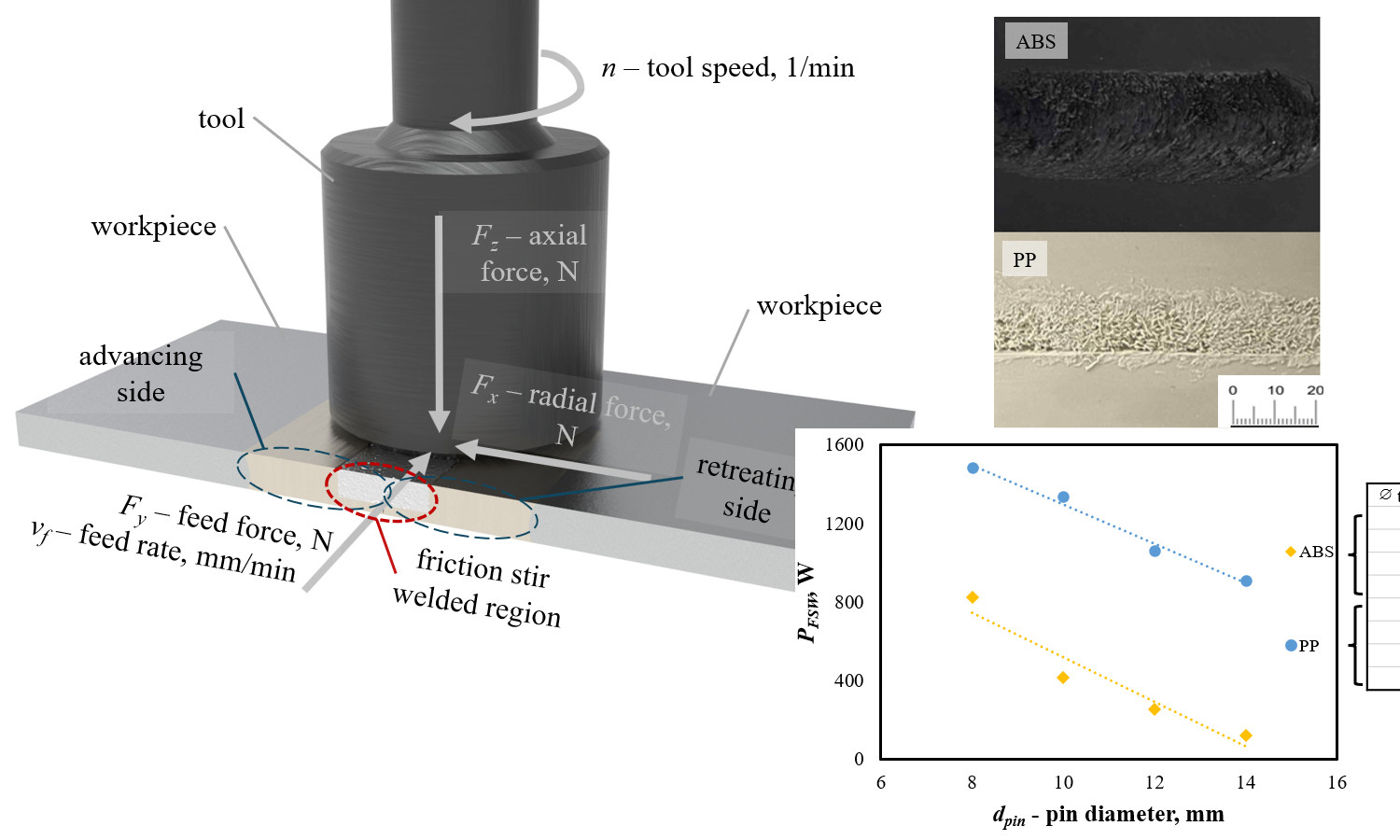
We investigated welding forces and joint strength in friction stir welding of 4 mm thick acrylonitrile butadiene styrene (ABS) and polypropylene (PP) plates using pin diameters of 8–14 mm at constant tangential speed and feed per revolution. We measured three force components, and examined joints by tensile testing, differential scanning calorimetry (DSC) and optical microscopy. PP generated approximately 4.6 times higher welding forces than ABS, consistent with its lower melt flow index (MFI) and melt volume-flow rate (MVR). The highest joint strengths were 10.86 MPa for PP (12 mm pin) and 14.96 MPa for ABS (14 mm pin). DSC revealed a slight decrease in the crystallinity of PP and a small shift in the glass transition temperature of ABS, with no evidence of significant degradation. The estimated volumetric enthalpy requirement of PP was 34–37% higher than that of ABS at 180–200 °C. Microscopy revealed tunnel defects, voids and insufficient root bonding in PP, whereas ABS showed flash formation and weld thinning. These results suggest that the flow behavior of the polymer contributes to welding forces and joint quality.
RELATED ARTICLES
Markus Gahleitner
Vol. 20., No.5., Pages 435-436, 2026
DOI: 10.3144/expresspolymlett.2026.33
Vol. 20., No.5., Pages 435-436, 2026
DOI: 10.3144/expresspolymlett.2026.33
This is an editorial article. It has no abstract.
Amanda Legnani, André Luis Marcomini, Philipe Augusto Pocidonio Silva, Ricardo Geraldo de Sousa, Anderson Júnior dos Santos, João Paulo Ferreira Santos
Vol. 20., No.4., Pages 326-341, 2026
DOI: 10.3144/expresspolymlett.2026.26
Vol. 20., No.4., Pages 326-341, 2026
DOI: 10.3144/expresspolymlett.2026.26
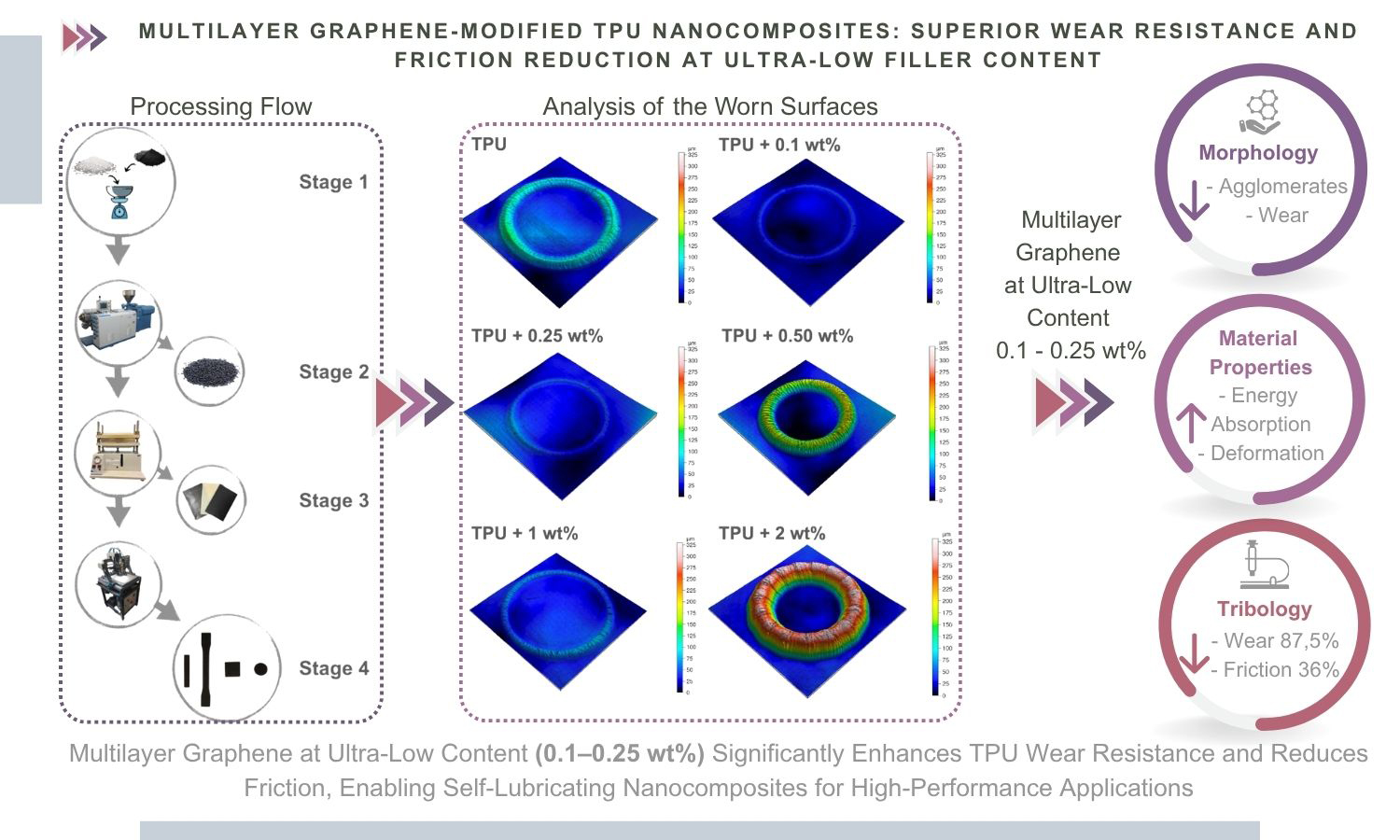
This work presents the development of high-performance thermoplastic polyurethane (TPU) nanocomposites reinforced with low contents of multilayer graphene (mG), aiming to improve their tribological behavior. Using twin-screw extrusion followed by hot pressing, nanocomposites containing 0.1, 0.25, 0.5, 1, and 2% mG weight were fabricated and systematically evaluated. Nanocomposites with only 0.1–0.25 wt% mG achieved a 36% reduction in friction coefficient and 87.5% reduction in wear volume compared to neat TPU. Results are rarely reported at such low filler loadings. Scanning electron microscopy (SEM) analysis revealed uniform dispersion at these optimal concentrations, while higher mG contents led to agglomeration and performance loss. Rheological studies indicated improved flow behavior, and dynamic-mechanical analysis confirmed increased energy dissipation and thermal response. These results suggest that the concentrations of 0.1% and 0.25% of multilayer graphene used in the study are promising for improving the performance of TPU nanocomposites in applications requiring high wear resistance for advanced applications in automotive, biomedical, and high-load engineering components, where durability and low friction are essential.
Jana Navratilova
Vol. 20., No.2., Pages 112-113, 2026
DOI: 10.3144/expresspolymlett.2026.9
Vol. 20., No.2., Pages 112-113, 2026
DOI: 10.3144/expresspolymlett.2026.9
This is an editorial article. It has no abstract.
Abdulaziz Al-Shehri, John Sweeney, Paul Spencer, Phil Coates, Fin Caton-Rose, Ajay Taraiya
Vol. 19., No.12., Pages 1238-1255, 2025
DOI: 10.3144/expresspolymlett.2025.92
Vol. 19., No.12., Pages 1238-1255, 2025
DOI: 10.3144/expresspolymlett.2025.92
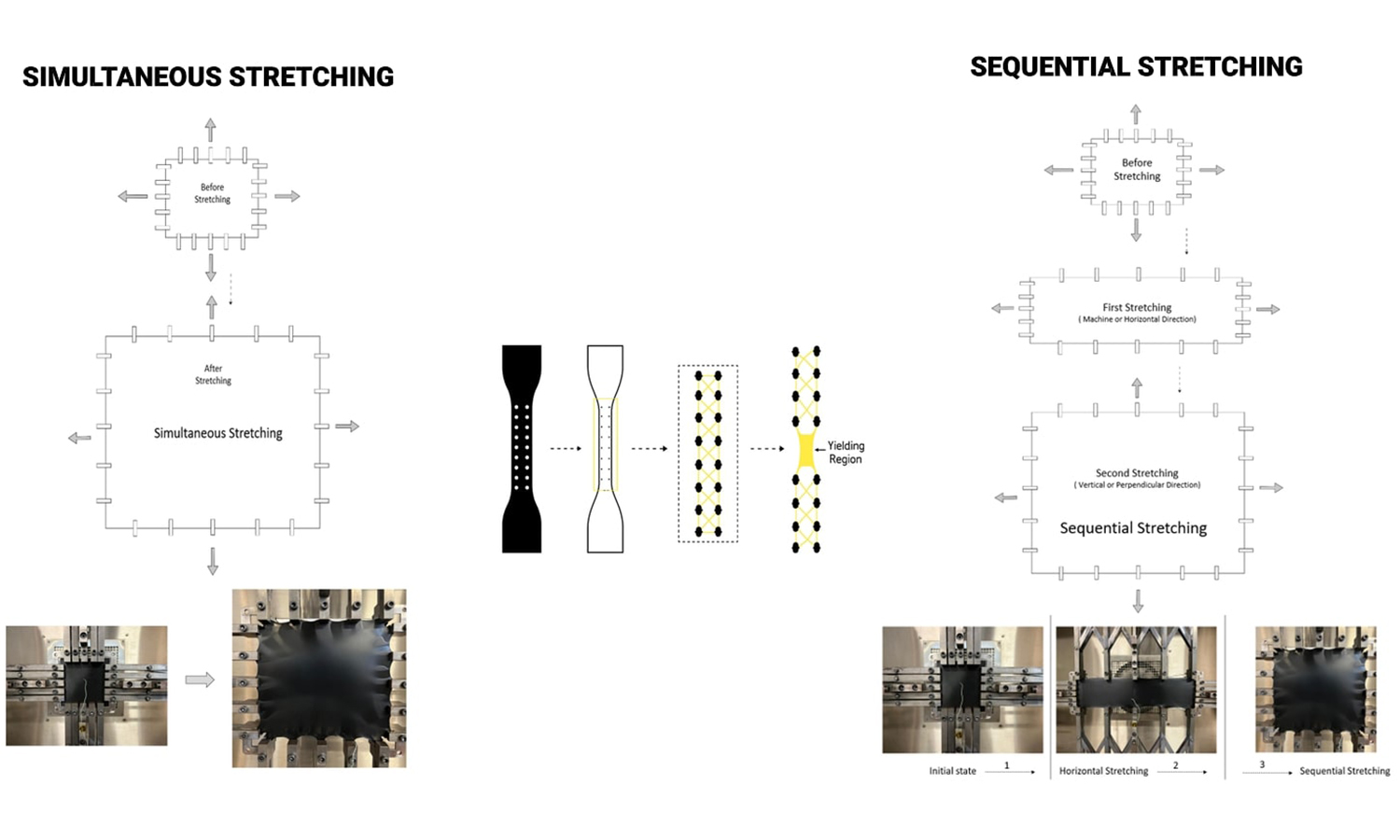
This study examines the combined effects of molecular modalities (unimodal, bimodal, trimodal) and biaxial stretching modes (sequential and simultaneous) on the yielding, stiffness, and necking behaviour of stretched high-density polyethylene (HDPE). Yield strength and stiffness were examined in relation to oriented material produced by drawing at linear strain rates 5.4·10–3, 2.2·10–2, and 8.6·10–2 s–1 under both stretching modes. Simultaneous stretching outperformed sequential stretching, with yield strength increasing with draw rate. Unimodal HDPE showed higher yield strength and stiffness than bimodal and trimodal grades, while trimodal HDPE had the lowest necking tendency from greater flexibility and uniformity. The highest necking tendency was observed in unimodal HDPE in strain localization analysis using the maximum strain/average strain ratio, while trimodal HDPE deformed more uniformly due to improved molecular weight distribution and strain hardening. Increasing the draw rate reduced strain localization, improving mechanical performance. Insights for optimising polyethylene materials in industry are provided by gel permeation chromatography (GPC), nuclear magnetic resonance (NMR) spectroscopy, and mechanical analyses, establishing the correlation between HDPE structure, processing, and properties.
Wenhui Han, Yaqi Ge, Peng Wang, Haojun Zang, Shengqiang Xu, Huiguang Bian, Chuansheng Wang
Vol. 19., No.12., Pages 1274-1285, 2025
DOI: 10.3144/expresspolymlett.2025.94
Vol. 19., No.12., Pages 1274-1285, 2025
DOI: 10.3144/expresspolymlett.2025.94

This study investigates eugenol as an alternative to mitigate environmental pollution and worker hazards associated with antioxidant N-(1,3-dimethyl)butyl-N′-phenyl-p-phenylenediamine (4020) while aligning with trends toward sustainable additives. Silica/natural rubber (NR) composites with varying ratios of eugenol and 4020 were prepared to assess their aging resistance, mechanical properties, and the synergistic antioxidant effects. Thermogravimetric analysis, cross-linking density experiments, thermo-oxidative aging tests, and oxidation induction tests revealed the highest thermo-oxidative aging resistance when 0.5 phr of 4020 was substituted with eugenol. When 1.0 phr of 4020 was replaced by eugenol, the antioxidant properties of the composites matched those containing 2.0 phr of 4020. However, when eugenol exceeded 1 phr, the antioxidant properties gradually decreased. DIN wear tests showed optimal wear resistance when 1 phr of 4020 was replaced with eugenol. These findings suggest that 50% of conventional antioxidants can be substituted with eugenol without compromising material properties. The partial substitution of eugenol in silica/NR composites proves eugenol can act as a sustainable alternative, providing comparable antioxidant capacity while reducing environmental impact.