Crystallinity design for performance optimization
Markus Gahleitner
Vol. 20., No.5., Pages 435-436, 2026
DOI: 10.3144/expresspolymlett.2026.33
DOI: 10.3144/expresspolymlett.2026.33
Corresponding author: Markus Gahleitner 
GRAPHICAL ABSTRACT
RELATED ARTICLES
Zhen Chen, Liang Xu, Yu Bai, Wei Wang , Junfeng Qian, Xiaoliang Yin, Jizhou Du, Jing Zhang
Vol. 20., No.7., Pages 724-741, 2026
DOI: 10.3144/expresspolymlett.2026.55
Vol. 20., No.7., Pages 724-741, 2026
DOI: 10.3144/expresspolymlett.2026.55
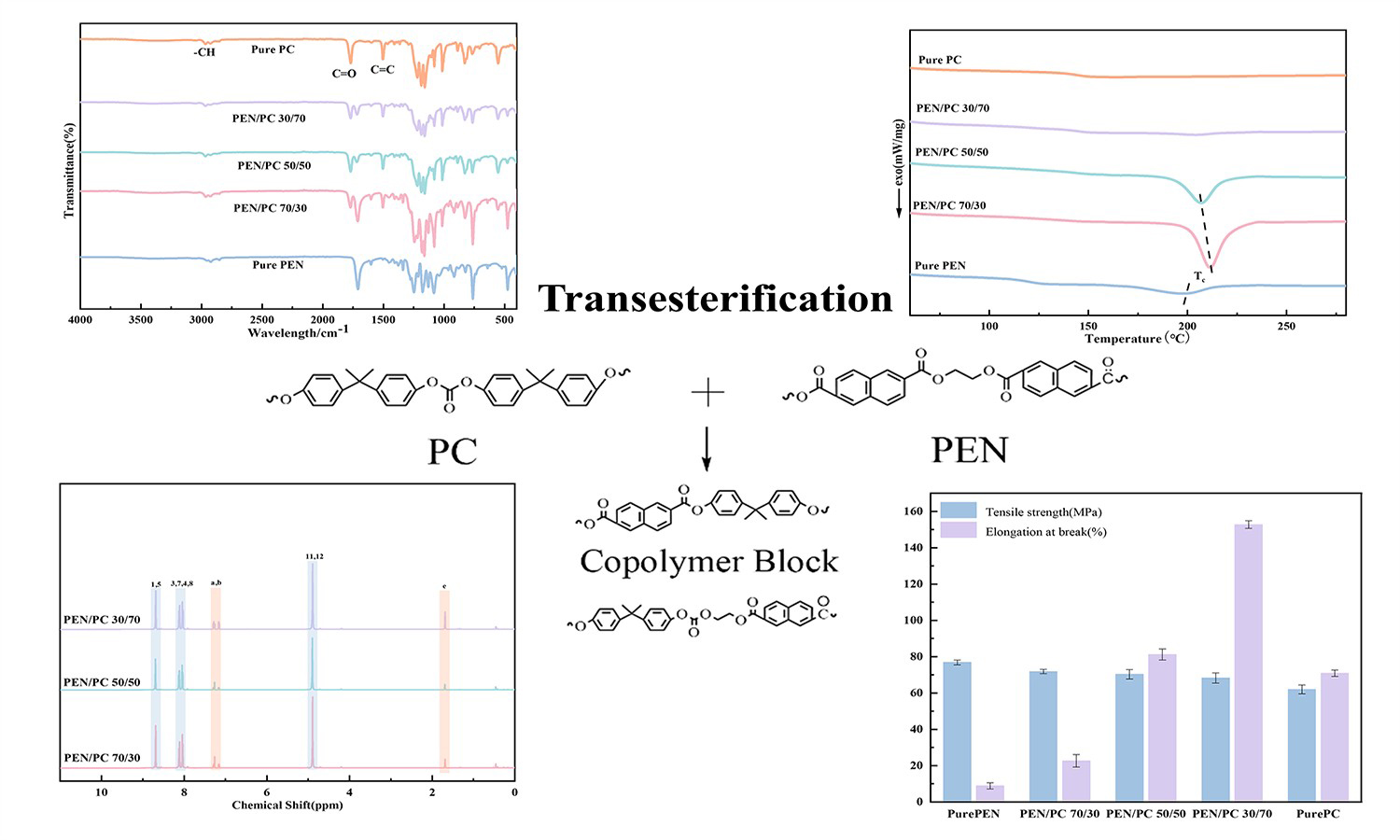
Conventional poly(ethylene terephthalate) (PET) and polycarbonate (PC) blends exhibit insufficient heat resistance, restricting their use in demanding applications such as new energy vehicles and portable consumer electronics. Poly(ethylene 2,6-naphthalate) (PEN) offers superior thermal stability, strength and chemical resistance, making PEN/PC blends promising alternatives. In this study, we investigated the relationships between the composition, structure and properties of PEN/PC blends through non-catalyzed melt blending. Fourier transform infrared spectroscopy (FTIR) and proton nuclear magnetic resonance spectra (1H NMR) confirm transesterification between PEN and PC, with the extent of exchange (X) increasing with PC content. Non-isothermal differential scanning calorimetry (DSC) and X-ray diffraction (XRD) show that moderate PC content promotes crystallization, while high PC content suppresses it. Thermogravimetric analysis (TGA) shows enhanced thermal stability in PEN-rich blends. Compared to PET/PC, PEN/PC blends maintain similar tensile strength but exhibit 53% higher elongation and 1–2.5% lower density. This study demonstrates the potential of PEN/PC blends for high-performance, thin-walled applications in the new energy vehicle and electronics industries.
Joanna Szymańska, Wojciech Hubert Bednarek, Beata Strzemiecka, Dominik Paukszta
Vol. 20., No.5., Pages 501-513, 2026
DOI: 10.3144/expresspolymlett.2026.38
Vol. 20., No.5., Pages 501-513, 2026
DOI: 10.3144/expresspolymlett.2026.38
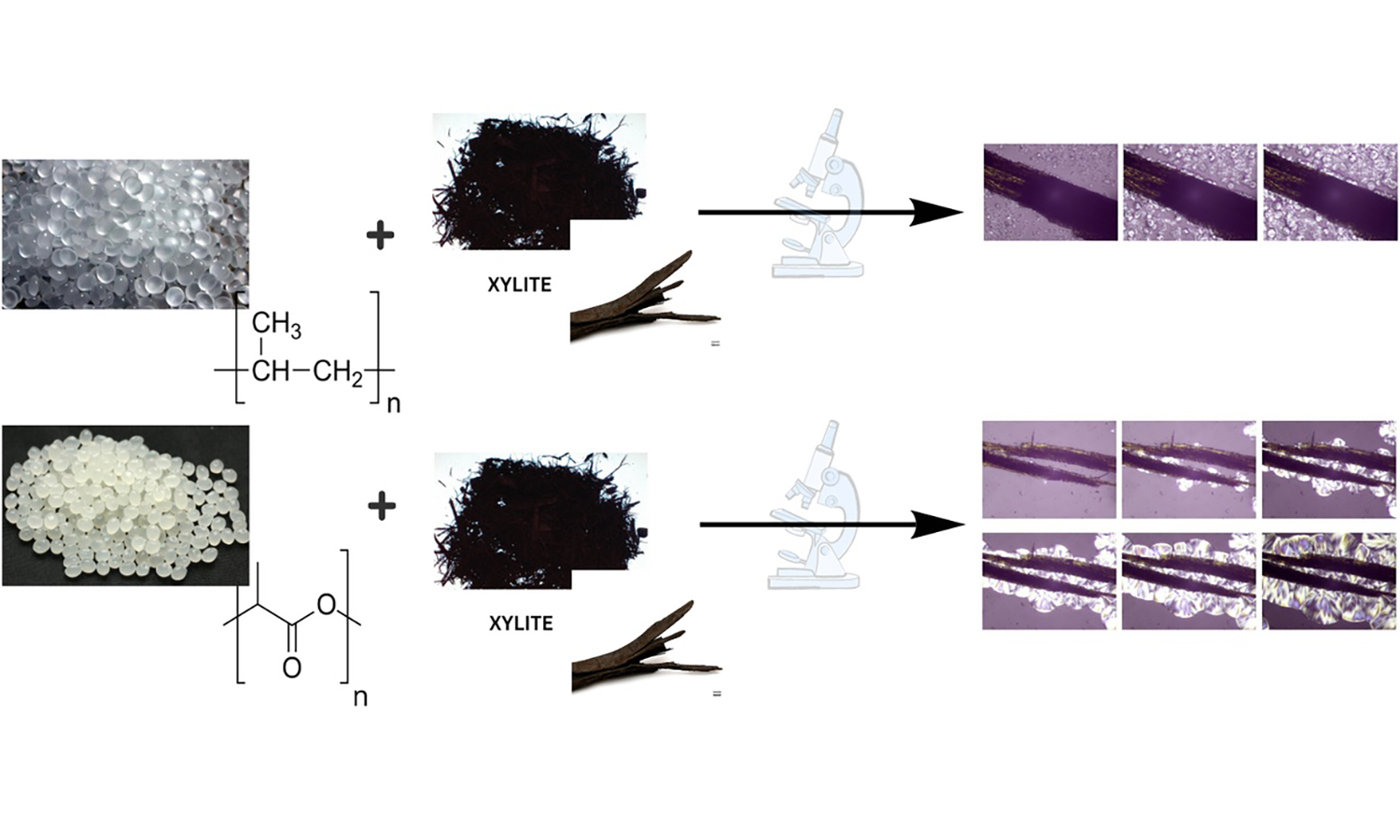
Crystallinity describes the degree of structural order in solids, and in polymers it strongly influences rheological, mechanical, thermal, and optical properties as well as degradation. In this study, we investigate how adding a xylitic brown coal fraction affects the crystallization of polylactide (PLA) and polypropylene (PP) under static and shear conditions. We characterized composites by wide-angle X-ray scattering (WAXS), Fourier transform infrared spectroscopy (FTIR), polarization light microscopy (PLM), scanning electron microscopy (SEM) and scanning electron microscopy with energy-dispersive X-ray spectroscopy (SEM-EDS) to examine both crystallization and filler structure. Results show that the lignocellulosic filler markedly alters crystallization kinetics and supramolecular morphology. In PLA-based composites, a transcrystalline layer (TCL) developed at the interface, modifying crystallization and reducing spherulite formation. In PP, only a weak TCL developed due to limited interfacial compatibility. Under shear, PP displayed the expected acceleration of spherulite growth, while PLA showed competing mechanisms between spherulitic nucleation and TCL formation. These findings highlight the role of natural, hybrid organic–mineral fillers in tailoring polymer crystallization processes and improving composite design.
Jana Navratilova
Vol. 20., No.2., Pages 112-113, 2026
DOI: 10.3144/expresspolymlett.2026.9
Vol. 20., No.2., Pages 112-113, 2026
DOI: 10.3144/expresspolymlett.2026.9
This is an editorial article. It has no abstract.
Sandra Paszkiewicz, Kamila Sałasińska, Zaida Ortega, Mateusz Barczewski, Jacek Andrzejewski, Konrad Walkowiak, Izabela Irska, Magdalena Jurczyk Kowalska, Anna Boczkowska, Marcin Borowicz, Joanna Paciorek-Sadowska, Elżbieta Piesowicz, Katarzyna Pokwicka-Croucher
Vol. 19., No.12., Pages 1286-1309, 2025
DOI: 10.3144/expresspolymlett.2025.95
Vol. 19., No.12., Pages 1286-1309, 2025
DOI: 10.3144/expresspolymlett.2025.95
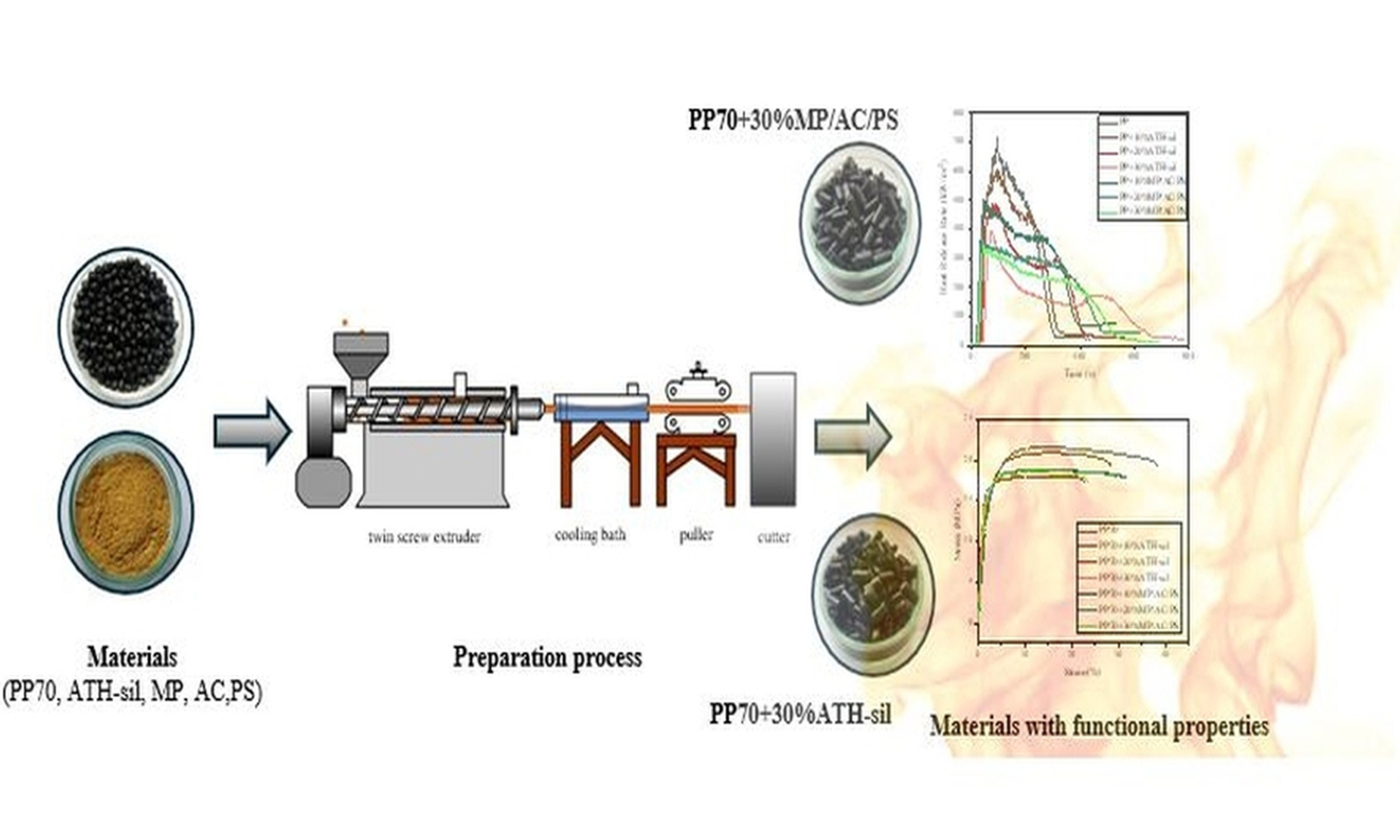
Two series of polymer blends based on post-consumer polypropylene (rPP) and tire rubber crumbs (Trc) under the trademark ECOPLASTOMER® PP70 with a mutual ratio of components 70/30 wt%, containing 10, 20, and 30 wt% of flame retardants, have been prepared using a twin-screw extruder. The influence of commercially available silane-treated alumina trihydrate (ATH-sil) with the eco-friendly system based on melamine phosphate (MP), aluminum hydroxide (AC), and peanut shells (PS), used as flame retardant agents, on the mechanical, thermal, and flammability properties of polymer blends was assessed – the incorporation of ATH-sil results in the appearance of peaks related to OH groups in the Fouriertransform infrared spectroscopy (FTIR) spectra. Similar observations are made for the MP/AC/PS system. differential scanning calorimetry (DSC) analysis revealed that using the selected flame retardants did not impact the melting and crystallization temperatures of the polymer. Tensile strength experienced a minor decrease, particularly in compositions containing more than 20 wt% of the flame retardants, while hardness remained unaffected by their share. Both flame retardants reduced the flammability of the modified polypropylene/rubber powder blends, and the most favorable outcomes were achieved with ATH-sil; however, only when employed at a minimum of 30 wt%. The formulated MP/AC/PS system proved more adept at reducing flammability and smoke emissions at lower flame retardant levels (up to 20 wt%).
Abdulaziz Al-Shehri, John Sweeney, Paul Spencer, Phil Coates, Fin Caton-Rose, Ajay Taraiya
Vol. 19., No.12., Pages 1238-1255, 2025
DOI: 10.3144/expresspolymlett.2025.92
Vol. 19., No.12., Pages 1238-1255, 2025
DOI: 10.3144/expresspolymlett.2025.92
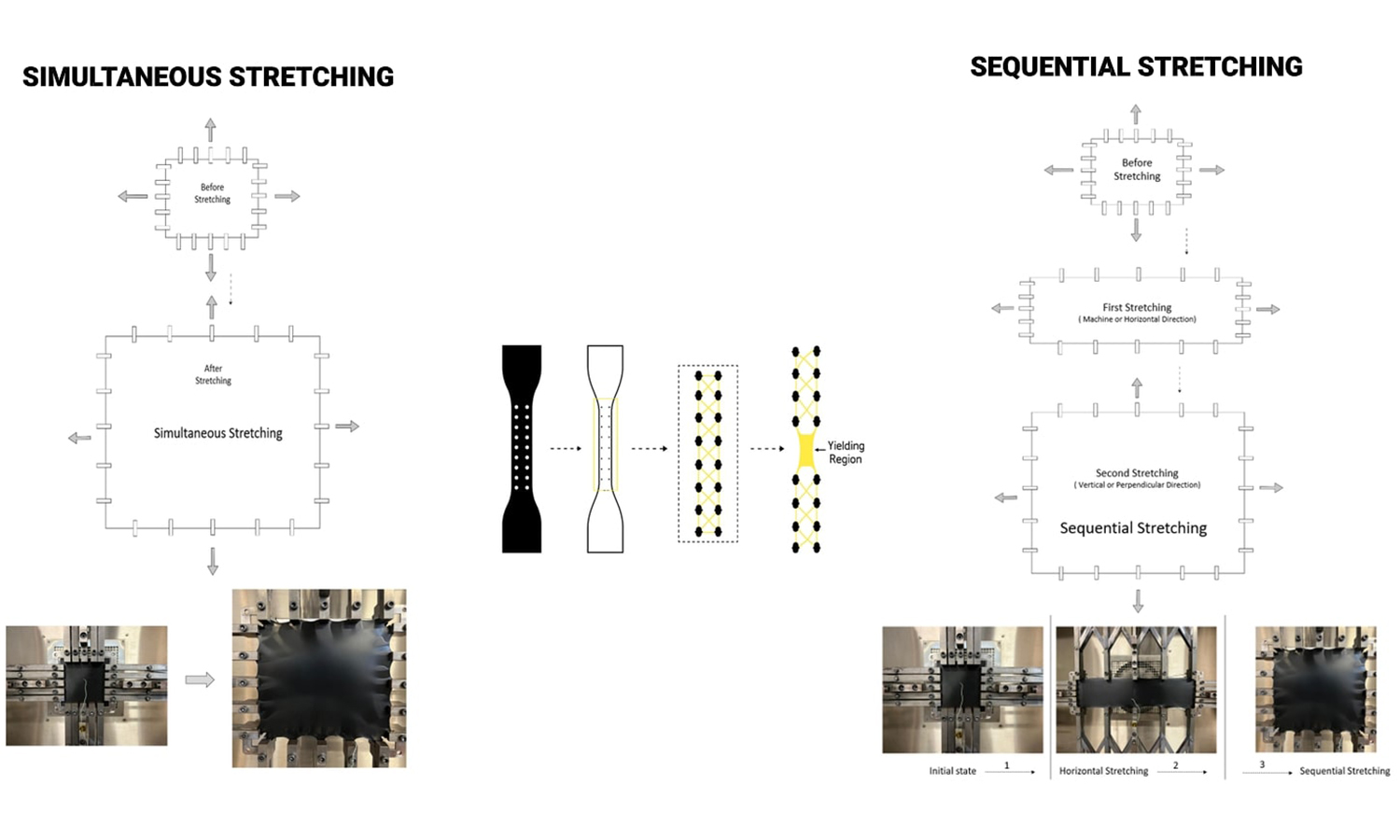
This study examines the combined effects of molecular modalities (unimodal, bimodal, trimodal) and biaxial stretching modes (sequential and simultaneous) on the yielding, stiffness, and necking behaviour of stretched high-density polyethylene (HDPE). Yield strength and stiffness were examined in relation to oriented material produced by drawing at linear strain rates 5.4·10–3, 2.2·10–2, and 8.6·10–2 s–1 under both stretching modes. Simultaneous stretching outperformed sequential stretching, with yield strength increasing with draw rate. Unimodal HDPE showed higher yield strength and stiffness than bimodal and trimodal grades, while trimodal HDPE had the lowest necking tendency from greater flexibility and uniformity. The highest necking tendency was observed in unimodal HDPE in strain localization analysis using the maximum strain/average strain ratio, while trimodal HDPE deformed more uniformly due to improved molecular weight distribution and strain hardening. Increasing the draw rate reduced strain localization, improving mechanical performance. Insights for optimising polyethylene materials in industry are provided by gel permeation chromatography (GPC), nuclear magnetic resonance (NMR) spectroscopy, and mechanical analyses, establishing the correlation between HDPE structure, processing, and properties.