The effects of condensed-mode operation on the polymerization, morphology and properties of high-impact ethylene–propylene copolymers
János Molnár , Pavel Shutov, Renate Eckmayr, Jingbo Wang, Vasileios Touloupidis, Markus Gahleitner
, Pavel Shutov, Renate Eckmayr, Jingbo Wang, Vasileios Touloupidis, Markus GahleitnerVol. 20., No.9., Pages 939-954, 2026
DOI: 10.3144/expresspolymlett.2026.69
DOI: 10.3144/expresspolymlett.2026.69
Corresponding author: János Molnár 
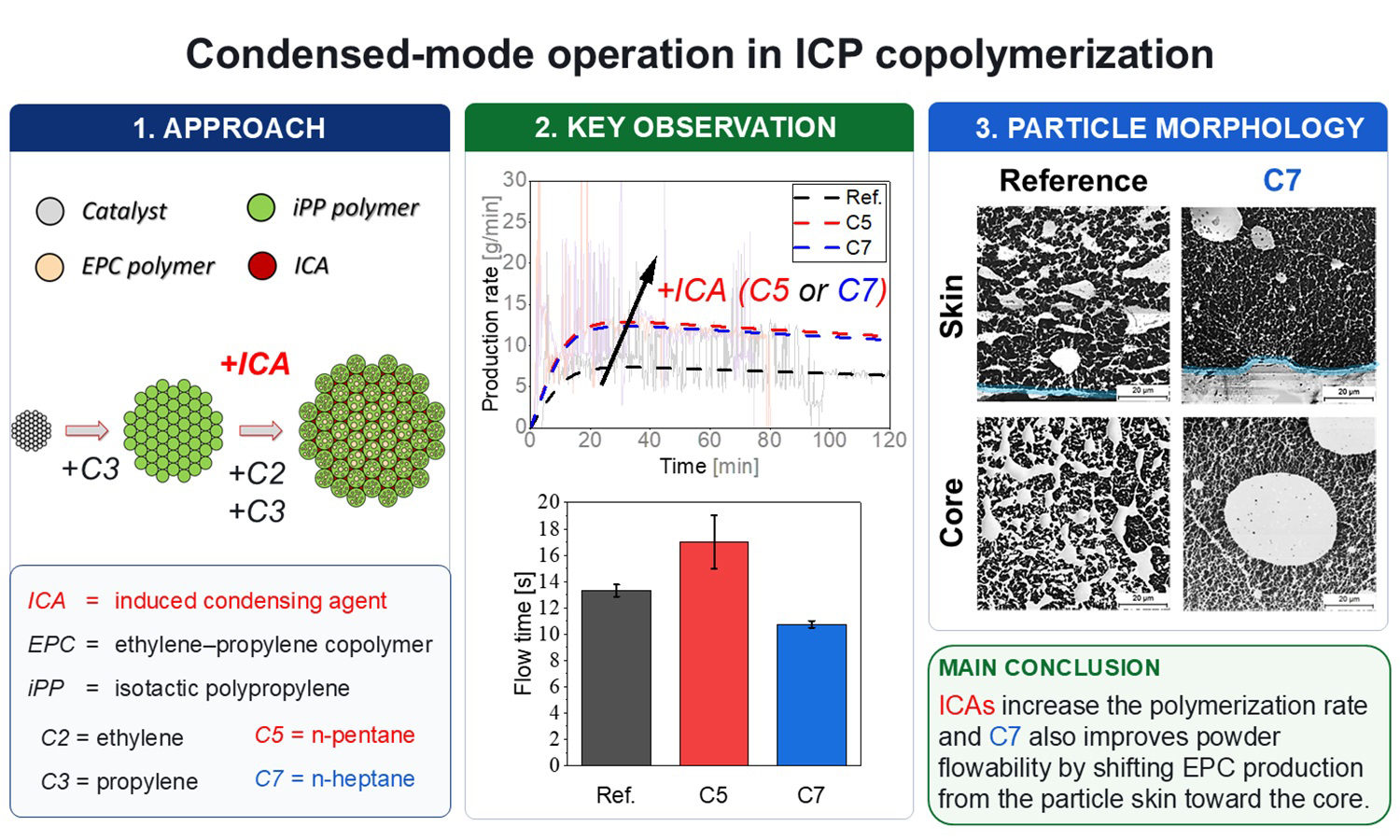
GRAPHICAL ABSTRACT
ABSTRACT
Elastomeric ethylene–propylene copolymer (EPC) content is a decisive factor in the impact performance of multiphase polypropylene (PP) impact copolymers (ICPs). However, producing PP ICPs with high EPC content remains challenging because increasing EPC content raises powder stickiness, potentially leading to production problems such as fouling or sheeting. Condensed mode operation with an induced condensing agent (ICA) has recently been proposed to reduce stickiness and improve flowability. In this study, we performed bench-scale PP ICP polymerizations with n-pentane (C5) or n-heptane (C7) as ICAs to assess this approach. Both ICAs enhanced monomer solubility and the polymerization rate through co-solubility. At high EPC content, C7 improved powder flowability, whereas C5 gave stickiness comparable to or greater than that of the reference. Atomic force microscopy revealed that C7 shifted the dispersed EPC phase toward the particle core, explaining the improved flowability. In contrast to literature reports, ethylene response and EPC comonomer distribution remained unchanged. Consequently, mechanical and thermal properties were unaffected. Condensed-mode operation may therefore offer benefits only when specific ICAs, such as C7, are used in substantial amounts, limiting practical applicability because of additional purification costs.
RELATED ARTICLES
Jana Navratilova
Vol. 20., No.2., Pages 112-113, 2026
DOI: 10.3144/expresspolymlett.2026.9
Vol. 20., No.2., Pages 112-113, 2026
DOI: 10.3144/expresspolymlett.2026.9
This is an editorial article. It has no abstract.
Abdulaziz Al-Shehri, John Sweeney, Paul Spencer, Phil Coates, Fin Caton-Rose, Ajay Taraiya
Vol. 19., No.12., Pages 1238-1255, 2025
DOI: 10.3144/expresspolymlett.2025.92
Vol. 19., No.12., Pages 1238-1255, 2025
DOI: 10.3144/expresspolymlett.2025.92
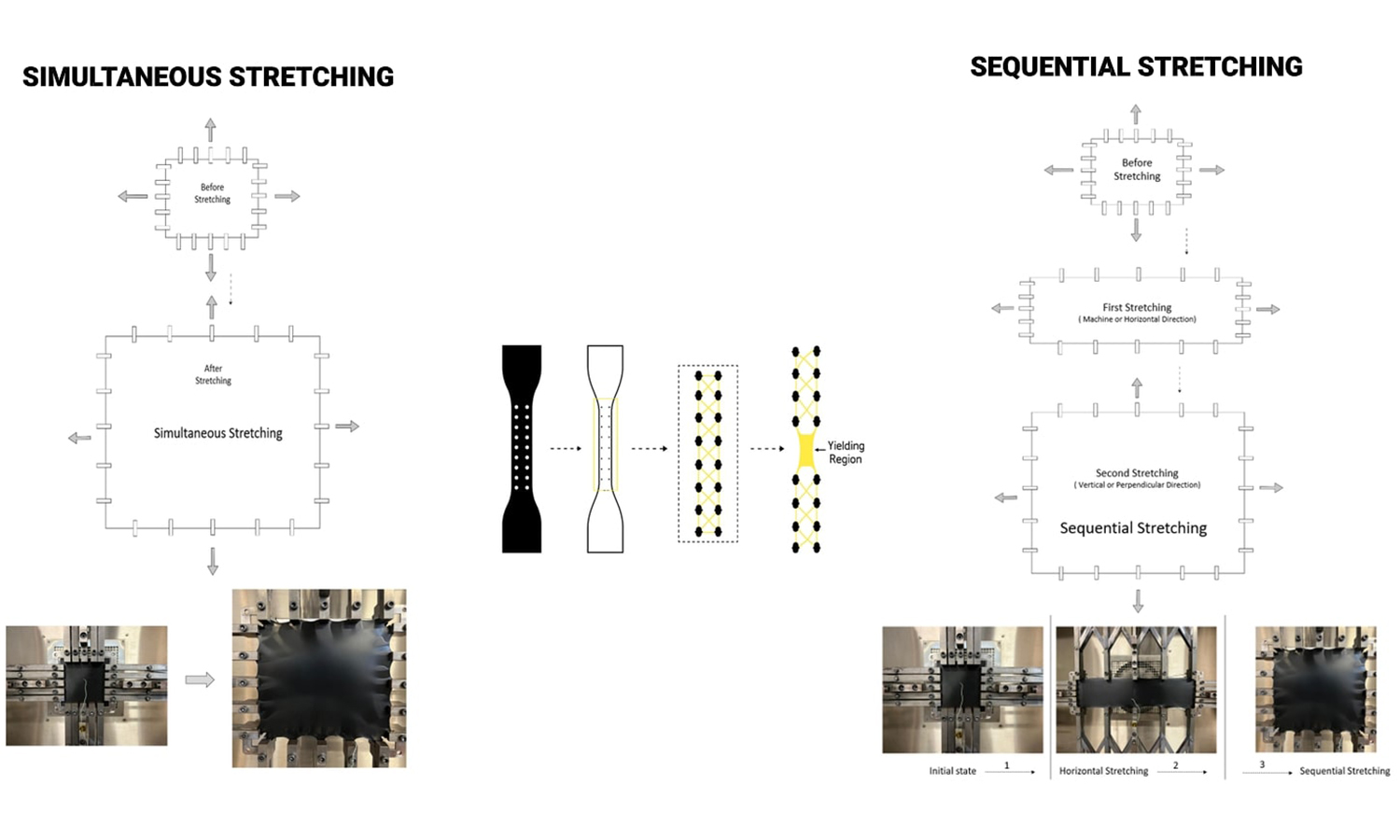
This study examines the combined effects of molecular modalities (unimodal, bimodal, trimodal) and biaxial stretching modes (sequential and simultaneous) on the yielding, stiffness, and necking behaviour of stretched high-density polyethylene (HDPE). Yield strength and stiffness were examined in relation to oriented material produced by drawing at linear strain rates 5.4·10–3, 2.2·10–2, and 8.6·10–2 s–1 under both stretching modes. Simultaneous stretching outperformed sequential stretching, with yield strength increasing with draw rate. Unimodal HDPE showed higher yield strength and stiffness than bimodal and trimodal grades, while trimodal HDPE had the lowest necking tendency from greater flexibility and uniformity. The highest necking tendency was observed in unimodal HDPE in strain localization analysis using the maximum strain/average strain ratio, while trimodal HDPE deformed more uniformly due to improved molecular weight distribution and strain hardening. Increasing the draw rate reduced strain localization, improving mechanical performance. Insights for optimising polyethylene materials in industry are provided by gel permeation chromatography (GPC), nuclear magnetic resonance (NMR) spectroscopy, and mechanical analyses, establishing the correlation between HDPE structure, processing, and properties.
Xiaohua Li, Weiming Liu, Junlong Wang, Shanshan Shao, Weiliang Ding
Vol. 19., No.6., Pages 578-593, 2025
DOI: 10.3144/expresspolymlett.2025.44
Vol. 19., No.6., Pages 578-593, 2025
DOI: 10.3144/expresspolymlett.2025.44
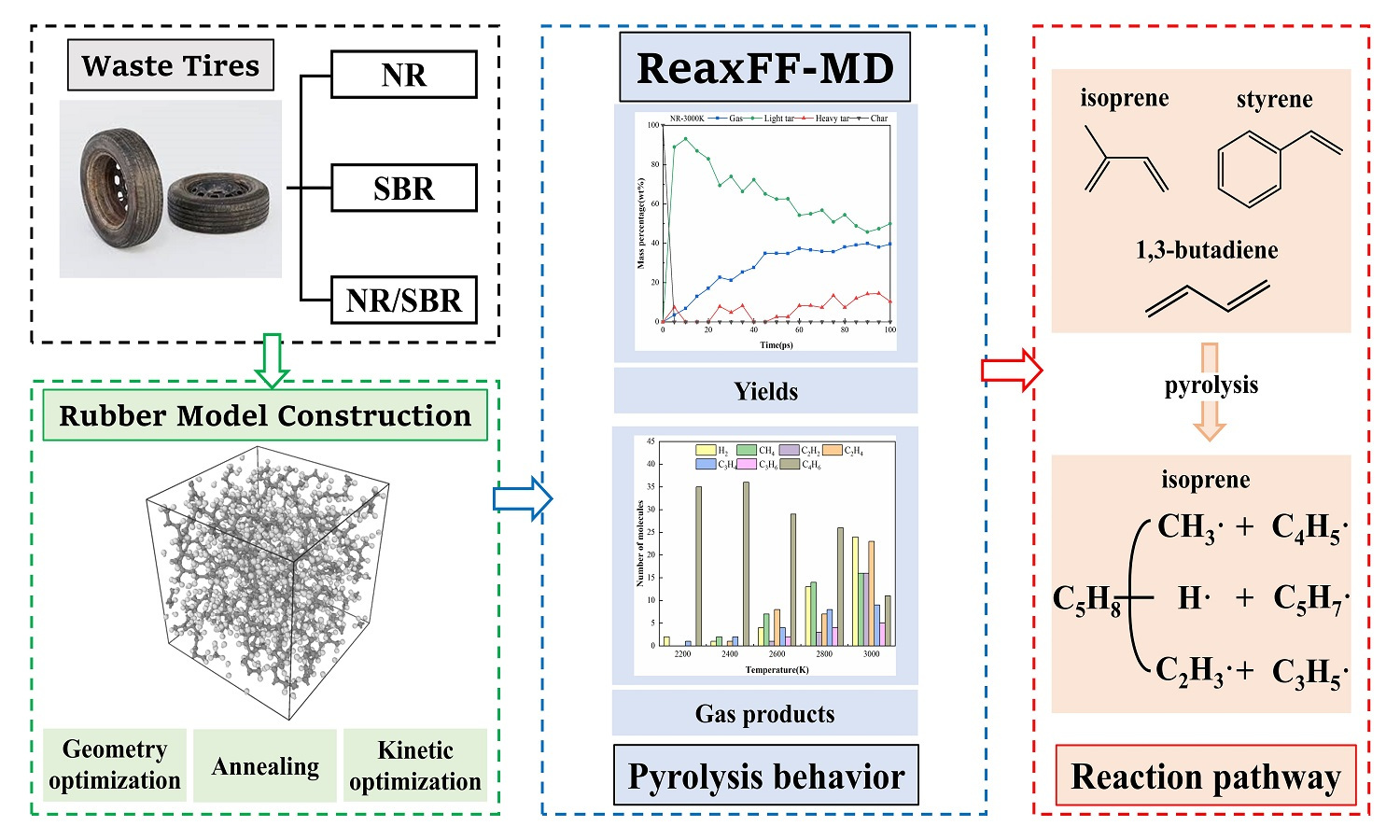
Pyrolysis is one of the effective methods for recycling waste tire rubber, and there are fewer studies on the simulation and mechanism of pyrolysis of multi-component mixed rubber. This study employs reactive force field molecular dynamics (ReaxFF-MD) simulations to analyze the pyrolysis product evolution processes of natural rubber (NR), styrene-butadiene rubber (SBR), and mixed rubber (NR/SBR). The results show that with increasing temperature, the gas yield of NR/SBR increases from 16.32% at 2000 K to 37.01% at 3000 K, and the molecular numbers of gas products such as H2 and small-molecule hydrocarbons increase with temperature. The co-pyrolysis of NR/SBR accelerates solid rubber pyrolysis time and promotes the formation of main gas products (excluding C4H6). Using simulation results, the reaction pathways of pyrolysis intermediates were analyzed: the main intermediates of NR are isoprene monomers and C10H16• short-chain radicals, while those of SBR are styrene and butadiene. The bond cleavage mechanisms of intermediates were compared through reaction energy barrier calculations. This study systematically reveals the pyrolysis product characteristics and reaction mechanisms of rubbers, providing theoretical support for the selective pyrolysis recycling of various waste rubbers.
Soňa Zenzingerová, Jana Navratilova, Lenka Gajzlerová, Michal Kudláček, David Jaška, Lubomir Benicek, Roman Čermák
Vol. 18., No.9., Pages 921-930, 2024
DOI: 10.3144/expresspolymlett.2024.69
Vol. 18., No.9., Pages 921-930, 2024
DOI: 10.3144/expresspolymlett.2024.69

This study compares the efficiency of commercially available sorbitol-based clarifying agent (NA) and varying amounts of long chain-branched polypropylene (LCBPP) acting as a specific α-nucleating agent for linear polypropylene (PP). The sorbitol-based clarifying agent, 1,3;2,4-bis(3,4-dimethyl benzylidene)sorbitol (Millad 3988), in concentration 0.2 wt%, and LCBPP in the concentration of 1, 2, 5 and 10 wt% were mixed into PP. The comparison of the effect of NA and long branches under isothermal conditions on the crystallization process, crystallinity and polymorphic composition was realized by differential scanning calorimetry and wide-angle X-ray scattering. The addition of long chain-branched polypropylene, even at the lowest concentration, performs better at higher crystallization temperatures and has a superior effect on the crystallization process, crystallization rate and overall crystallization than the addition of NA.
Markus Zach, Davide Tranchida, Enrico Carmeli, Jingbo Wang, Markus Gahleitner, Bernhard Hofko, Elena Pomakhina, Minna Aarnio-Winterhof
Vol. 18., No.7., Pages 715-727, 2024
DOI: 10.3144/expresspolymlett.2024.53
Vol. 18., No.7., Pages 715-727, 2024
DOI: 10.3144/expresspolymlett.2024.53

Blown films from ethylene-propylene random copolymers (C2C3-RACOs) are used in many packaging applications today, constituting a major fraction of both mono- and multilayer packaging film constructions. Combining high processing speed and output with good mechanical and optical performance, mostly high toughness and low haze, requires understanding the structure-property-processing relations. To improve said understanding for C2C3-RACO blown films, two commercial grades with a nearly identical C2 content of ~4.4 wt% and identical melt flow rate (MFR) but different nucleation were selected. These were tested in a processing study, varying melt temperature, blow-up ratio (BUR) and neck length. The film structure was analysed by wide angle X-ray scattering (WAXS) and atomic force microscopy (AFM), and the performance by standard mechanical and optical tests. Variation of film crystallinity was found to be in the range of 62 to 65%, much smaller than in earlier cast film studies on comparable polymers. The tensile modulus is the only performance parameter for which a general positive correlation to crystallinity can be found, blown films being about 50% stiffer than the softest cast films of a comparable polymer. Ductility and toughness are enhanced by higher orientation, resulting from higher BUR and/or higher neck length. For transparency and haze, low surface roughness is decisive at comparable crystallinity, which can be achieved by increasing melt temperature.