Study on the oil and heat-oxidative aging resistance of renewable chopped cellulose fiber reinforced acrylonitrile-butadiene rubber composites
Junxiu Xue , Kaituo Fang, Zhenchun Xu, Huiguang Bian, Yu Wang, Yongming Zhang
, Kaituo Fang, Zhenchun Xu, Huiguang Bian, Yu Wang, Yongming ZhangVol. 20., No.5., Pages 489-500, 2026
DOI: 10.3144/expresspolymlett.2026.37
DOI: 10.3144/expresspolymlett.2026.37
Corresponding author: Yongming Zhang 
GRAPHICAL ABSTRACT
ABSTRACT
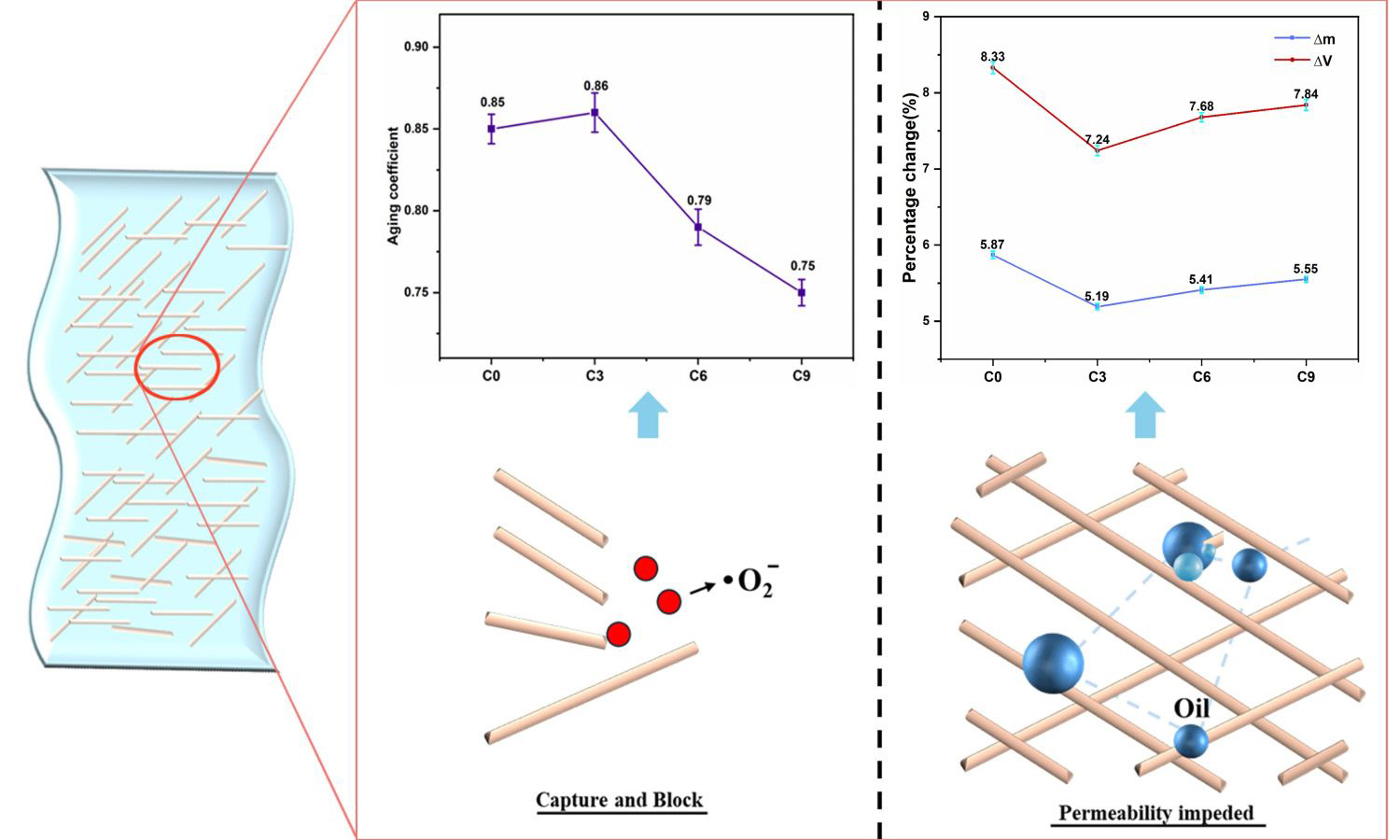
This study investigates the effects of renewable chopped cellulose fiber (CCleF) on the physical and mechanical properties, oil resistance, and thermal-oxidative aging behavior of acrylonitrile-butadiene rubber (NBR), aiming to determine the optimal filler content. CCleF/NBR composites with varying CCleF loadings were prepared and systematically characterized through analyses of vulcanization behavior, three-dimensional morphology, mechanical properties, thermal-oxidative aging, and oil resistance. The results indicate that the composite with 3 phr CCleF exhibits uniform fiber dispersion and optimal overall performance, showing enhanced processability, a reduced vulcanization time, and improved physical and mechanical properties. After thermal-oxygen aging, the composite demonstrated superior stability: the percentage change in tensile modulus, rebound resilience, and DIN abrasion decreased significantly by 13.73, 49.82, and 74.9%, respectively, while the aging coefficient reached 0.86. Notably, this composite also exhibited excellent oil resistance, with a volume expansion rate of 7.24%, which is 13.1% lower than that of unfilled NBR. Correspondingly, the tensile product’s retention rate decreased by 37.72%, while rebound resilience and abrasion resistance improved. This study demonstrates that incorporating 3 phr CCleF is a practical approach to achieving high-performance NBR, providing a material basis for its use in demanding environments such as the petrochemical industry.
RELATED ARTICLES
Péter Tamás-Bényei, Andrea Kohári, Ákos Görbe, Lóránt Kiss, Katalin Litauszki, Ferenc Szabó, László Mészáros, Károly Renner, Tamás Bárány
Vol. 20., No.6., Pages 547-550, 2026
DOI: 10.3144/expresspolymlett.2026.41
Vol. 20., No.6., Pages 547-550, 2026
DOI: 10.3144/expresspolymlett.2026.41
This is an editorial article. It has no abstract.
Reinforcing effect of thermo-oxidative reclaimed rubber on NR/SBR blends for tire tread applications
Yunhui Xu, Zaheer ul Haq, Junrong Li, Hui Tu, Zaixue Wang, Houluo Cong
Vol. 20., No.2., Pages 142-153, 2026
DOI: 10.3144/expresspolymlett.2026.12
Vol. 20., No.2., Pages 142-153, 2026
DOI: 10.3144/expresspolymlett.2026.12
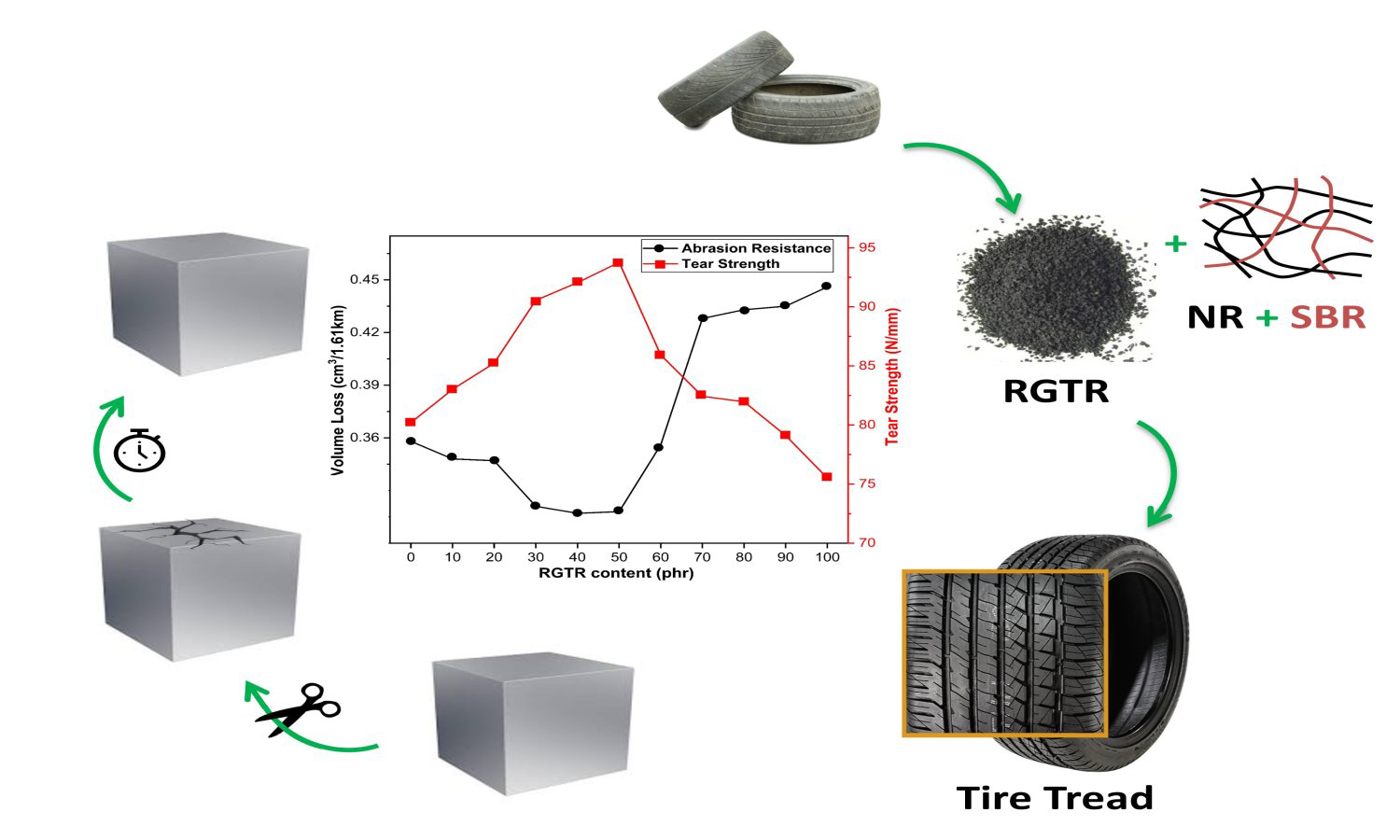
This study explores the application of thermo-oxidative reclaimed ground tire rubber (RGTR) in natural rubber (NR)/styrene butadiene rubber (SBR) composite, focusing on its impact on morphology, mechanical properties, rheological behavior, vulcanization characteristics, aging resistance, tear strength and abrasion resistance. The findings revealed that RGTR enhances the tear strength and abrasion resistance of NR/SBR composites while maintaining comparable tensile strength, elongation at break, and modulus. The incorporation of RGTR reduced Mooney viscosity of the NR/SBR composites and improved flowability. It also shortened the vulcanization time and enhanced vulcanization efficiency. The NR/SBR composites with RGTR loadings below 60 phr exhibited optimal performance, achieved a maximum tear strength of 93.77 N/mm and improved abrasion resistance. However, higher RGTR content led to increased agglomeration, as evidenced by scanning electron microscopy (SEM), which showed finer dispersion at lower RGTR contents and larger aggregates at higher loadings. These findings demonstrate the potential of RGTR as a sustainable additive for enhancing specific properties in NR/SBR composites, contributing to both performance optimization and waste tire management.
Dibyendu Dey, Sharmistha Dhar, Barkat Aziz, Sambhu Bhadra, Sujith Nair, Kinsuk Naskar
Vol. 20., No.2., Pages 127-141, 2026
DOI: 10.3144/expresspolymlett.2026.11
Vol. 20., No.2., Pages 127-141, 2026
DOI: 10.3144/expresspolymlett.2026.11
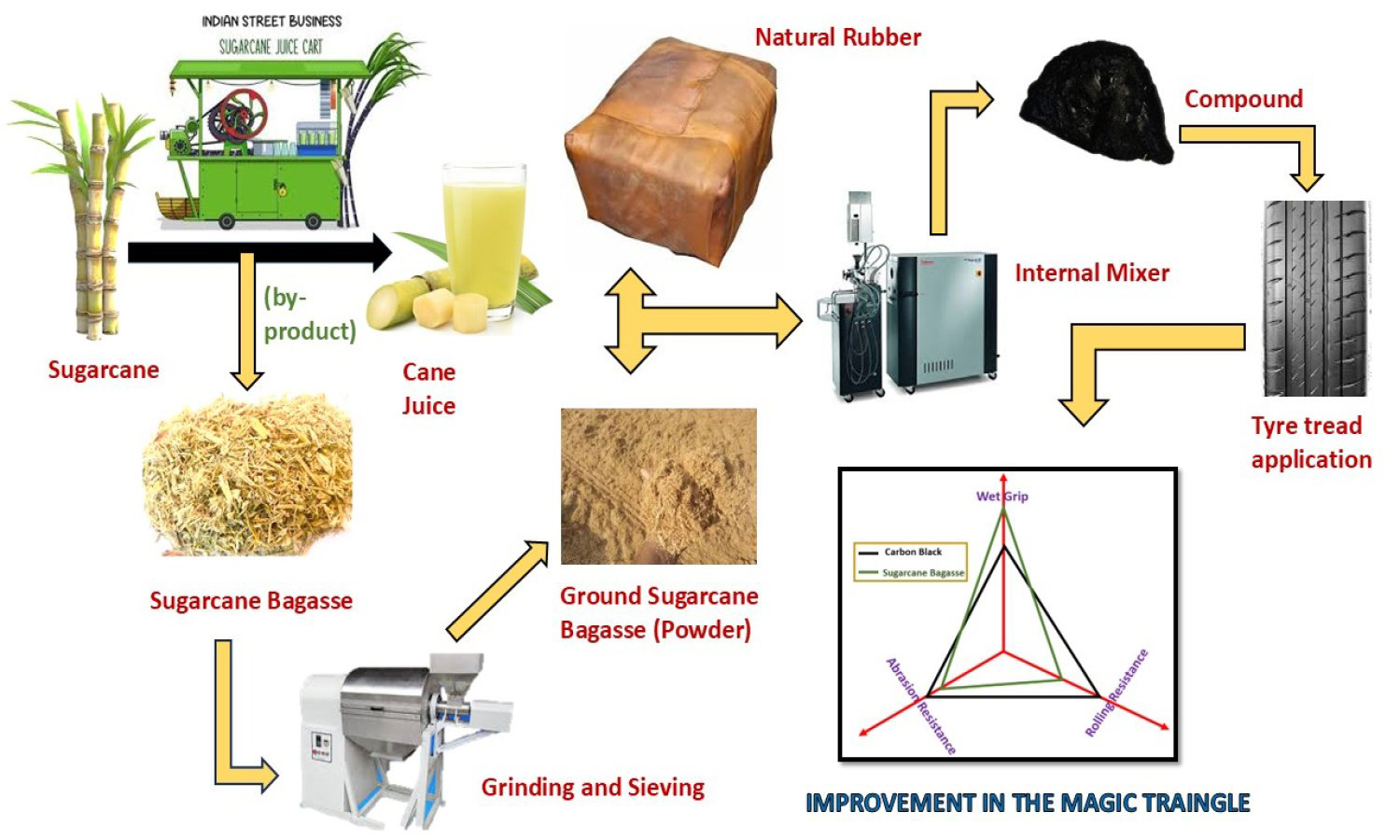
Ground sugarcane bagasse (GSB), an agro-waste rich in lignocellulosic components, was studied as a sustainable bio-filler in natural rubber (NR) tread compounds to lessen reliance on petroleum-derived carbon black (CB). A control formulation with 45 phr CB was compared to hybrid formulations with 40, 35, and 30 phr CB mixed with 5, 10, and 15 phr GSB. Tensile strength 13.1 MPa, elongation at break 700%, and hardness 67 Shore A were all optimally balanced by the compound containing 10 phr GSB (S2), while also exhibiting good cure behavior and thermal stability. Improved tire performance characteristics were confirmed by a dynamic mechanical study, which showed that tan δ at 60 °C decreased by 8.0% (resulting in lower rolling resistance) and increased by 3.9% (improving wet traction) at 0°C. The Payne effect showed improved filler dispersion as a result of GSB partially replacing CB. The results show that appropriately dispersed GSB can partially reinforce NR, enhancing energy efficiency and sustainability. However, larger GSB loadings decrease modulus, tear strength, and abrasion resistance due to lower interfacial adhesion and the presence of micro-voids. According to this study, pulverized sugarcane bagasse shows promise as an environmentally friendly filler for green tire applications, promoting the circular economy and lowering the carbon footprint of rubber compounding.
Jutatip Makmanee Treitler, Diew Saijun, Kritsada Phatcharasit, Suwat Rattanapan
Vol. 19., No.12., Pages 1310-1319, 2025
DOI: 10.3144/expresspolymlett.2025.96
Vol. 19., No.12., Pages 1310-1319, 2025
DOI: 10.3144/expresspolymlett.2025.96
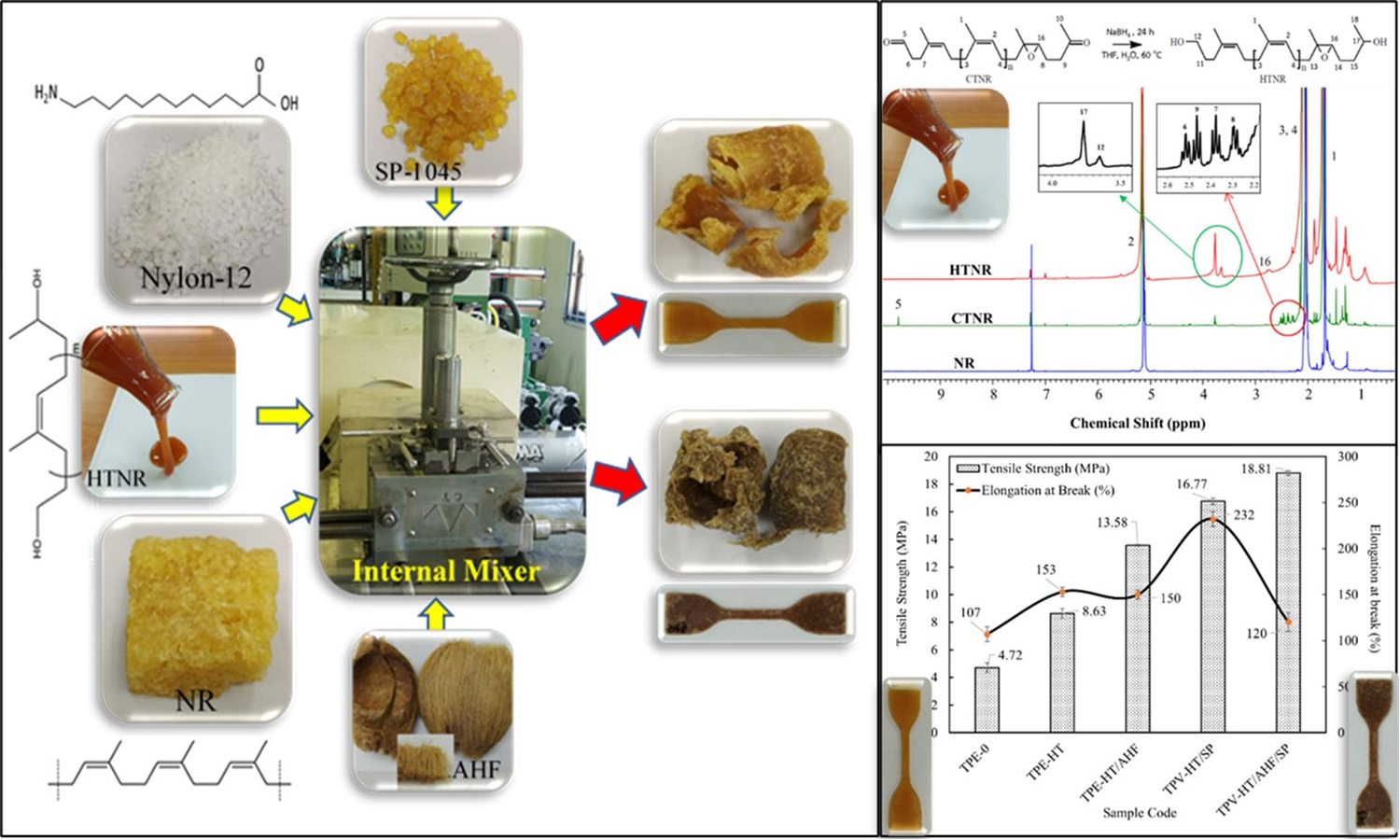
This work introduces an innovative method to enhance the compatibility of nylon-12/natural rubber thermoplastic elastomers by utilizing hydroxyl telechelic natural rubber as a reactive compatibilizer and natural fibers as reinforcement. Hydroxyl telechelic natural rubber was synthesized from natural rubber via oxidative cleavage to carbonyl telechelic natural rubber, followed by reduction with sodium borohydride. Proton nuclear magnetic resonance (1H-NMR) and Fourier transform infrared spectroscopy (FTIR) verified the structure. Incorporating hydroxyl telechelic natural rubber into nylon-12/natural rubber (40/60 wt%) blends significantly enhanced interfacial adhesion, improving tensile strength and elongation at break compared to the uncompatibilized mix. Dynamic vulcanization using phenolic resin achieved an optimal balance of strength and ductility. The incorporation of areca husk fiber enhanced tensile strength, hardness, and solvent resistance, with a slight decrease in ductility and tear strength. Rheological analysis indicated that hydroxyl telechelic natural rubber increased melt viscosity due to improved phase interactions, while dynamic vulcanization reduced the melt flow index through network formation. Solvent uptake experiments confirmed that hydroxyl telechelic natural rubber, areca husk fiber, and SP-1045 vulcanizing agent minimized swelling in isooctane, toluene, and diesel oil.
Xue Xu, Rujie Li, Li Gao, Beibei Sun, Hongming Liu, Shiai Xu
Vol. 19., No.9., Pages 959-976, 2025
DOI: 10.3144/expresspolymlett.2025.72
Vol. 19., No.9., Pages 959-976, 2025
DOI: 10.3144/expresspolymlett.2025.72
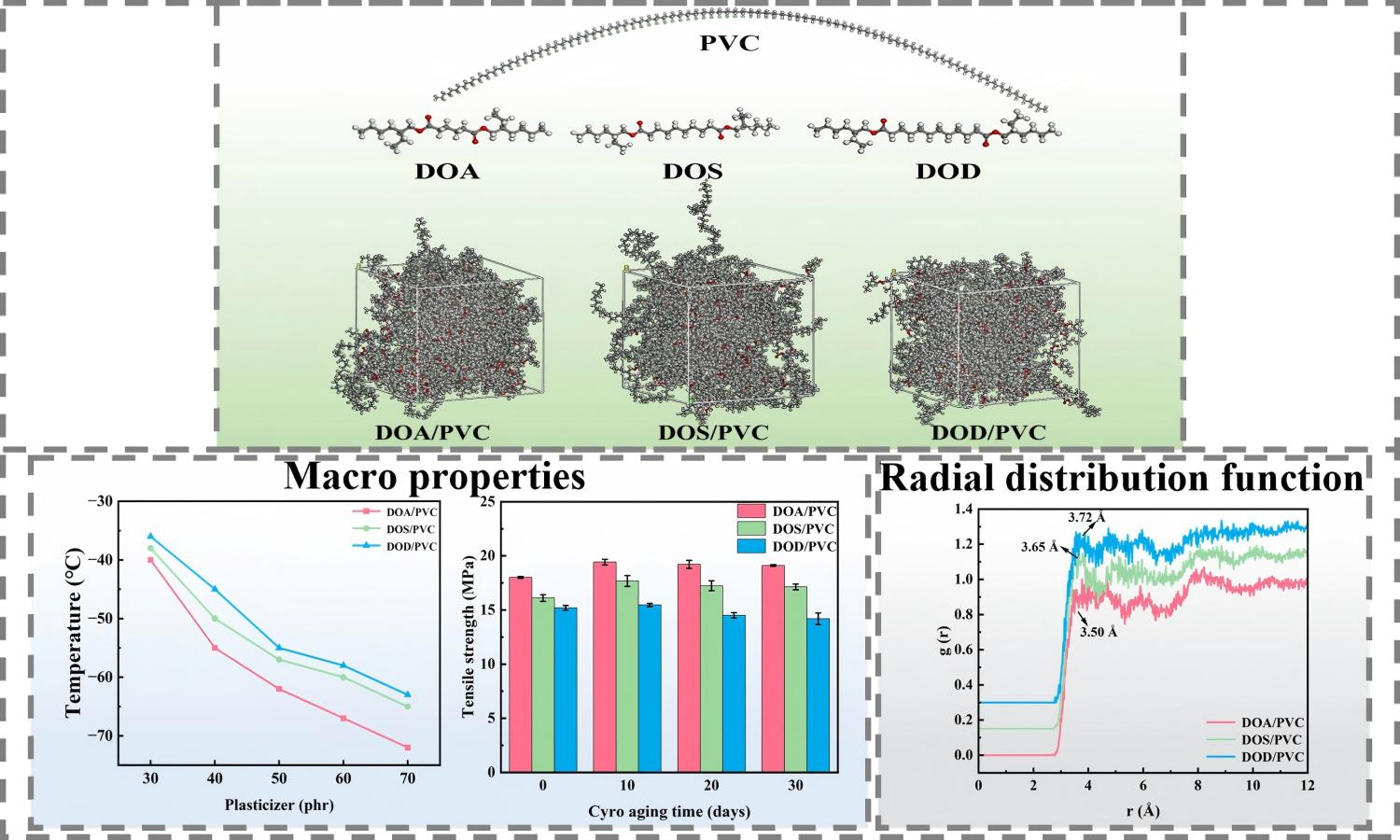
As polyvinyl chloride (PVC) films are hard and brittle in a low-temperature environment, aliphatic dibasic acid ester plasticizers with different acid chain lengths were fabricated, i.e. di(2-ethylhexyl) adipate (DOA), di(2-ethylhexyl) sebacate (DOS) and dioctyl dodecanedioate (DOD), and their effects on the cold-resistant properties of PVC were investigated using experiments and molecular dynamics (MD) simulations. The brittleness temperature and tensile properties of plasticizers/PVC are negatively related to the acid chain length of the aliphatic dibasic acid esters. The brittleness temperatures of the three systems are all below –50 °C. In-situ low-temperature tensile tests and aging tests indicate that DOA/PVC exhibits the best cold resistance and stability. MD simulations further reveal that the best compatibility between DOA and PVC is attributed to its strong binding energy and weak hydrogen bonding interactions, while van der Waals forces are dominant in DOS/PVC and DOD/PVC. This study elucidates the structure-property relationship between aliphatic dibasic acid ester plasticizers and PVC from the perspective of molecular interactions, and provides insights into the design of cold-resistant PVC plasticizers.