
Selection criteria of polymer nanocomposites for electrical energy storage applications: A concise review
Mathew Olurotimi Adeoti , Tamba Jamiru, Taoreed Adesola Adegbola, Ibrahim Suleiman, Mohammed Abdullahi, Basiru Philip Aramide
, Tamba Jamiru, Taoreed Adesola Adegbola, Ibrahim Suleiman, Mohammed Abdullahi, Basiru Philip AramideVol. 19., No.2., Pages 208-229, 2025
DOI: 10.3144/expresspolymlett.2025.16
DOI: 10.3144/expresspolymlett.2025.16
Corresponding author: Mathew Olurotimi Adeoti 
GRAPHICAL ABSTRACT

ABSTRACT
Polymer nanocomposites are drawing considerable interest in electrical energy storage research owing to their distinctive characteristics and promising roles in various devices, such as batteries, supercapacitors, and fuel cells. This review examines the selection criteria of polymer nanocomposites for electrical energy storage applications and the current advancements in developing and producing polymer nanocomposites specifically tailored for electrical energy storage applications. Key topics covered include the selection of polymer matrices, choice of nanofillers, fabrication techniques, characterization methods, and performance evaluation of the resulting nanocomposites. The impact of nanofiller dispersion, interface engineering, and morphology control on electrical storage properties is emphasized. Proper dispersion enhances uniformity and interfacial interactions, improving electrical, mechanical, and thermal properties. Interface engineering boosts polymer-nanofiller compatibility, while morphology control optimizes nanofiller structure and arrangement for better storage efficiency. Emerging trends, challenges, and future research directions are also discussed, providing insights for developing advanced polymer nanocomposites with improved electrical energy storage capabilities.
RELATED ARTICLES
Alessandro Pegoretti
Vol. 20., No.7., Pages 662-663, 2026
DOI: 10.3144/expresspolymlett.2026.49
Vol. 20., No.7., Pages 662-663, 2026
DOI: 10.3144/expresspolymlett.2026.49
This is an editorial article. It has no abstract.
Nurul Ain Arjuna, Noor Maizura Ismail, S. M. Anisuzzaman, Rachel Fran Mansa, Murni Sundang, Akhtar Razul Razali
Vol. 19., No.4., Pages 441-454, 2025
DOI: 10.3144/expresspolymlett.2025.32
Vol. 19., No.4., Pages 441-454, 2025
DOI: 10.3144/expresspolymlett.2025.32
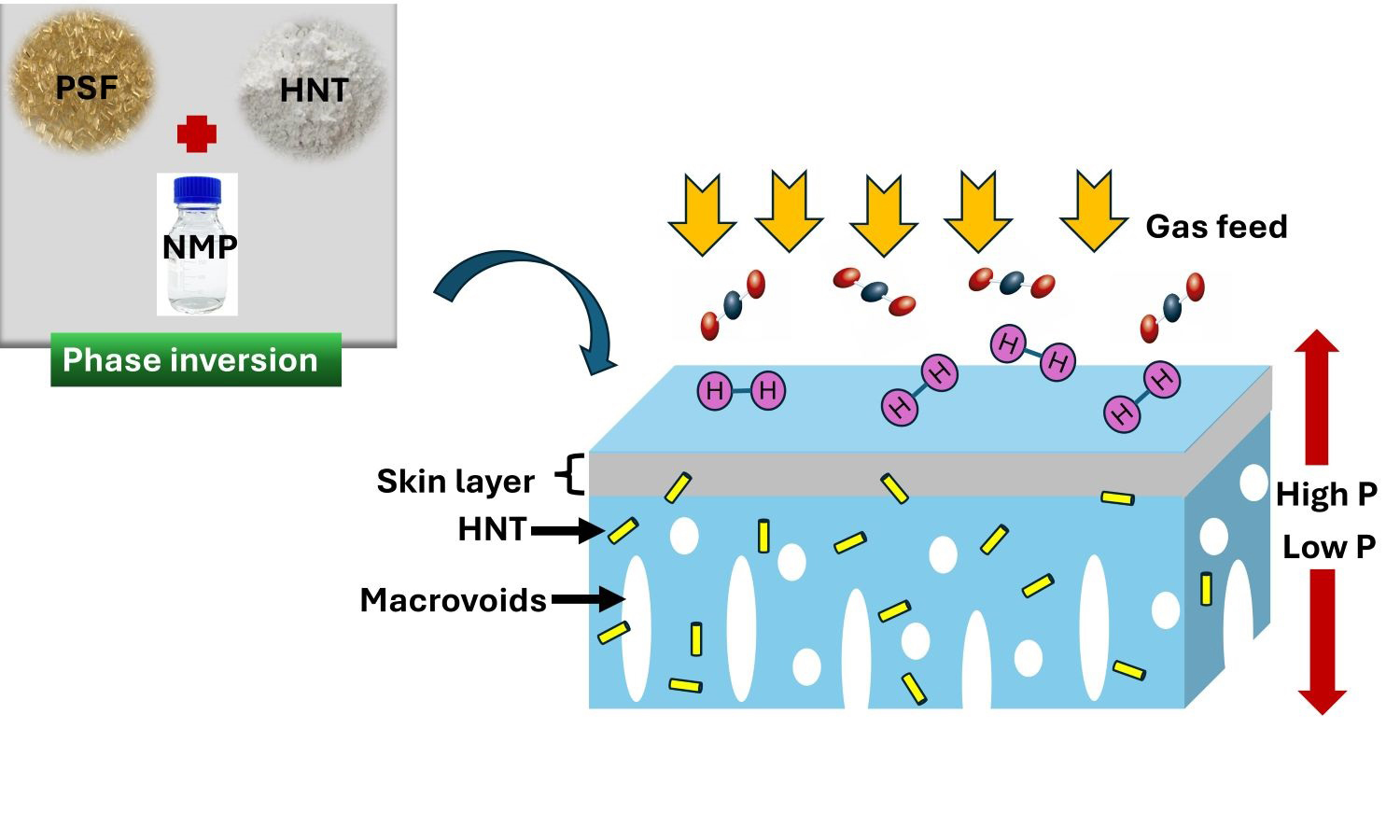
Membrane-based gas separation offers practical advantages for hydrogen (H2) and carbon dioxide (CO2) separation for steam methane reforming units. Modification of membrane materials can optimize membrane performance. In this study, the central focus is on investigating the effect of different loadings of halloysite nanotubes (HNTs) (0, 0.5, 1.0, 1.5, and 2.0 wt%) incorporated into a blend of cellulose acetate (CA) and polysulfone (PSF) polymers with the aim of improving the membrane properties. The Fourier transform infrared spectroscopy-attenuated total reflectance (FTIR-ATR) results confirmed that the primary functional groups of PSF and CA remained intact upon HNTs incorporation, with no distinct HNT peaks altering the main chemical functionalities. Field emission scanning electron microscopy- energy dispersive X-ray spectroscopy (FESEM-EDX) analyses showed that low concentrations of HNTs (0.5 wt%) improved surface smoothness and reduced macrovoids, beneficial for gas separation. Cross-sectional images of FESEM micrographs showed no evidence of obvious agglomeration, suggesting a good dispersion of HNTs. From the X-ray diffraction (XRD) analysis, all the membrane samples retained an amorphous structure, indicating that the incorporation of HNT has less effect on the polymer chain properties of the membranes.
Yunhui Wu, Chengkai Luo, Huanyu Liu, Wen Li, Jun-Wei Zha
Vol. 18., No.12., Pages 1265-1276, 2024
DOI: 10.3144/expresspolymlett.2024.94
Vol. 18., No.12., Pages 1265-1276, 2024
DOI: 10.3144/expresspolymlett.2024.94

Currently, polylactic acid (PLA) is an attractive alternative to polypropylene (PP) because of its biodegradability. This study introduces a novel modification strategy for PLA by creating a multifunctional ionization layer with ionic salts. This approach achieves humidity sensing, reliable antibacterial properties, and excellent degradability simultaneously. The modified PLA textile sensor exhibits high sensitivity to respiratory humidity (0.92 at 90% RH), with ultrafast response (0.12 s) and recovery times (0.16 s). Additionally, the textile demonstrates excellent antibacterial performance against both E. coli (99.9%) and S. aureus (99.9%) after 1 h of contact. It also shows notable biodegradability with a weight loss rate of 60.38% after 30 days. Also, the ionic salt mechanism is explained through dynamic ionization interactions attributed to the modified ionic salts, which feature both long-chain alkanes and active ions. This work presents a new method to enhance the respiratory detection and antibacterial performance of biodegradable masks.
Zhengping Zhao, Zhao Xu, Zhong Zheng, Wei Wang, Wenyu Wang, Xingcheng Yang, Siqi Zhu, Jia Wei Chew
Vol. 18., No.10., Pages 976-990, 2024
DOI: 10.3144/expresspolymlett.2024.75
Vol. 18., No.10., Pages 976-990, 2024
DOI: 10.3144/expresspolymlett.2024.75

Lithium-ion batteries (LIBs) are widely used as important energy storage and energy supply devices. The porous design and heteroatomization modification of carbon-based anode materials are crucial for achieving high-capacity and reversible energy storage in LIBs. Sol-gel method and pyrolysis treatment were used to obtain silica/silver composite particles used as templates. Polyphosphazene-coated silica/silver composite composite carbon materials (SiO2/Ag@PZS-C) were synthesized through in-situ self-assembly and carbonization of polyphosphazene. The electrochemical behavior and lithium storage mechanism of SiO2/Ag@PZS-C was also studied. The results reveal that the composite exhibited high specific capacity, stable cycling and superior rate performance. The double modification of silver nanoparticles and polyphosphazene carbon significantly improves the conductivity of silica and reduces the volume change. Moreover, the carbon shell of polyphosphazene facilitated the formation of a stable solid electrolyte interface film (SEI), preventing direct contact between the active material and the electrolyte, thereby substantially enhancing lithium storage performance.
Péter Csvila, Tibor Czigány
Vol. 18., No.10., Pages 1023-1038, 2024
DOI: 10.3144/expresspolymlett.2024.78
Vol. 18., No.10., Pages 1023-1038, 2024
DOI: 10.3144/expresspolymlett.2024.78
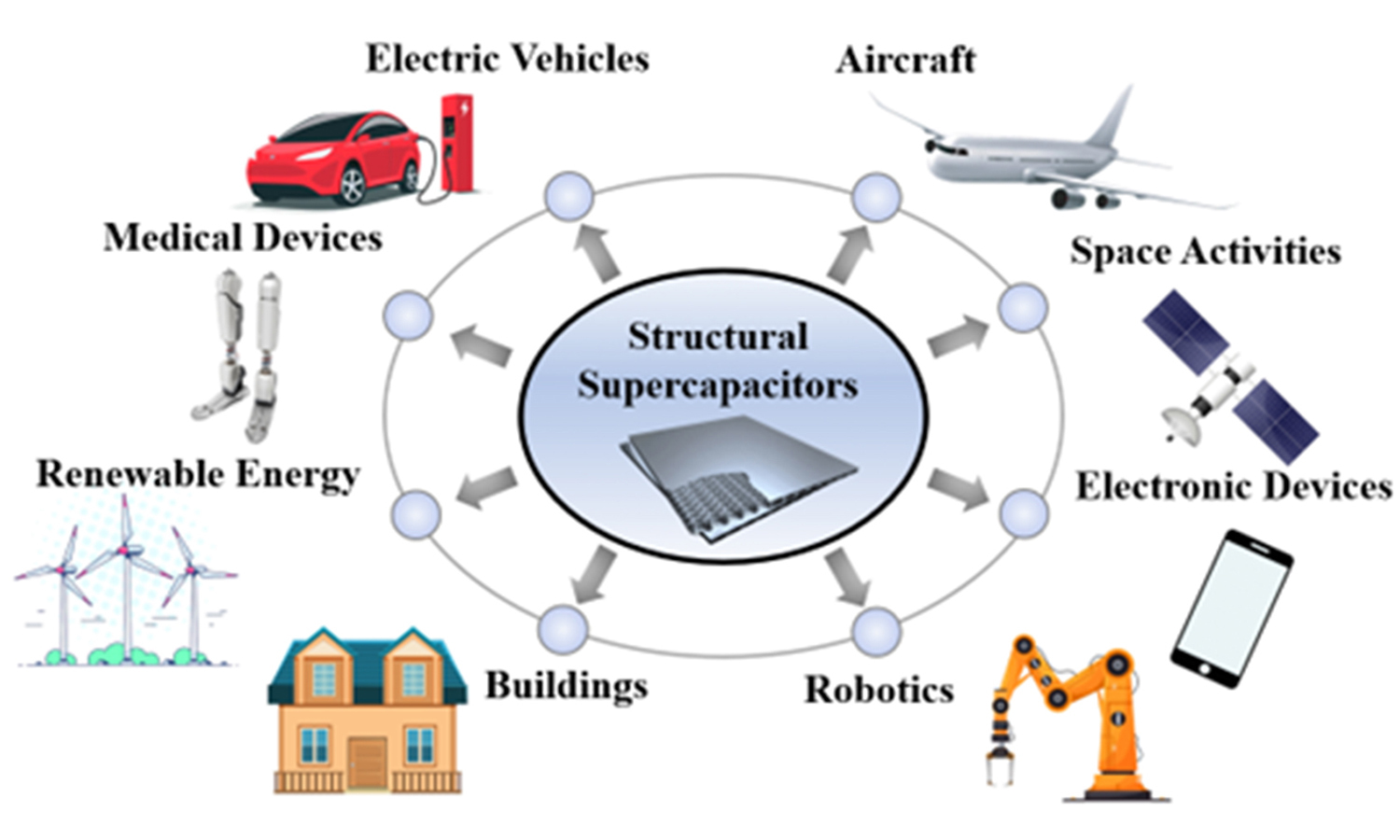
The article gives an overview of energy storage composites, their materials, manufacturing processes, and applications. Carbon- and metal-based nanoparticles and their relevant properties are presented. We focus on multifunctional structural supercapacitors and their components. Thus, we describe the main structural electrolytes and elements of the structural electrodes. We show that the nanoparticles significantly influence the electrochemical properties of the electrode. For example, carbon-based nanoparticles can achieve low energy density but high power density, while the opposite is true for metal-based nanoparticles. We show that when carbon- and metal-based nanoparticles are used together, a positive synergy is created between them, promoting the development of favorable electrochemical properties in the electrodes. Furthermore, we present structural supercapacitors and possible ways to introduce nanoparticles into the system. Finally, we present a summary of the progress achieved so far and the advancements expected in the future, as well as potential areas where structural supercapacitors could be used.