
Strategy for reducing rubber wear emissions: The prospect of using calcium lignosulfonate
Michaela Džuganová , Radek Stoček, Marek Pöschl, Ján Kruželák, Andrea Kvasničáková, Ján Hronkovič, Jozef Preťo
, Radek Stoček, Marek Pöschl, Ján Kruželák, Andrea Kvasničáková, Ján Hronkovič, Jozef PreťoVol. 18., No.12., Pages 1277-1290, 2024
DOI: 10.3144/expresspolymlett.2024.95
DOI: 10.3144/expresspolymlett.2024.95
Corresponding author: Michaela Džuganová 
GRAPHICAL ABSTRACT

ABSTRACT
This study explores the transformative potential of calcium lignosulfonate (CaL) as a sustainable additive in rubber composites based on nitrile rubber (NBR) and styrene-butadiene rubber (SBR). Through comprehensive mechanical testing, fatigue crack growth (FCG) analysis, and scanning electron microscopy (SEM), we evaluated the tensile strength, elongation at break, surface morphology, and crack growth behavior of these innovative composites. By incorporating CaL into carbon black-reinforced rubber compounds (RUB/CB) based on nitrile rubber and styrene-butadiene rubber, we achieved good dispersion of both components as well as satisfactory morphology, resulting in tensile strengths of 16.3 and 12.7 MPa, respectively. While the CB/CaL hybrid did not significantly influence the intrinsic strength of the rubber samples, the ultimate strength of these compounds increased drastically – over five-fold compared to RUB/CB – indicating great potential for real-life applications. This study underscores the promise of lignin-based additives in the development of eco-friendly, highperformance rubber materials.
RELATED ARTICLES
Anthony Allen Parker, Joseph John Marcinko
Vol. 20., No.9., Pages 885-904, 2026
DOI: 10.3144/expresspolymlett.2026.66
Vol. 20., No.9., Pages 885-904, 2026
DOI: 10.3144/expresspolymlett.2026.66
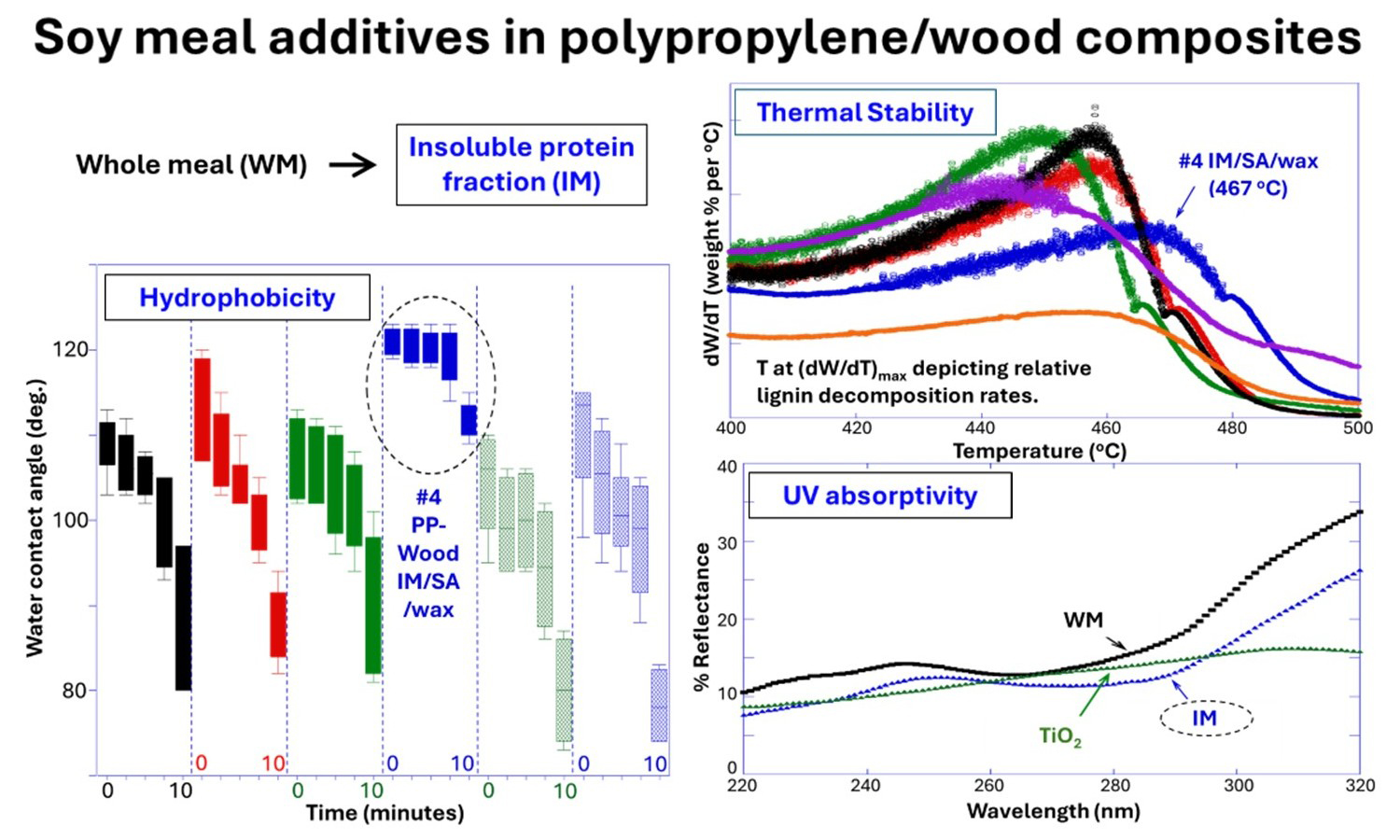
We have discovered that water-insoluble proteins (IM) isolated from whole soy meal (WM) have the capacity to improve the thermal stability of polypropylene (PP) wood composites without negatively impacting mechanical properties. We compared an undiluted composite to composites diluted with 5% by weight of a 3/1 w/w mixture of stearic acid and paraffin wax (SA/wax), 5% by weight IM, 5% by weight WM, 5% by weight of a 50/50 w/w mixture of IM in combination with SA/wax, and 5% by weight WM in combination with SA/wax. Water contact angle (CA) measurements and Fourier transform infrared spectroscopy (FTIR) revealed a synergy between IM and SA/wax, resulting in enhanced surface hydro - phobicity. Thermogravimetric analysis (TGA) showed lower weight loss in composites made with IM up to the onset of the degradation of PP, and reduced rates of lignin degradation, independently of the presence of SA/wax. Dynamic mechanical analysis (DMA) revealed higher modulus and lower viscoelastic loss resulting from the removal of water-soluble soy components from WM. Total reflectance ultraviolet spectroscopy (UV) showed that IM absorbs UV radiation strongly in the UV-B and UV-C regions. Collectively, these findings suggest that IM has the potential to become a multi-purpose additive for use in PP wood composites.
Mpho Phillip Motloung, Mokgaotsa Jonas Mochane
Vol. 19., No.11., Pages 1092-1132, 2025
DOI: 10.3144/expresspolymlett.2025.82
Vol. 19., No.11., Pages 1092-1132, 2025
DOI: 10.3144/expresspolymlett.2025.82
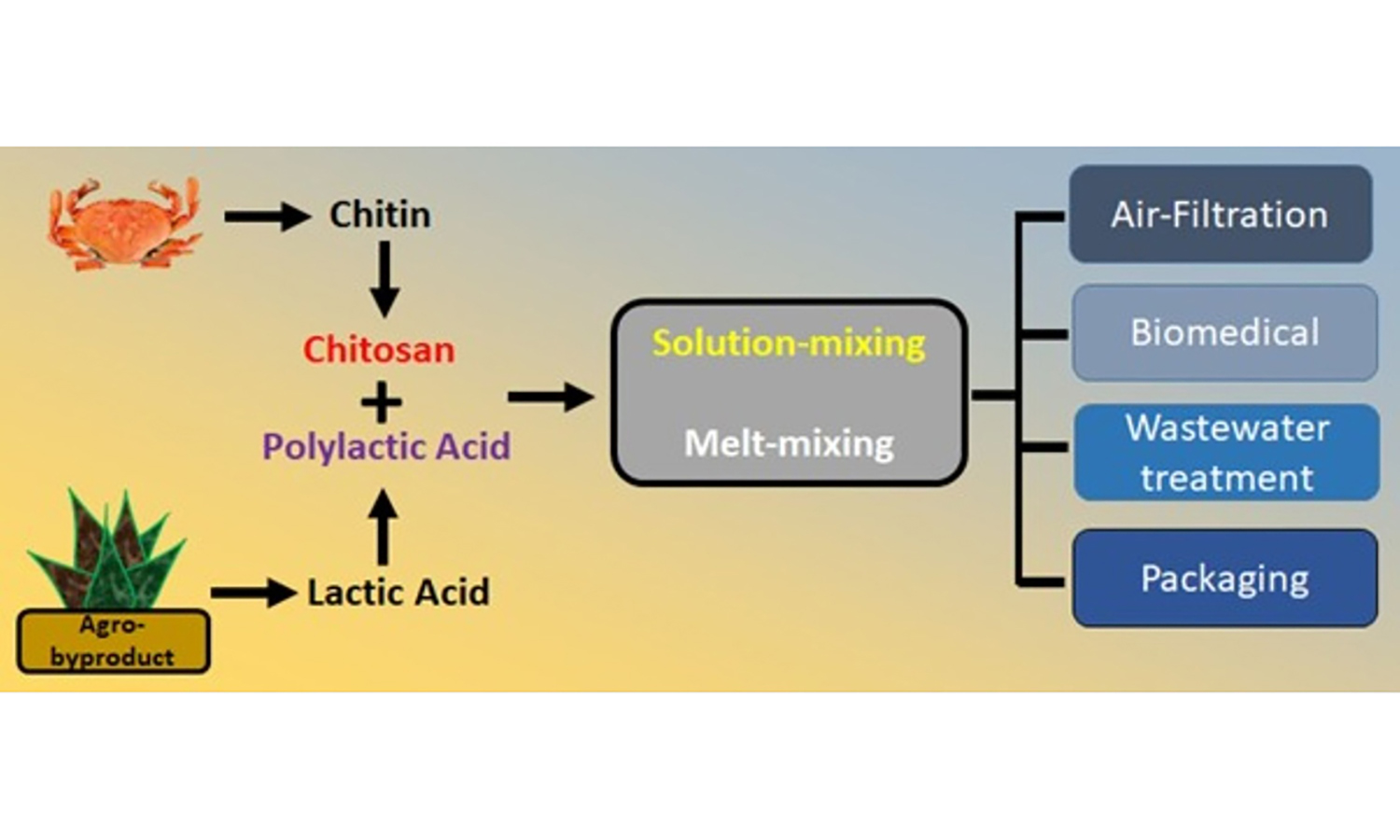
Polylactic acid (PLA) is one of the most widely used biopolymers, and it has demonstrated a huge potential for replacing some of the conventional plastics in certain application fields. However, due to a lack of other attributes such as antimicrobial properties and slow degradation rates, it is often blended with other polymers to impart these properties. Chitosan has desirable features including antimicrobial and antioxidant properties, biodegradability and biocompatibility, and environmental friendliness. Thus, it is widely blended with PLA to generate materials that can be applied in various fields. In recent years, PLA/chitosan blend composites and nanocomposites have been produced to develop sustainable and ecofriendly materials that can be suitable in active food packaging, water treatment, air filtration, and biomedical applications. This review provides an overview of the recent advancements in the development of PLA/chitosan blend composites and nanocomposites for various applications. The processing strategies, mechanical and thermal properties, together with utilization in biomedical, air filtration, water treatment, and packaging applications, are provided.
Kinsuk Naskar
Vol. 19., No.10., Pages 977-978, 2025
DOI: 10.3144/expresspolymlett.2025.73
Vol. 19., No.10., Pages 977-978, 2025
DOI: 10.3144/expresspolymlett.2025.73
This is an editorial article. It has no abstract.
Katalin Litauszki, Tamás Tábi, László Mészáros
Vol. 19., No.5., Pages 455-456, 2025
DOI: 10.3144/expresspolymlett.2025.33
Vol. 19., No.5., Pages 455-456, 2025
DOI: 10.3144/expresspolymlett.2025.33
This is an editorial article. It has no abstract.
Ju Li, Lize Yang, Shuo Chen, Guotao Sun
Vol. 19., No.1., Pages 47-59, 2025
DOI: 10.3144/expresspolymlett.2025.4
Vol. 19., No.1., Pages 47-59, 2025
DOI: 10.3144/expresspolymlett.2025.4
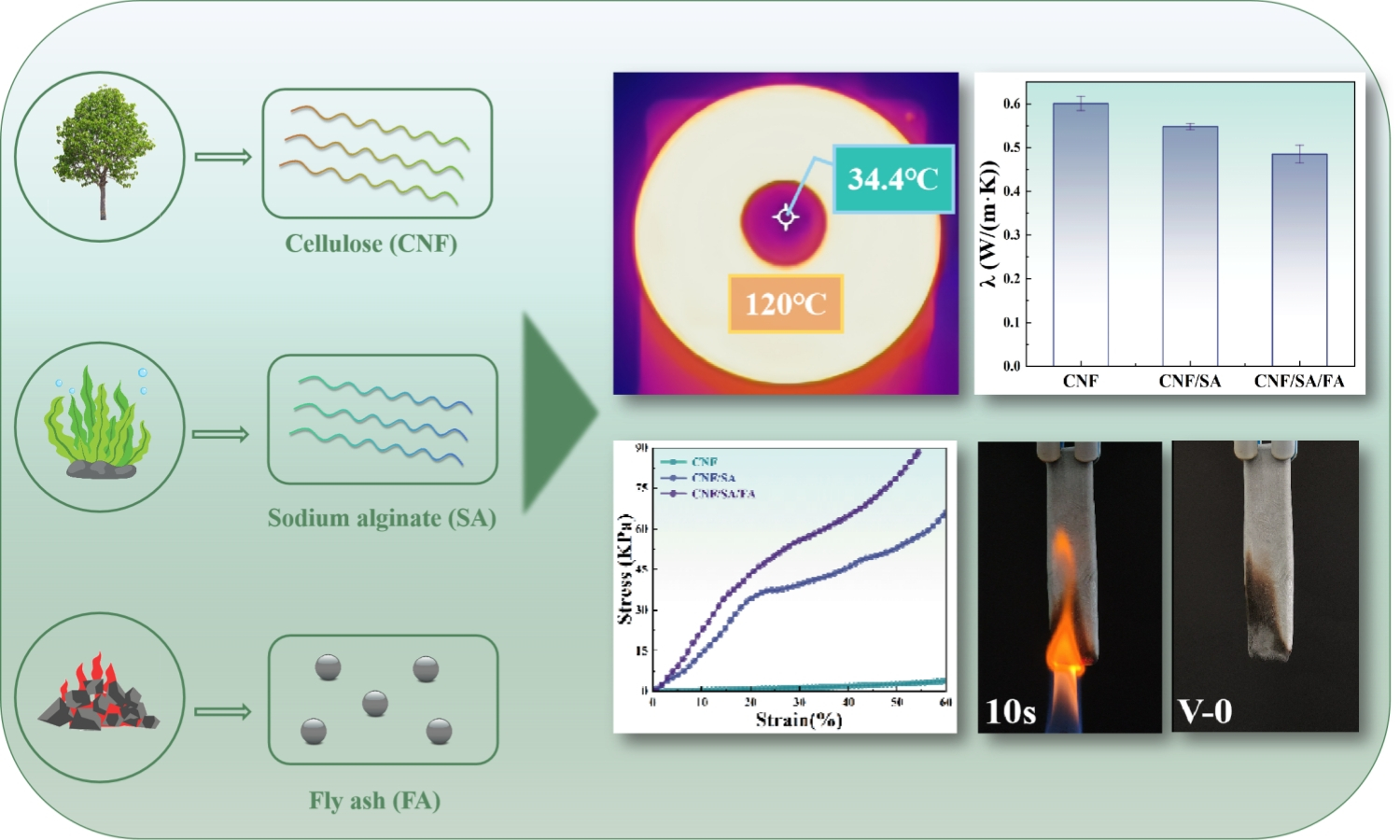
The widespread use of cellulose nanofiber (CNF)-based aerogels is hindered by their limited flame retardancy and mechanical properties. This study addresses these challenges by developing cellulose nanofiber/sodium alginate/fly ash (CNF/SA/FA) aerogel through a one-pot method, utilizing industrial waste fly ash (FA) as a reinforcing material. Various characterization and analytical techniques were employed to evaluate the properties of the CNF/SA/FA aerogel. The findings have revealed that resulting aerogel exhibited excellent thermal insulation performance, with a thermal conductivity of 0.485 W/(m·K), along with an impressive compressive strength of 88.4 kPa and favorable shape processability. Vertical combustion tests demonstrated a V-0 rating, indicating superior flame retardancy, and the aerogel achieved a remarkable 79.16% residual carbon, confirming their effective heat shielding capabilities. Notably, the incorporation of FA significantly enhanced both the thermal and mechanical properties of the composite aerogel, presenting a sustainable and effective solution to optimizing the properties of aerogel for thermal insulation.