
Asymmetric polyethersulfone membranes modified with polyelectrolyte complexes: Morphology, thermal analysis and transport properties
Rayane da Silva Vale , Vanessa Bezerra da Silva, Jonas Contiero, Daniel M. Knauss, Caio Marcio Paranhos
Vol. 18., No.3., Pages 245-259, 2024
DOI: 10.3144/expresspolymlett.2024.18
DOI: 10.3144/expresspolymlett.2024.18
Corresponding author: Rayane da Silva Vale 
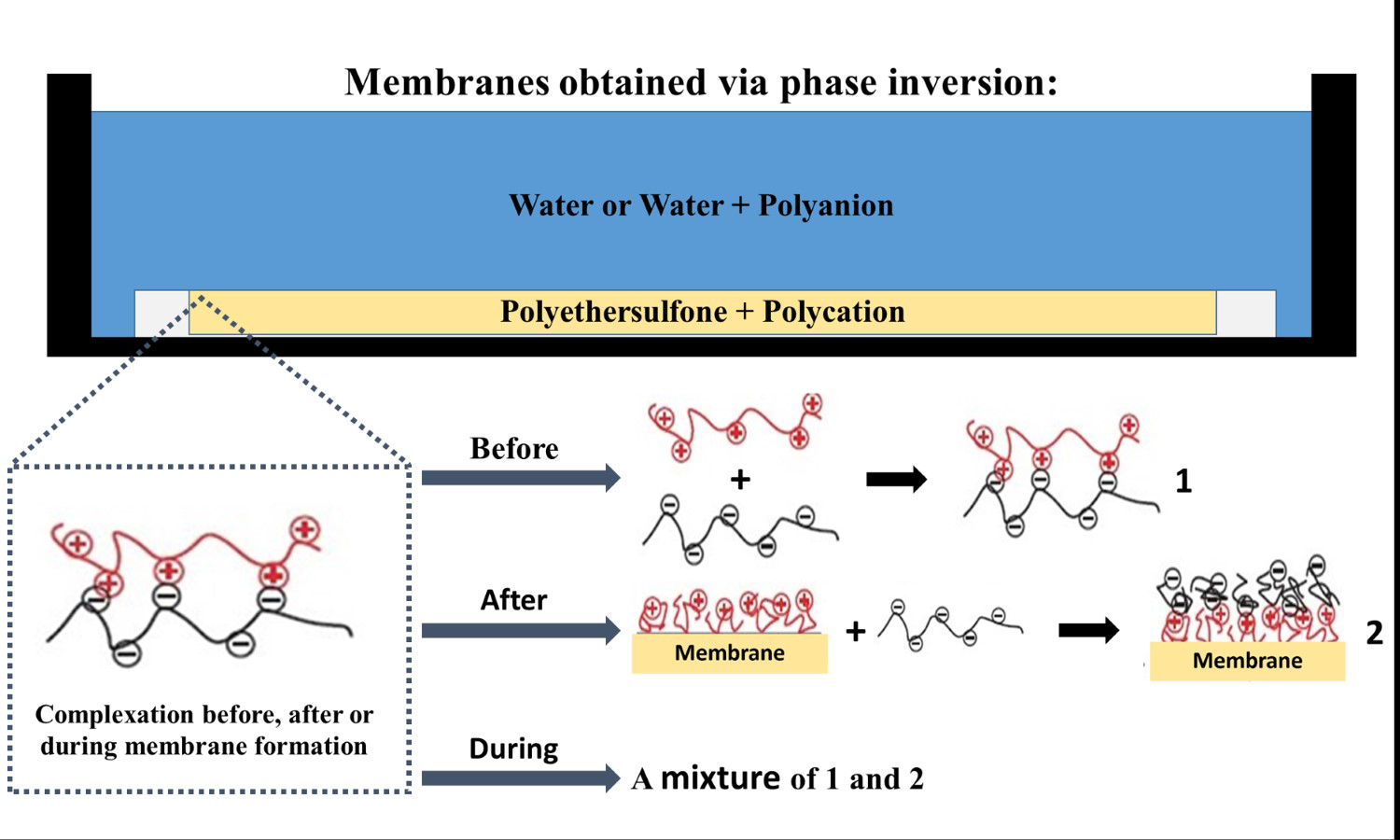
GRAPHICAL ABSTRACT
ABSTRACT
Mixing additives into a polymeric membrane constitutes an easy way to change their properties. Polyelectrolyte complexes (PECs) (polyelectrolytes combined via electrostatic interaction) are good materials for this due to their hydrophilicity, tunable surface charge, and stable structure. In the present study, membranes containing PECs were obtained using three methodologies: complexation before, after, and during membrane formation. The chosen polyelectrolytes were 4-fluorophenyl sulfone-terminated poly(diallylpiperidinium hexafluorophosphate) and sulfonated poly(ethylene terephthalate); the polymeric matrix was polyethersulfone. Fourier transform infrared spectroscopy confirmed the presence of PECs in the membranes. Scanning electron microscopy images of the membranes showed a dense skin and porous sub-layer, with variations in the thickness of the dense layer influenced by the presence of polyelectrolytes. The increase in water vapor permeability indicated that the complexes alter the hydrophilic profile of the membranes. The thermogravimetric curves showed different thermal behaviors depending on the interaction between the polyelectrolytes. All membranes demonstrated enhanced retention of Remazol red dye during filtration, with retention rates exceeding 95%. Notably, the Blend membrane exhibited the highest retention (over 98%) of the dye.
RELATED ARTICLES
Sofiane Bensadi, Mourad Amara, Omar Arous, Yassine Berbar, Fairouz Saad Saoud
Vol. 20., No.10., Pages 1017-1033, 2026
DOI: 10.3144/expresspolymlett.2026.75
Vol. 20., No.10., Pages 1017-1033, 2026
DOI: 10.3144/expresspolymlett.2026.75
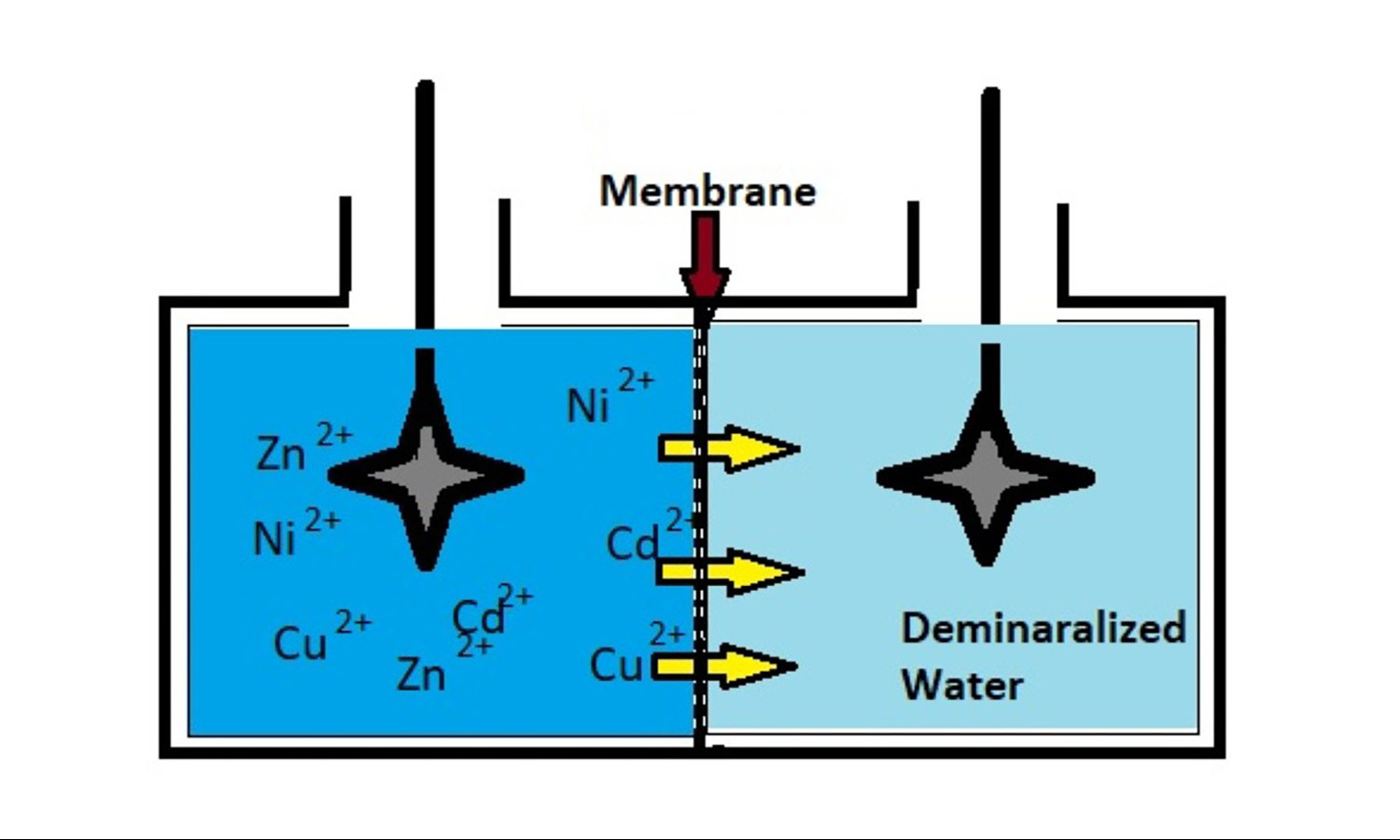
To prepare high-performance dialysis membranes, we investigated the effect of polyvinylpyrrolidone (PVP), polyethylene glycol (PEG), and also the simultaneous effect of both additives in cellulose triacetate (CTA) membranes. In this study, we investigate the transfer and fixation phenomena of Cu2+, Ni2+, Cd2+ and Zn2+ ions into dialysis membranes. We prepared three CTA-based membranes with different concentrations of the [PVP/(PVP+PEG)] ratio, and evaluated the impact of this ratio on membrane performance by dialysis with cationic solutions. All the membranes were characterized by Fouriertransform infrared spectroscopy (FTIR), thermogravimetric analyses (TGA) and scanning electron microscopy (SEM). The membrane with a higher [PVP/(PVP+PEG)] ratio exhibited superior transfer efficiency compared to the other membranes, 56.11 and 47.87% of Cd2+ and Cu2+, respectively. Significant amounts of metal ions were fixed by the membranes. Cu2+ and Zn2+ ions had fixation rates of 27.54 and 26.45%, respectively, obtained with a [PVP/(PVP+PEG)] ratio of 0.8. To explain the phenomenon of metal ion fixation by membranes, we performed a study of the behaviour of PVP in solutions in the presence of metallic ions using potentiometric methods. We found that interactions can form between PVP and metallic ions present in the solution in an order that follows the sequence: Cu2+ > Zn2+ > Ni2+ > Cd2+.