Environmental PET litter is a resource not to be wasted
Katalin Bocz , Ferenc Ronkay
, Ferenc RonkayVol. 19., No.9., Pages 860-861, 2025
DOI: 10.3144/expresspolymlett.2025.65
DOI: 10.3144/expresspolymlett.2025.65
Corresponding author: Katalin Bocz 
GRAPHICAL ABSTRACT
RELATED ARTICLES
Bokome Shaku, Reagan L. Mohlala, Kabelo B. Dilebo, Tshwafo E. Motaung
Vol. 20., No.9., Pages 905-922, 2026
DOI: 10.3144/expresspolymlett.2026.67
Vol. 20., No.9., Pages 905-922, 2026
DOI: 10.3144/expresspolymlett.2026.67
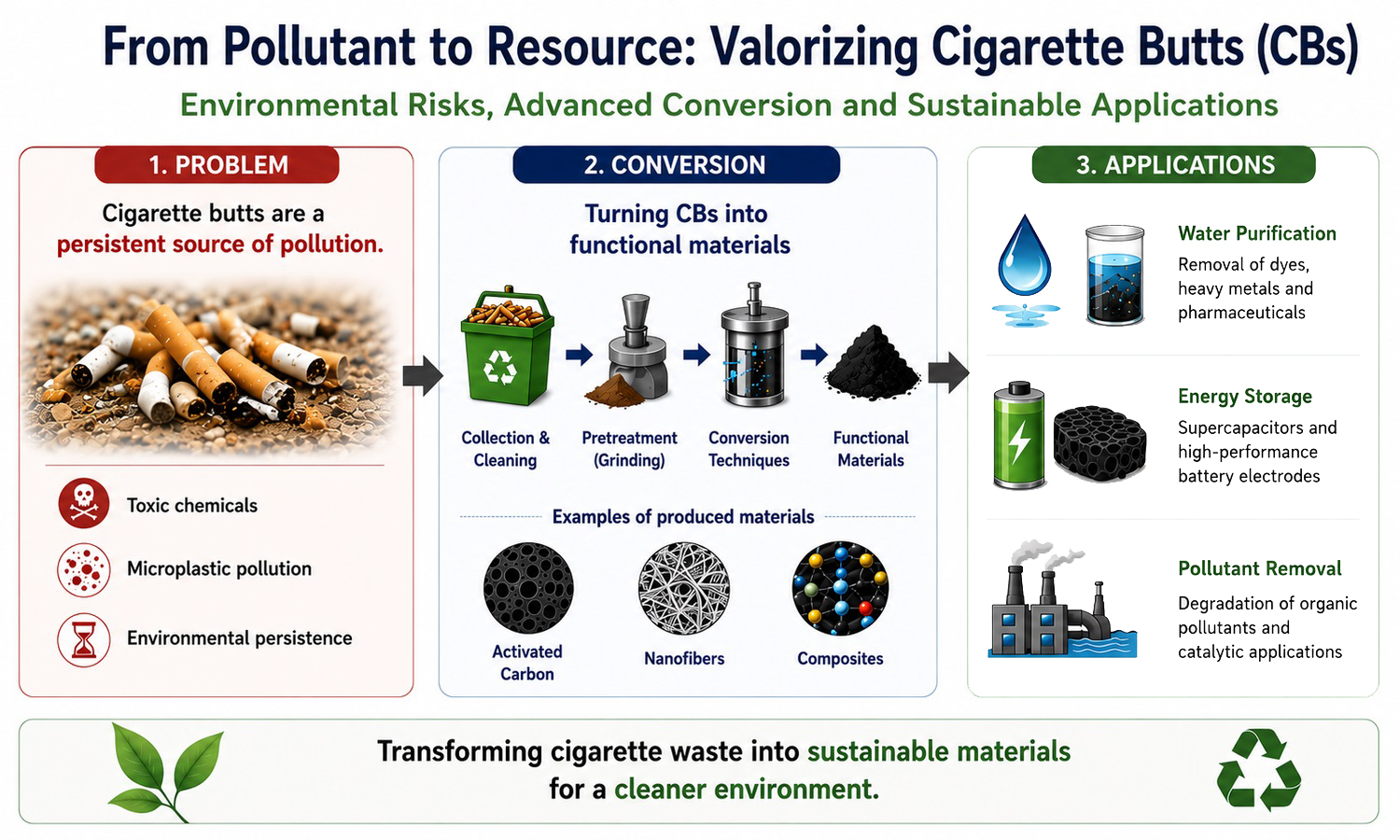
Cigarette butts (CBs) are among the most abundant forms of anthropogenic litter worldwide and constitute a persistent source of environmental contamination due to their slow degradation and the release of toxic substances into terrestrial and aquatic ecosystems. This review critically evaluates recent advances in the valorisation of CB waste into value-added functional materials. Particular attention is given to conversion strategies including chemical activation, electrospinning, hydrothermal processing, and nanocomposite fabrication. These approaches enable the production of activated carbons, cellulose-derived nanomaterials, and metal-doped composites with promising applications in water purification, energy storage, vector control, and pollutant remediation. The underlying mechanisms, performance, scalability, and sustainability of these technologies are discussed. Finally, current challenges, research gaps, and future opportunities of large-scale implementation are highlighted. Collectively, the findings demonstrate that CBs can be re-envisioned not only as a persistent environmental pollutant but also as valuable secondary resources that support circular economy and sustainable material development strategies.
Andrea Kohári, Tamás Bárány
Vol. 20., No.9., Pages 923-938, 2026
DOI: 10.3144/expresspolymlett.2026.68
Vol. 20., No.9., Pages 923-938, 2026
DOI: 10.3144/expresspolymlett.2026.68

The virgin polymer content of thermoplastic polyurethane (TPU) can be reduced with the use of recycled tire rubber, but blend properties strongly depend on the structure of the rubber phase. In this study, we compared TPU-based compounds containing ground tire rubber (GTR), devulcanized GTR (dGTR) and dynamically revulcanized dGTR in terms of mechanical and rheological behavior. GTR-filled blends showed higher tensile strength at the same rubber content, whereas dGTR-containing blends exhibited higher elongation at break up to 40 wt% rubber. Among the thermoplastic dynamic vulcanizates, peroxide-cured blends provided higher tensile strength, higher elongation at break and lower compression set than sulfur-cured blends. The rubber phase also strongly affected melt rheology: dGTR-containing blends showed higher storage modulus (G′) and complex viscosity (η*) than the corresponding GTR-filled blends over the entire frequency range. In contrast, there were only minor rheological differences between sulfur- and peroxide-cured systems, indicating that rubber content had a stronger effect on melt behavior than the curing system. The novelty of this study is the direct comparison of GTR, dGTR and dynamically revulcanized dGTR within the same TPU matrix, showing how the breakdown and partial rebuilding of the recycled rubber network can be used to tune both solid-state properties and melt processability in TPU compounds with high recycled content.
Joanna Smorawska-Kliza, Julia Habaj, Ewa Głowińska
Vol. 20., No.3., Pages 217-232, 2026
DOI: 10.3144/expresspolymlett.2026.18
Vol. 20., No.3., Pages 217-232, 2026
DOI: 10.3144/expresspolymlett.2026.18
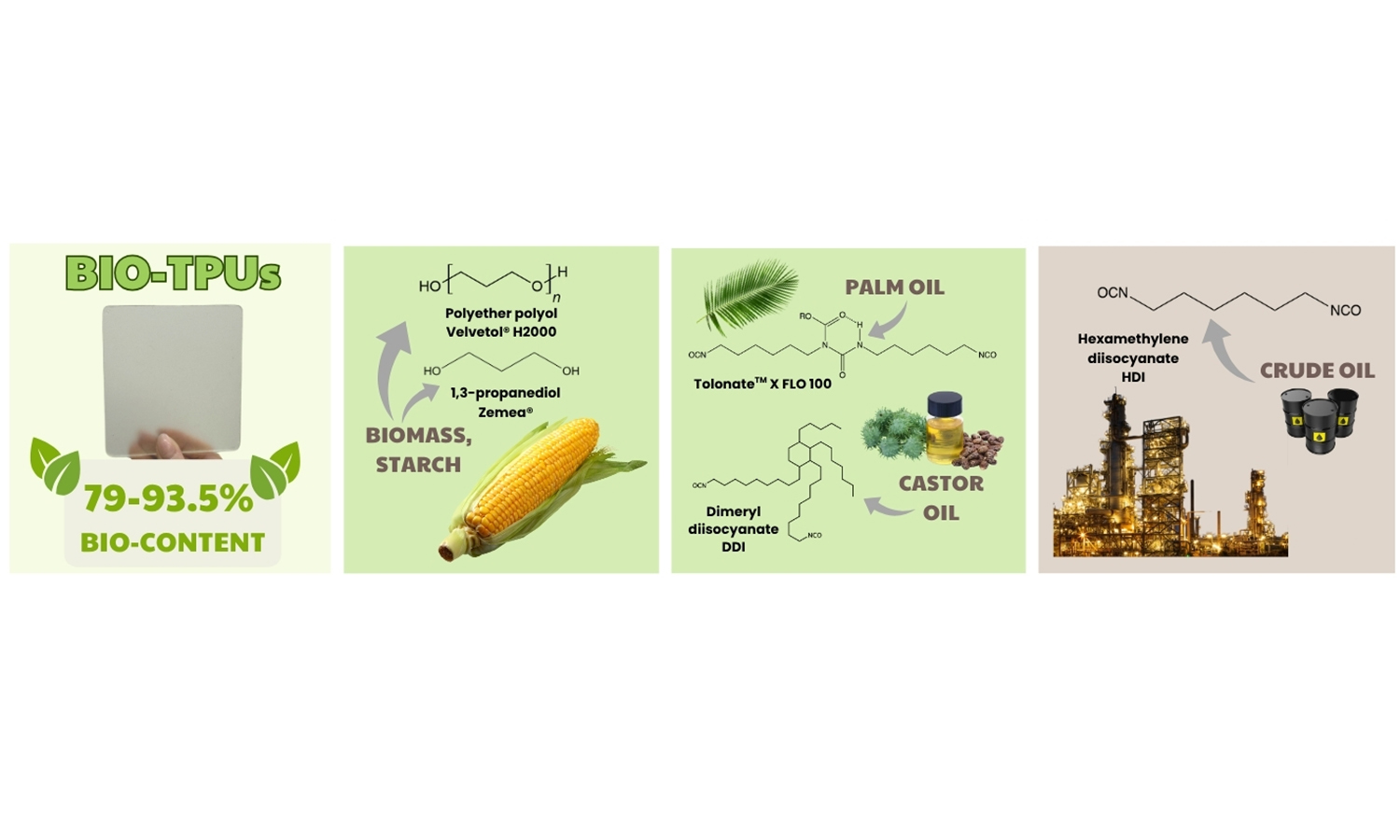
Modification of the hard segment structure in polyurethanes using isocyanate mixtures has emerged as one of the most effective strategies for developing new materials with enhanced properties and a high content of bio-based carbon. In this work, next-generation sustainable thermoplastic polyurethane elastomers (bio-TPUs) were synthesized using aliphatic isocyanate mixtures based on bio-derived diisocyanates Tolonate™ X FLO 100 and dimeryl diisocyanate (DDI) alongside hexamethylene diisocyanate (HDI). Poly(trimethylene ether) glycol (PO3G) and bio-based 1,3-propanediol served as renewable hydroxyl-terminated components. The bio-TPUs were prepared using the common ‘one-shot’ method. The resulting materials were analyzed to assess phase separation, morphology, as well as mechanical, thermal and thermomechanical properties. The results confirm the significant influence of the type of diisocyanate mixture on the properties of bio-TPU, improving their thermal stability (up to 300 °C) and reducing the melting temperature to 140 °C, which makes them suitable for low-temperature processing.
Sandra Paszkiewicz, Kamila Sałasińska, Zaida Ortega, Mateusz Barczewski, Jacek Andrzejewski, Konrad Walkowiak, Izabela Irska, Magdalena Jurczyk Kowalska, Anna Boczkowska, Marcin Borowicz, Joanna Paciorek-Sadowska, Elżbieta Piesowicz, Katarzyna Pokwicka-Croucher
Vol. 19., No.12., Pages 1286-1309, 2025
DOI: 10.3144/expresspolymlett.2025.95
Vol. 19., No.12., Pages 1286-1309, 2025
DOI: 10.3144/expresspolymlett.2025.95
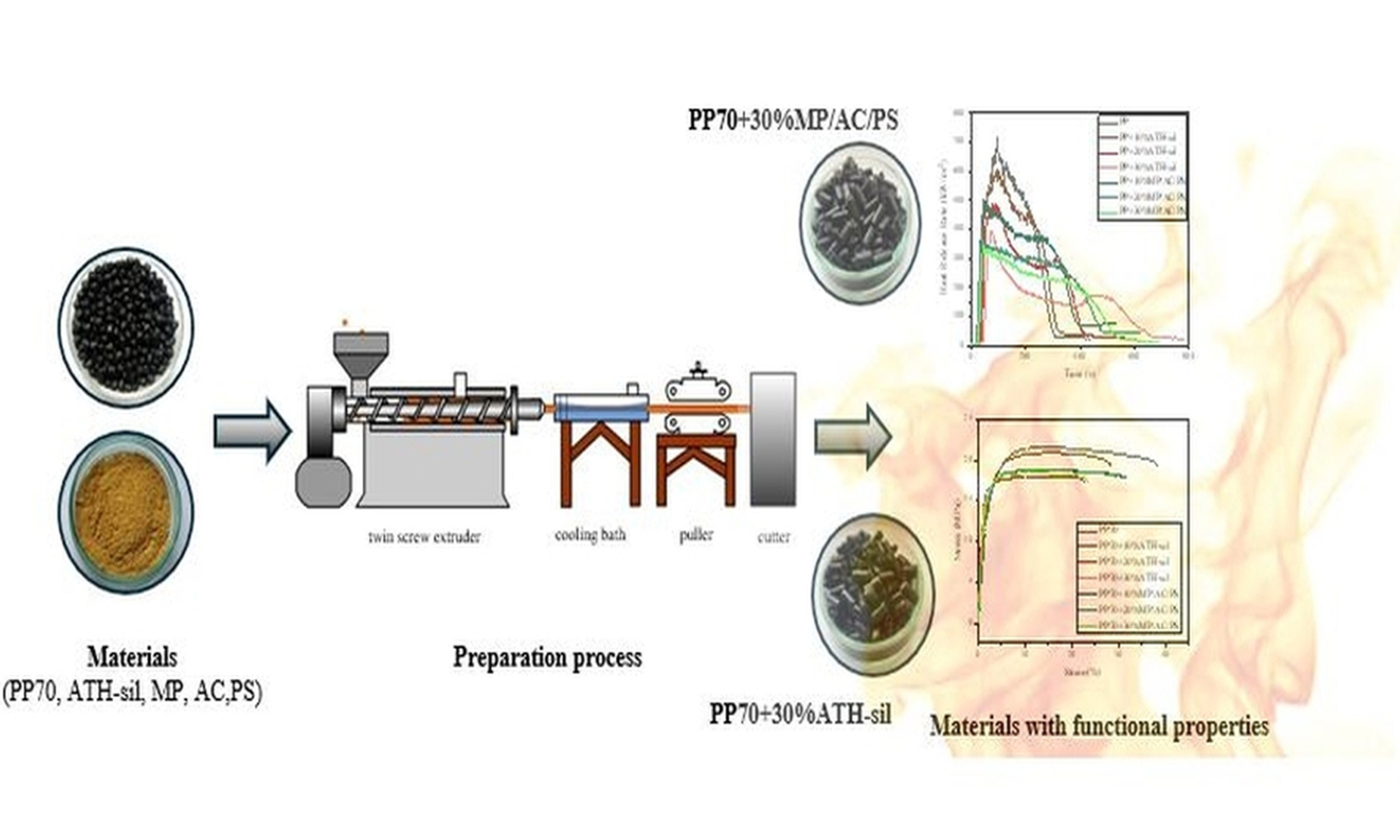
Two series of polymer blends based on post-consumer polypropylene (rPP) and tire rubber crumbs (Trc) under the trademark ECOPLASTOMER® PP70 with a mutual ratio of components 70/30 wt%, containing 10, 20, and 30 wt% of flame retardants, have been prepared using a twin-screw extruder. The influence of commercially available silane-treated alumina trihydrate (ATH-sil) with the eco-friendly system based on melamine phosphate (MP), aluminum hydroxide (AC), and peanut shells (PS), used as flame retardant agents, on the mechanical, thermal, and flammability properties of polymer blends was assessed – the incorporation of ATH-sil results in the appearance of peaks related to OH groups in the Fouriertransform infrared spectroscopy (FTIR) spectra. Similar observations are made for the MP/AC/PS system. differential scanning calorimetry (DSC) analysis revealed that using the selected flame retardants did not impact the melting and crystallization temperatures of the polymer. Tensile strength experienced a minor decrease, particularly in compositions containing more than 20 wt% of the flame retardants, while hardness remained unaffected by their share. Both flame retardants reduced the flammability of the modified polypropylene/rubber powder blends, and the most favorable outcomes were achieved with ATH-sil; however, only when employed at a minimum of 30 wt%. The formulated MP/AC/PS system proved more adept at reducing flammability and smoke emissions at lower flame retardant levels (up to 20 wt%).
Dániel Gere, Tamás Bárány
Vol. 19., No.6., Pages 554-555, 2025
DOI: 10.3144/expresspolymlett.2025.41
Vol. 19., No.6., Pages 554-555, 2025
DOI: 10.3144/expresspolymlett.2025.41
This is an editorial article. It has no abstract.