Safe and sustainable-by-design: Redefining polymer engineering for a greener future
Andrea Toldy
Vol. 19., No.4., Pages 350-350, 2025
DOI: 10.3144/expresspolymlett.2025.25
DOI: 10.3144/expresspolymlett.2025.25
Corresponding author: Andrea Toldy 
GRAPHICAL ABSTRACT
RELATED ARTICLES
Maja Csapó, József Gábor Kovács
Vol. 20., No.4., Pages 414-434, 2026
DOI: 10.3144/expresspolymlett.2026.32
Vol. 20., No.4., Pages 414-434, 2026
DOI: 10.3144/expresspolymlett.2026.32
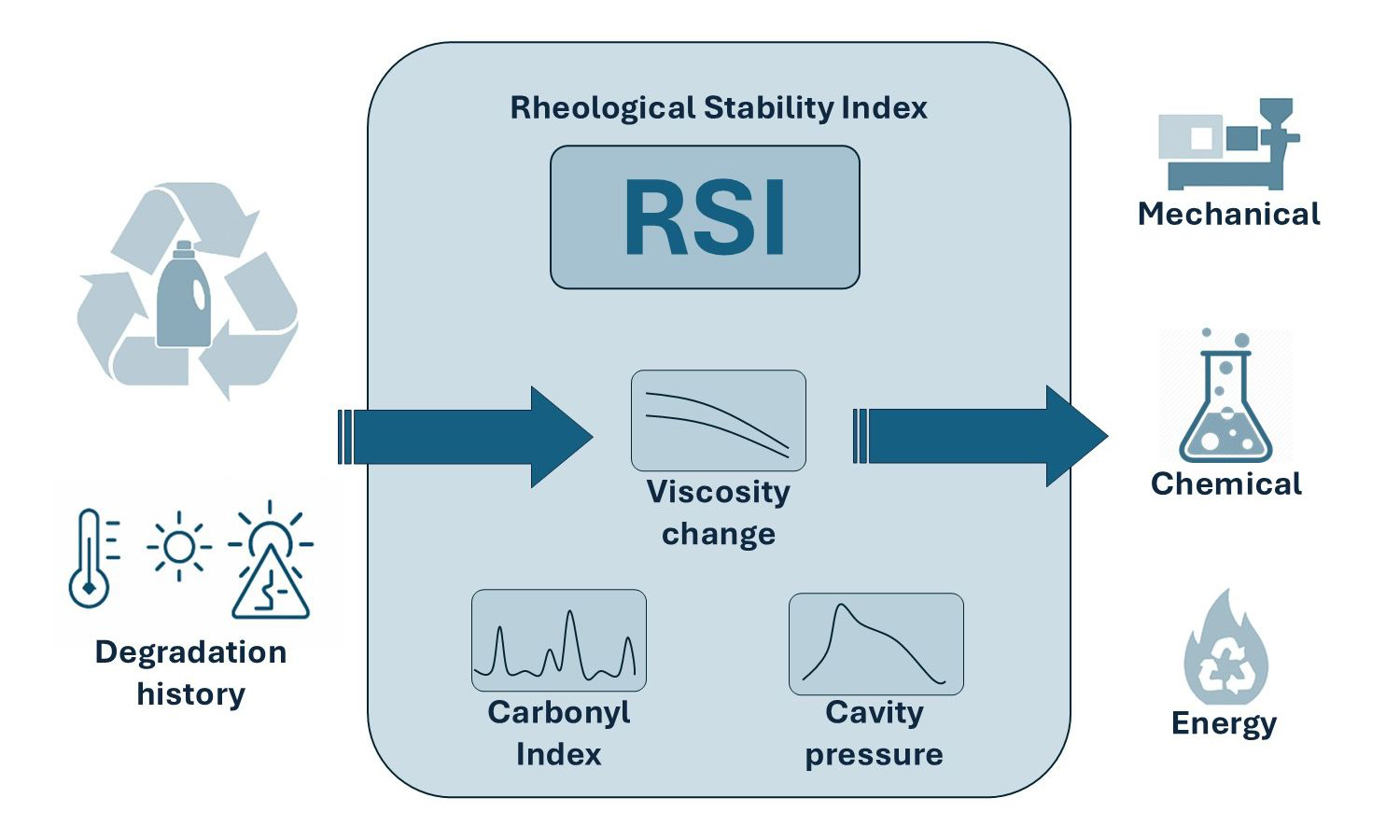
The greatest obstacle to recycling post-consumer high-density polyethylene (PCR-HDPE) is typically the degradation of properties caused by impurities and heterogeneity. However, a critical analysis of the literature reveals that the real bottleneck is not the material composition, but rather rheological stability, which simultaneously determines the degradation history of the waste stream, melt behavior, and processability at the cycle level. This review proposes a new perspective: the decision among mechanical, chemical, and energetic recycling is better made based on a unified rheological stability index (RSI), which integrates carbonyl index, viscosity change after multiple instances of melting, melt flow index (MFI) instability, in-mold pressure fluctuation, and the degree of polymer incompatibility. RSI enables the prediction of the processability of PCR-HDPE and identifies which recycling path a fraction is most suitable for. The study demonstrates how an RSI-based approach can reduce quality risk, improve cycle stability, and support circular decision-making in an industrial environment.
Katalin Bocz, Ferenc Ronkay
Vol. 19., No.9., Pages 860-861, 2025
DOI: 10.3144/expresspolymlett.2025.65
Vol. 19., No.9., Pages 860-861, 2025
DOI: 10.3144/expresspolymlett.2025.65
This is an editorial article. It has no abstract.
Dániel Gere, Tamás Bárány
Vol. 19., No.6., Pages 554-555, 2025
DOI: 10.3144/expresspolymlett.2025.41
Vol. 19., No.6., Pages 554-555, 2025
DOI: 10.3144/expresspolymlett.2025.41
This is an editorial article. It has no abstract.
Zaheer ul Haq, Teng Ren, Xinyan Yue, Krzysztof Formela, Denis Rodrigue, Xavier Colom Fajula, Tony McNally, Dong Dawei, Yong Zhang, Shifeng Wang
Vol. 19., No.3., Pages 258-293, 2025
DOI: 10.3144/expresspolymlett.2025.20
Vol. 19., No.3., Pages 258-293, 2025
DOI: 10.3144/expresspolymlett.2025.20
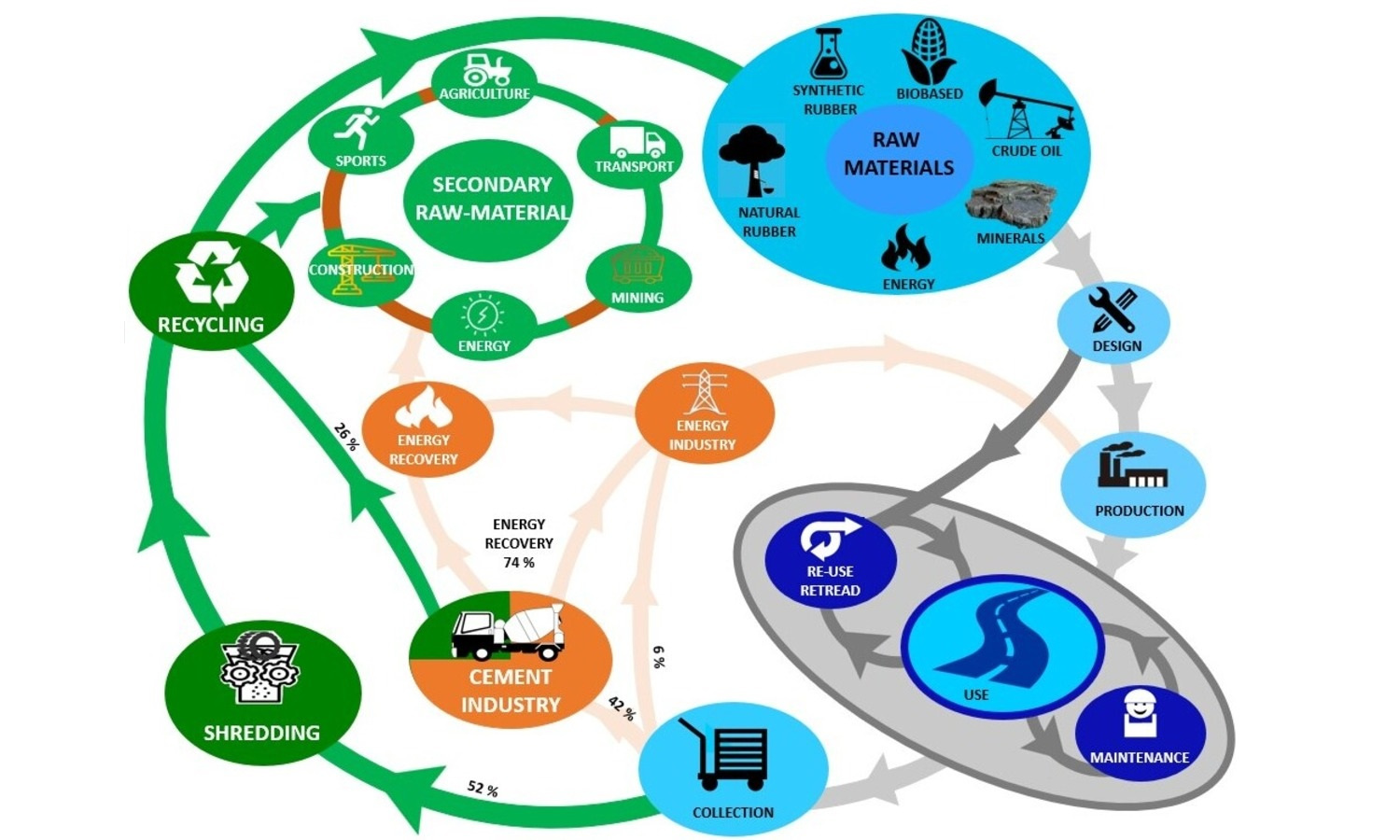
As a complex composite material, tire rubber has always presented significant environmental and waste management concerns due to its non-biodegradability and accumulation in landfills. The devulcanization of tire rubber has emerged as a historical challenge in the field of sustainable rubber engineering since Goodyear invented cross-linking in 1839. This review provides a comprehensive analysis of waste tire recycling processes, focusing on the sources, legislation, management strategies, and utilization across different regions. It explores the multifaceted challenges of devulcanizing rubber, with a specific focus on transitioning from ground tire rubber to the concept of multi-decrosslinking: sulfur bridge breakage, rubber chain depolymerization and micro-nano sized core-shell carbon black. Ideal devulcanization has restricted the release of reinforcing fillers, resulting in devulcanized rubber mainly containing dozens of micron particles, which hinder the wide usage of devulcanized rubber. This review comprehensively assesses the current state-of-the-art techniques for tire rubber devulcanization, including physical, chemical and biological methods. It explores the intricacies of ground tire rubber as a starting material, structural evolution of ground tire rubber during the devulcanization process and the associated challenges in achieving efficient devulcanization while retaining desirable mechanical properties. Furthermore, through an in-depth analysis of recent advancements, limitations and prospects, this paper offers a complete understanding of the challenges faced in tire rubber devulcanization. Considering the technical and environmental aspects of these processes, this work contributes to multi-decrosslinking, the ongoing discourse on sustainable materials development and circular economy initiatives, which pave the way for future innovations in the field of rubber recycling.
Wenxin Gan, Hanyu Xue, Hongyi Lin, Renjin Gao, Yuchi Zhang, Liwei Wang, Jiuping Rao
Vol. 19., No.3., Pages 311-325, 2025
DOI: 10.3144/expresspolymlett.2025.22
Vol. 19., No.3., Pages 311-325, 2025
DOI: 10.3144/expresspolymlett.2025.22
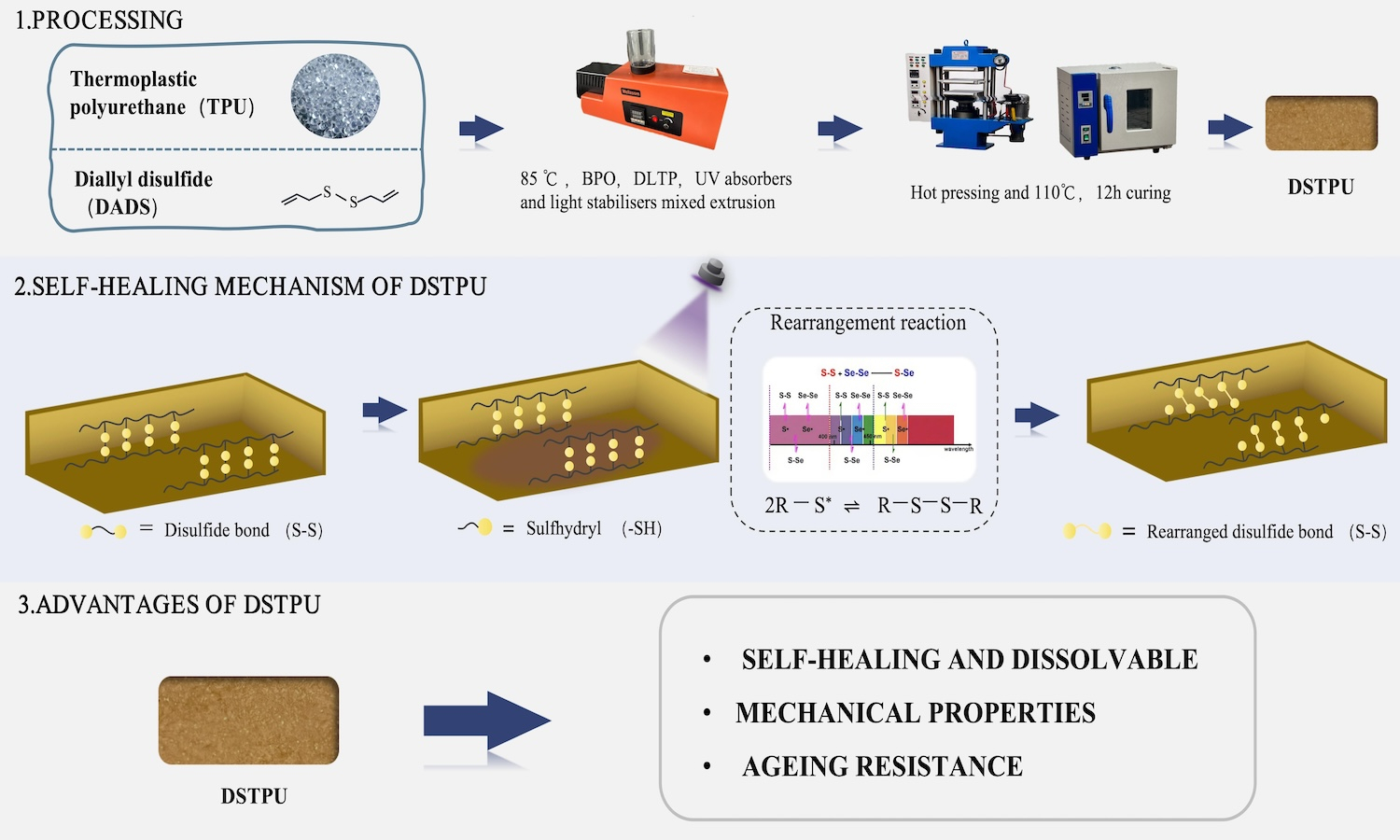
Cross-linking frequently enhanced the mechanical properties of linear polymeric materials; however, it also resulted in the transition from thermoplastic to thermosetting materials, which posed issues from an environmental perspective. Thermoplastic polyurethane (TPU) elastomers were extensively applied across various industries. To improve the mechanical properties of TPU while preserving its environmental benefits, this study integrated radical copolymerization technology to develop a reversible crosslinked TPU. Specifically, the linear polyurethane molecular chains were crosslinked using diallyl disulfide (DADS) as a functional cross-linking monomer. Through radical copolymerization reactions, reversible crosslinks formed from disulfide bonds were created between the linear polyurethane molecular chains, yielding a self-healing reversible crosslinked thermoplastic polyurethane (DSTPU). The study showed that DSTPU could self-heal and dissolve under UV light and alkaline N,N-dimethylformamide (DMF) conditions, achieving 82.2% self-healing efficiency at 3 phr DADS. It dissolved into fine particles in alkaline DMF. Disulfide bonds in DSTPU enhanced cross-linking, boosting 19% oxygen permeability, thermal conductivity (0.218 W/(m·K)), and mechanical properties like tensile stress (11.18 MPa), force (134.13 N), and elongation (548%). These bonds also enhanced aging resistance, cutting ΔYI to 6.0%.