
Hybrid effect on the mechanical properties of ramie/coir fiber–reinforced high-impact polypropylene
Gunawan Refiadi , Steven, Riza Wirawan, Hermawan Judawisastra
Vol. 20., No.10., Pages 1034-1052, 2026
DOI: 10.3144/expresspolymlett.2026.76
DOI: 10.3144/expresspolymlett.2026.76
Corresponding author: Riza Wirawan 
GRAPHICAL ABSTRACT
ABSTRACT
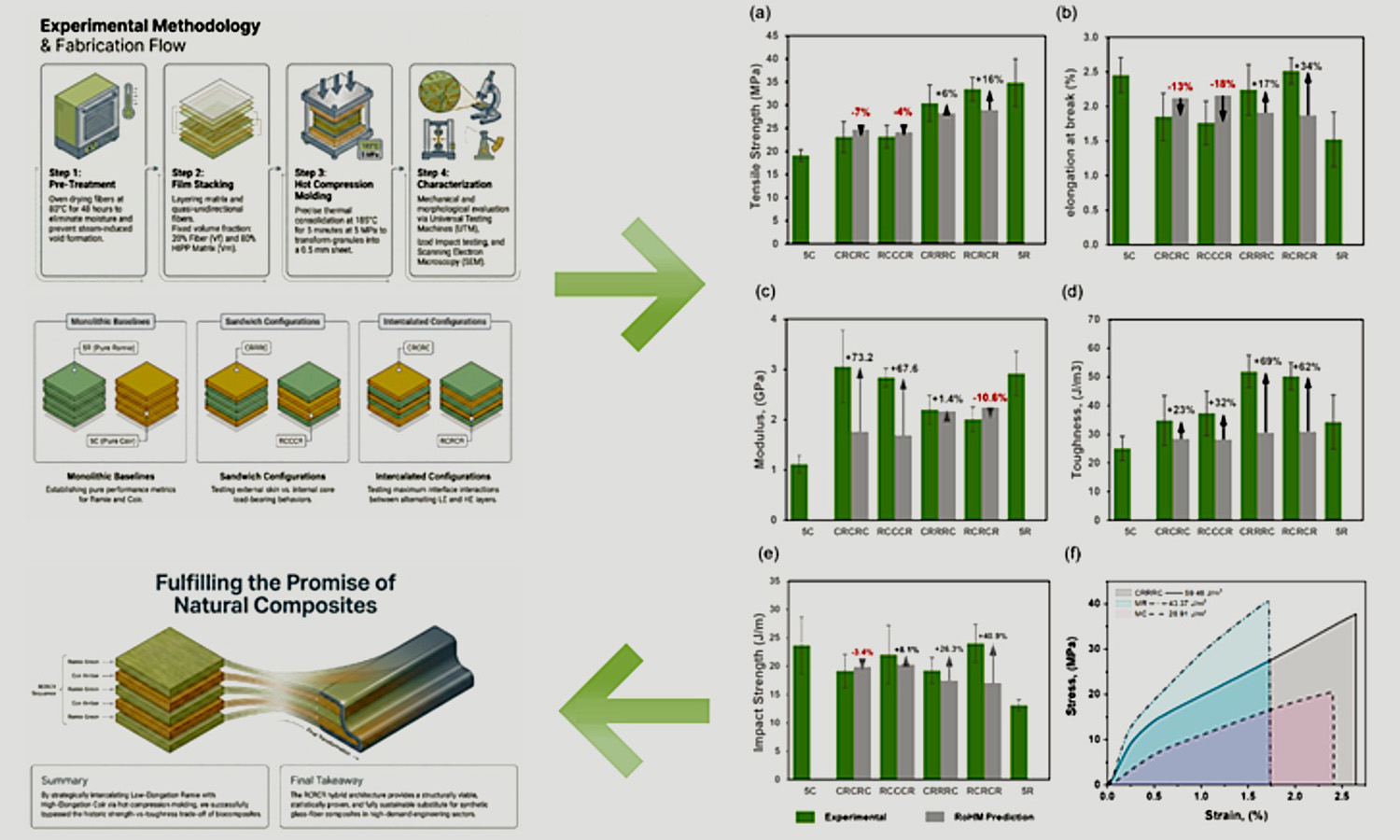
Natural fiber–reinforced thermoplastic composites offer ecological benefits but suffer from low impact resistance. We hybridized an untreated ramie (R)/coir (C) fiber–reinforced high-impact polypropylene matrix using a hot press to enhance toughness and impact strength through the adjustment of hybrid ratios and stacking sequences. The best hybrid architecture is the combination of a higher ratio of ramie-to-coir fibers and LE-intercalate configuration. The RCRCR produced a positive hybrid effect due to the synergistic load transfer between the low- and high-elongation (LE/HE) quasi-unidirectional fiber layers. The respective positive hybrid effect in tensile strength, strain to failure, toughness (for all hybrid configurations) and impact strength of RCRCR are 16, 34, 62 and 41% higher in comparison with the rule of hybrid mixtures (RoHM). These results were also validated by Tukey’s Honestly Significant Difference (HSD). Tukey’s HSD post-hoc analysis statistically validates these homogeneous subsets (p < 0.05). Consequently, tailoring the untreated ramie/coir hybrid architecture provides a balanced mechanical profile engineered for lightweight structural and light energy-absorbing engineering applications.
RELATED ARTICLES
Minghao Chen, Bin Wang, Sisi Wang, Xiping Li
Vol. 20., No.6., Pages 617-628, 2026
DOI: 10.3144/expresspolymlett.2026.46
Vol. 20., No.6., Pages 617-628, 2026
DOI: 10.3144/expresspolymlett.2026.46
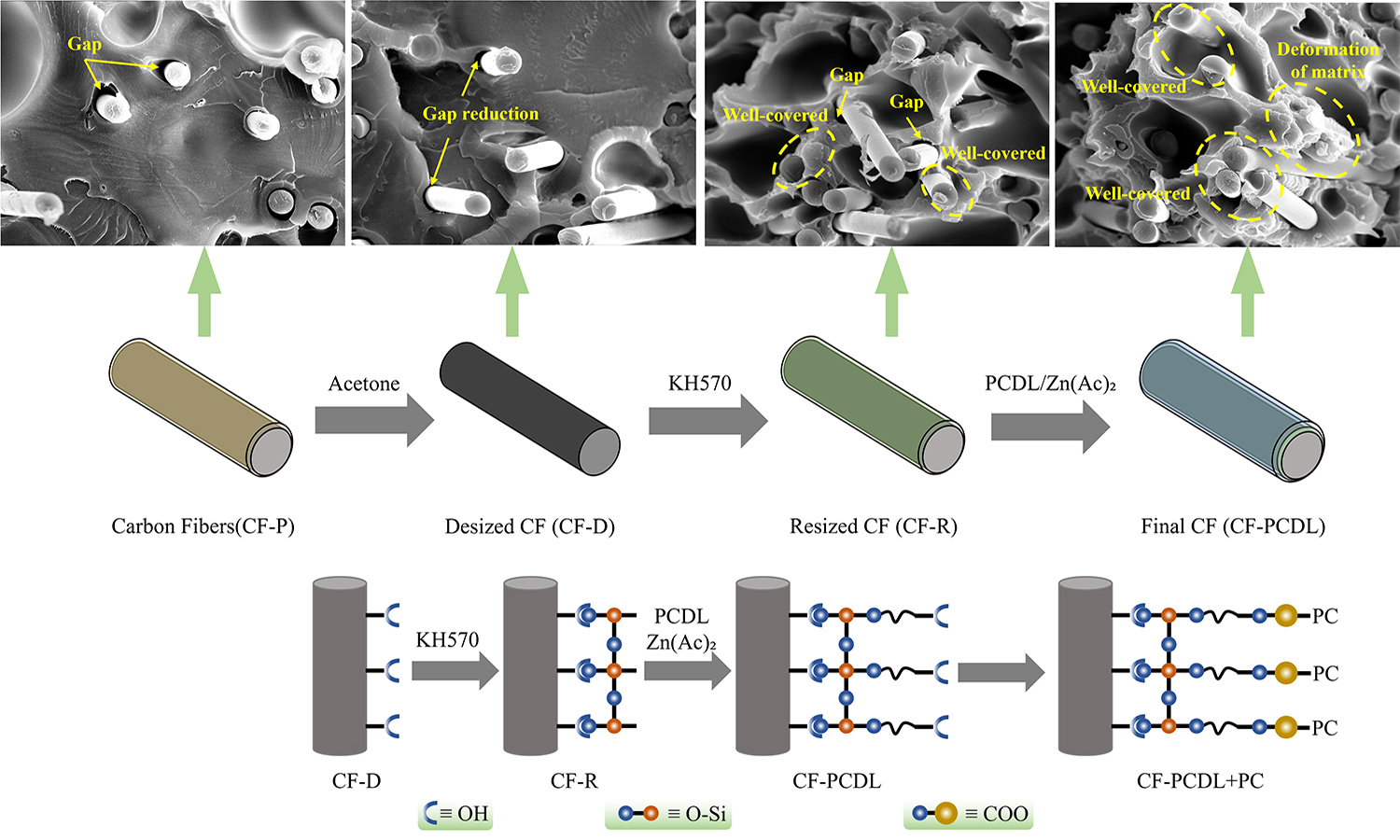
Enhancing the interfacial bonding performance between carbon fibers (CF) and thermoplastic resins is extensively researched. In this study, we propose a novel method for the synergistic surface modification of carbon fibers using a silane coupling agent and poly-carbonate diol (PCDL), which significantly improves the interfacial compatibility between CF and polycarbonate (PC). Scanning electron microscopy (SEM), Fourier-transform infrared spectroscopy (FTIR), and X-ray photoelectron spectroscopy (XPS) confirmed the successful grafting of silane onto the surface of CF and subsequent PCDL sizing. Mechanical characterization showed that the modified carbon fiber composites exhibited a 47.3% increase in interlaminar shear strength (ILSS) relative to the unmodified system. Notably, with a loading of 10 wt%, the modified fibers improved the tensile strength, flexural strength, and notched impact toughness by 36.2, 38.5, and 39.6%, respectively. The impact fracture surfaces exhibited typical characteristics of ductile fracture, with a dense and gap-free interfacial layer forming between the fiber and the matrix, indicating that the efficiency of stress transfer was effectively enhanced. The findings of this study are expected to provide a valuable technical reference for the fabrication of carbon fiber–reinforced thermoplastic composites.
Rebeka Lorber, Janez Slapnik, Borut Černe, Andreas Hausberger, Jan Sumfleth
Vol. 19., No.10., Pages 1073-1089, 2025
DOI: 10.3144/expresspolymlett.2025.80
Vol. 19., No.10., Pages 1073-1089, 2025
DOI: 10.3144/expresspolymlett.2025.80
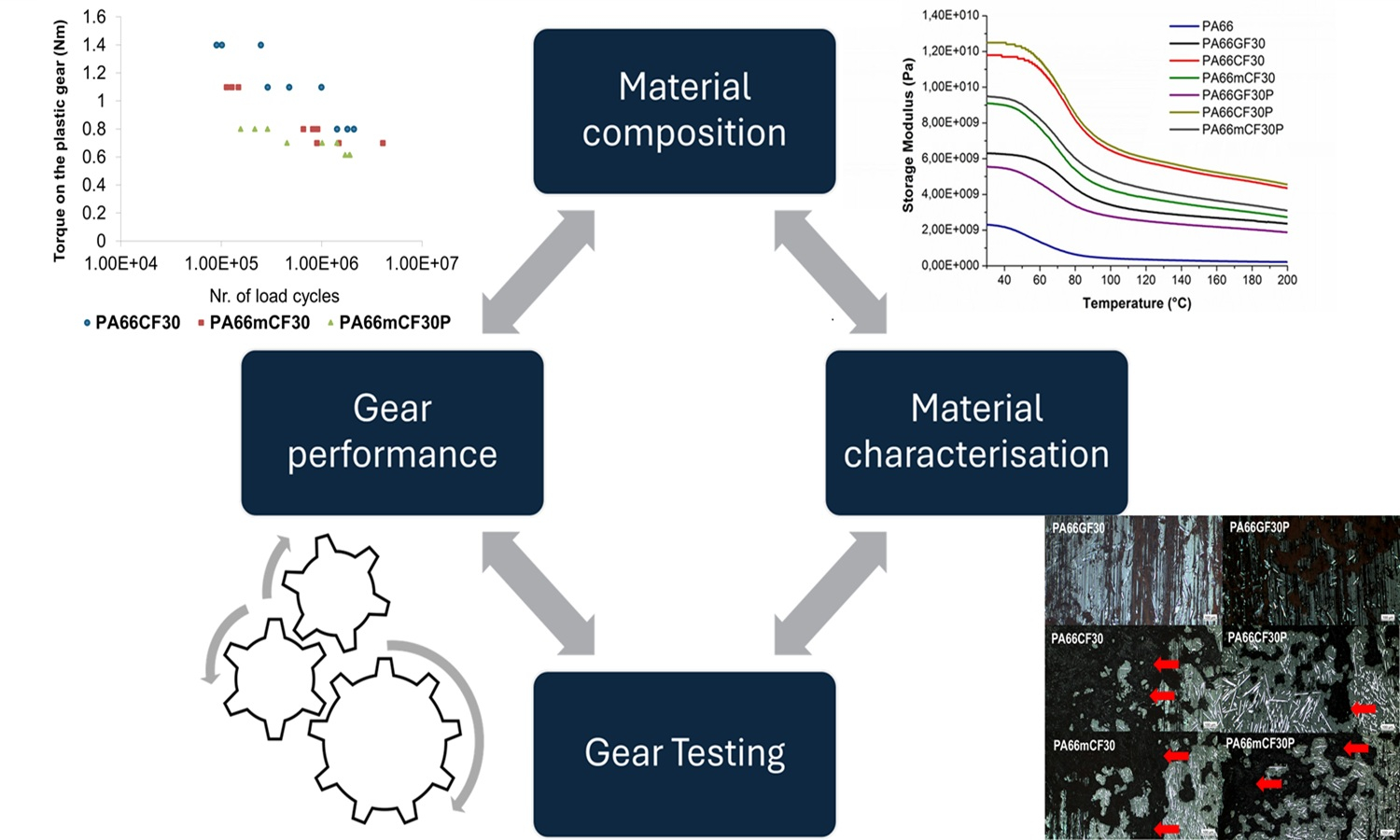
The study investigates the use of repurposed milled carbon fibre (mCF) as reinforcement for polyamide 66 (PA66) in gear applications, addressing environmental and cost concerns of virgin carbon fibres. Neat PA66 and PA66 composites reinforced with mCF, glass fibres (GF), and carbon fibres (CF), with and without polytetrafluoroethylene (PTFE), were injection moulded and evaluated for microstructure (fibre length), thermal, mechanical, surface, and tribological properties, as well as gear performance under VDI 2736 guidelines. CF reinforced composites showed the highest modulus and tensile strength, followed by mCF and GF. PTFE reduced modulus and strength in binary composites. All reinforced composites significantly lowered the coefficient of friction (COF) and wear rate compared to neat PA66, with mCF showing the most notable improvements. PTFE slightly improved tribological performance only for GF (wear) and CF (COF) composites. In gear testing, binary composites outperformed neat PA66, with CF performing best, followed by mCF and GF. Ternary composites had slightly lower performance than their binary equivalents. Correlation analysis showed that gear performance is closely linked to structural integrity. Failure analysis revealed higher crack susceptibility in mCF reinforced gears due to shorter fibre length. The findings highlight mCF reinforced PA66 as a sustainable, cost-effective material for durable polymer gears.
Magali Castres, Aboulghit El Malki Alaoui, Camille Caisso, Martin Monloubou, Michel Arrigoni
Vol. 18., No.10., Pages 1008-1022, 2024
DOI: 10.3144/expresspolymlett.2024.77
Vol. 18., No.10., Pages 1008-1022, 2024
DOI: 10.3144/expresspolymlett.2024.77

Nowadays, ultra high molecular weight polyethylene (UHMWPE), allows the combination of lightweight, high strength and is praised for the design of severely loaded structures. It has become a good option for lightweight armour solutions. It is therefore important to characterise its mechanical behaviour. Up to now, strain rate effects on mechanical behaviour have been poorly explored. In this work, this issue is tackled by studying the strain rate influence on the in-plane deformation, in shear and tension of the Tensylon® HSBD30A, a UHMWPE dedicated to ballistic and blast protection. Two laminates of Tensylon® of respective orientation [0 °/90°]20 and [±45°]20 were subjected to static and split Hopkinson tensile bar (SHTB) tests. A new mounting system was designed, and new specimen shapes were used to match the experimental setup configurations. Digital image correlation (DIC) was used to measure the in-plane strain. A significant strain-rate dependence on the material behaviour.is evidenced. Besides, results exhibit a higher strength for the [0°/90°]20 specimen than for the [±45°]20 one. Despite some limitations, the proposed setup and measurement methods allowed visualisation of strain rate effects on the stress-strain relationship for strain rates ranging from the quasi-static regime to the dynamic one (1500 s–1).