
Effect of synergistic interaction between pyrolytic carbon black and graphene oxide on the mechanical and electrical conductivity of rubber composites
Kaituo Fang, Junxiu Xue , Yu Wang, Yongming Zhang, Gang Yan, Li Li
, Yu Wang, Yongming Zhang, Gang Yan, Li LiVol. 20., No.7., Pages 687-697, 2026
DOI: 10.3144/expresspolymlett.2026.52
DOI: 10.3144/expresspolymlett.2026.52
Corresponding author: Junxiu Xue 
GRAPHICAL ABSTRACT
ABSTRACT
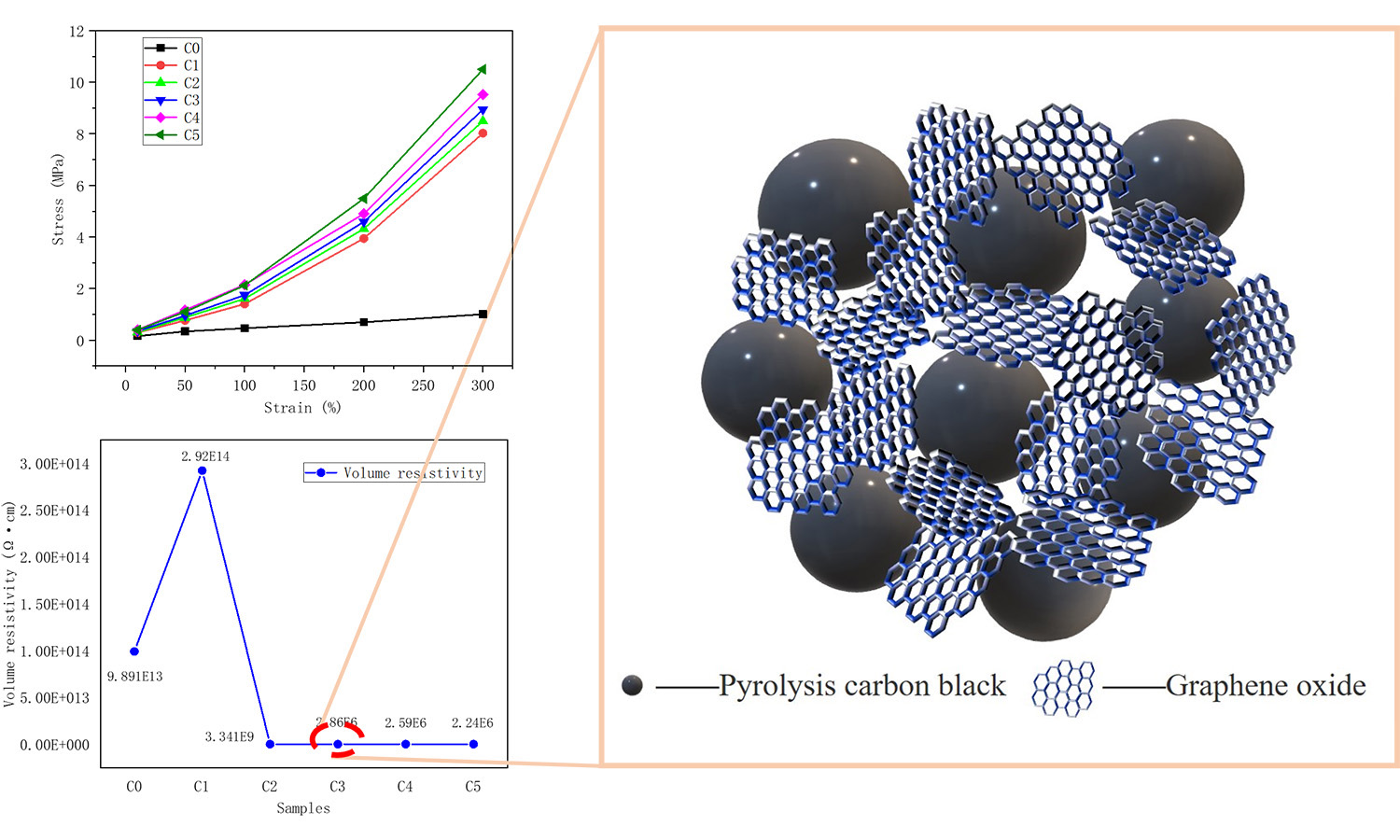
Pyrolytic carbon black (CBp) and graphene oxide (GO) are commonly used to reinforce polymer matrices; however, their tendency to agglomerate limits composite performance. Conventional dual filler systems are frequently costly and challenging to scale. We exploited synergistic CBp-GO interactions to suppress agglomeration and establish a stable filler network, thereby improving the mechanical and electrical properties of natural rubber (NR) composites. Composites were prepared by blending CBp (40 phr) with GO at 0–8 phr. Filler dispersion was characterized by scanning electron microscopy and a carbon black dispersibility tester. Mechanical, vulcanization, and electrical properties were measured. At an optimal CBp/GO ratio of 40:4, a continuous filler network formed, reducing volume resistivity by eight orders of magnitude relative to CBp-only composites and by three orders relative to composites containing 2 phr GO. The 300% modulus increased by 18.3%, and the electrical percolation threshold decreased by 22%. Excess GO (>4 phr) induced agglomeration and reduced tensile strength by 16.4%. A key innovation is the use of CBp in constructing a low-cost multi-filler system that suppresses GO agglomeration without chemical modification. This approach provides a sustainable route to producing highperformance rubber composites and promotes the recycling of waste rubber.
RELATED ARTICLES
Roland Petrény, Ádám Bezerédi, László Mészáros
Vol. 18., No.7., Pages 673-674, 2024
DOI: 10.3144/expresspolymlett.2024.49
Vol. 18., No.7., Pages 673-674, 2024
DOI: 10.3144/expresspolymlett.2024.49

This is an editorial article. It has no abstract.