
Effects of talc particle size on the non-isothermal crystallization kinetics and activation energy of isotactic polypropylene-based composites
Djamel Frihi, Mounir Gaci, Azzeddine Gharsallah, Ali Louaer, Hamid Satha , Abdelheq Layachi
, Abdelheq LayachiVol. 20., No.5., Pages 531-546, 2026
DOI: 10.3144/expresspolymlett.2026.40
DOI: 10.3144/expresspolymlett.2026.40
Corresponding author: Abdelheq Layachi 
GRAPHICAL ABSTRACT
ABSTRACT
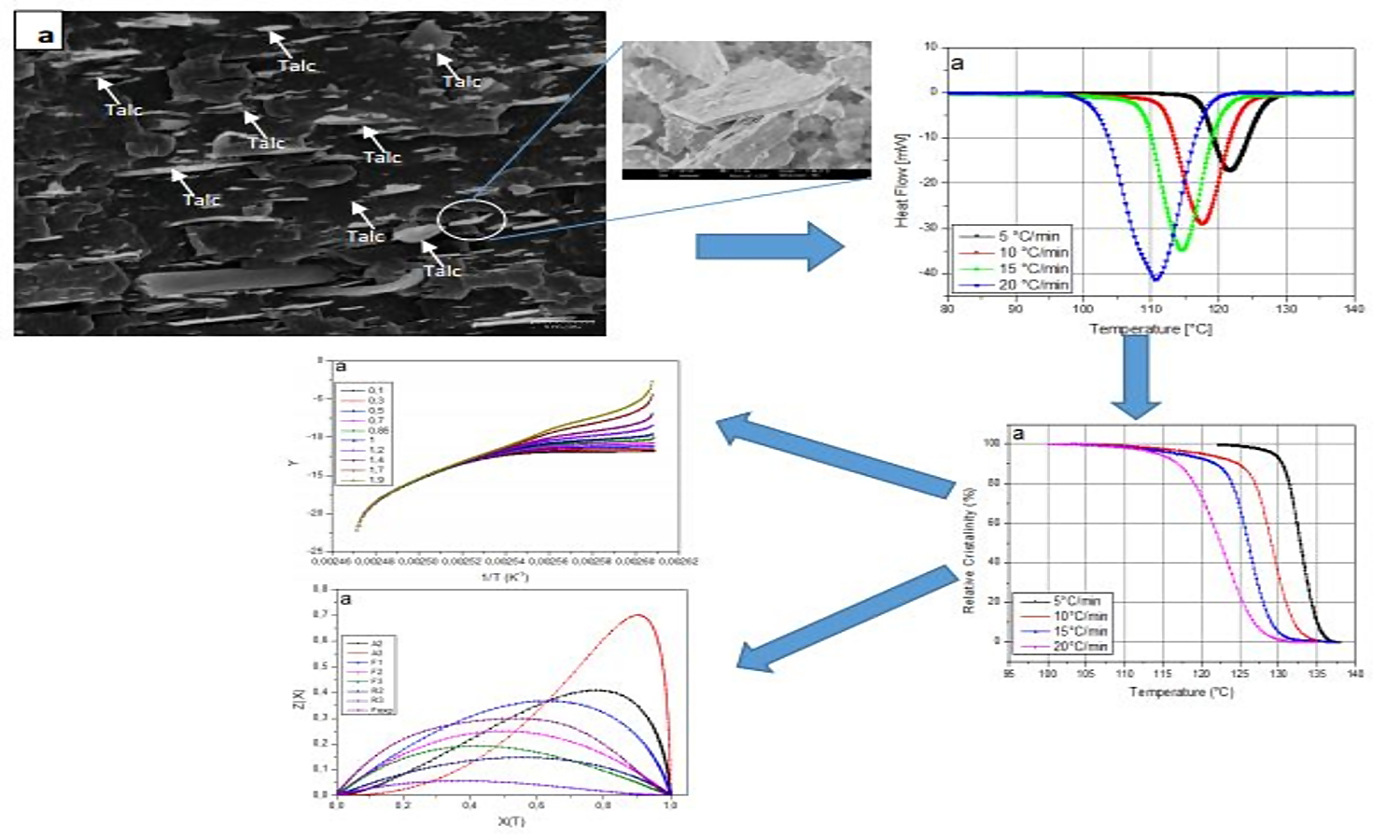
This study investigates the non-isothermal crystallization behavior of isotactic polypropylene (iPP) reinforced with two types of talc fillers: micrometric talc (μ-talc) and standard talc (S-talc). Composites containing 20 wt% filler were analyzed using differential scanning calorimetry (DSC), wide-angle X-ray scattering (WAXS), and scanning electron microscopy (SEM). Non-isothermal crystallization at cooling rates β = 5–20°C/min was evaluated using the Ozawa, Kissinger, Coats-Redfern, and Criado methods. Both μ-talc and S-talc act as efficient nucleating agents compared with neat iPP, but they operate through distinct mechanisms. μ-talc, owing to its finer particle size and higher surface area, increases the number of nucleation sites, thereby reducing the half-crystallization time (t1/2) and accelerating the crystallization kinetics. By contrast, S-talc, despite its lower surface area, enhances crystallization by virtue of its lamellar morphology, which promotes selective chain orientation, raises the crystallization temperature (Tc), and stabilizes secondary crystallization. Kinetic analysis confirmed this distinction: the activation energy (Ea) increased from neat iPP (≈185 kJ/mol) to μ-talc/iPP (≈215 kJ/mol) and further to S-talc/iPP (≈274 kJ/mol). The Coats-Redfern and Criado analyses consistently identified a second-order (F2) mechanism for the S-talc composites across all cooling rates, underscoring their stabilizing role in crystallization.
RELATED ARTICLES
Hamza Qayyum, Borhen Louhichi, Malik Hassan, Babar Ashfaq, Muhammad Sulaiman, Muhammad Bilal Khan, Nashmi H. Alrasheedi, Ghulam Hussain
Vol. 19., No.11., Pages 1173-1187, 2025
DOI: 10.3144/expresspolymlett.2025.86
Vol. 19., No.11., Pages 1173-1187, 2025
DOI: 10.3144/expresspolymlett.2025.86
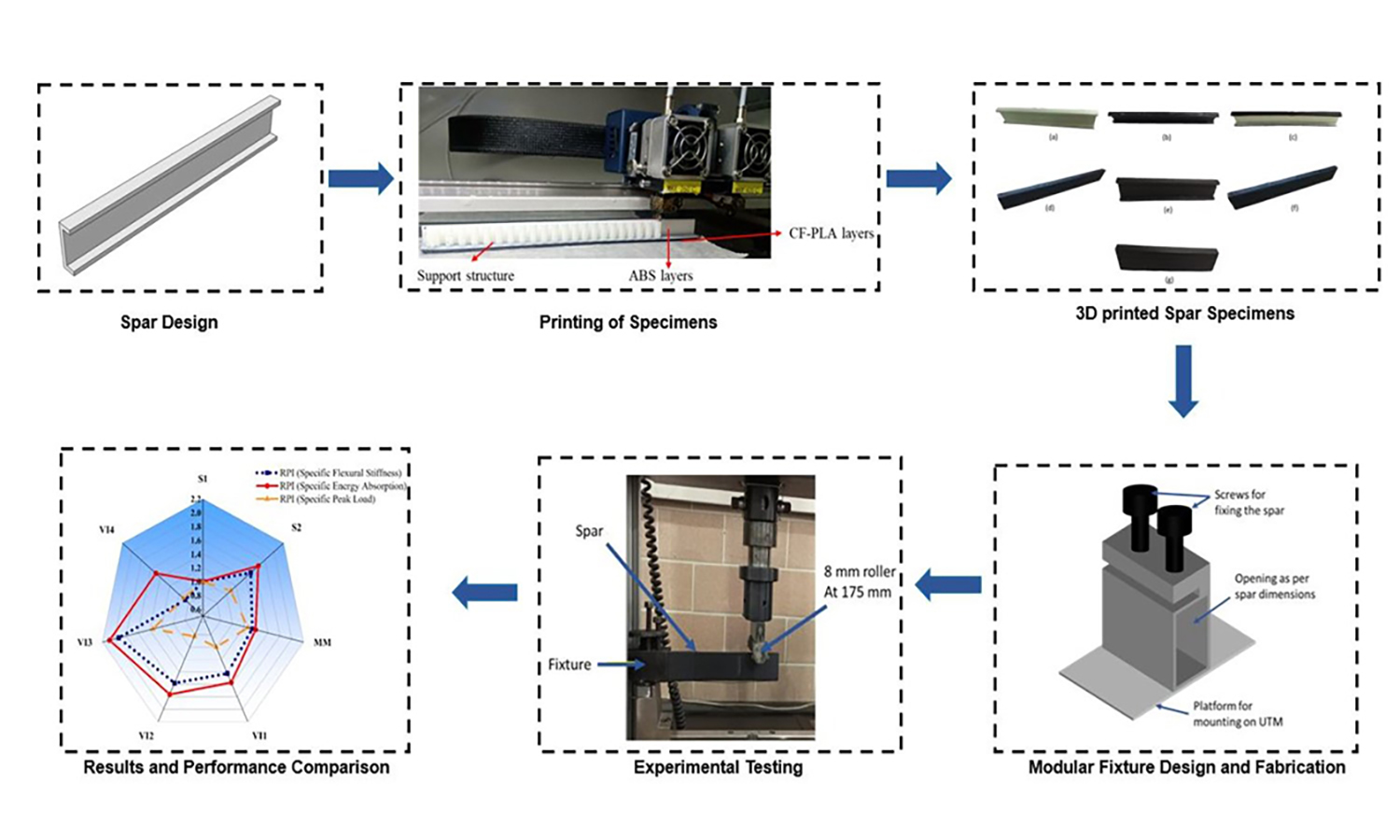
To reduce fuel consumption and extend flight time, the aerospace industry has focused on lightweight design. Achieving this without compromising structural integrity has been challenging. However, innovative additive manufacturing offers new opportunities for practical solutions. This study presents two methods: multi-material additive manufacturing (MMAM) and variable infill density additive manufacturing (VIDAM), aimed at reducing structural weight while maintaining mechanical performance. These methods were applied to a wing spar, a test geometry based on stress distribution principles from laminated beam mechanics. The structures produced with these new approaches showed improved mechanical responses compared to those made with traditional additive manufacturing techniques. A maximum increase of 91% in load-carrying capacity and a 34.8% increase in specific energy absorption were observed. scanning electron microscopy analysis revealed that layer bonding and material diffusion greatly influenced the mechanical performance. Although the study was conducted on small-scale models, the design concepts can be adapted to large-scale industrial applications that benefit from lightweight structures, such as the aerospace and automotive.
Joanna Szymańska, Wojciech H. Bednarek, Włodzimierz Urbaniak, Paweł Brzęk, Dominik Paukszta
Vol. 19., No.9., Pages 946-958, 2025
DOI: 10.3144/expresspolymlett.2025.71
Vol. 19., No.9., Pages 946-958, 2025
DOI: 10.3144/expresspolymlett.2025.71
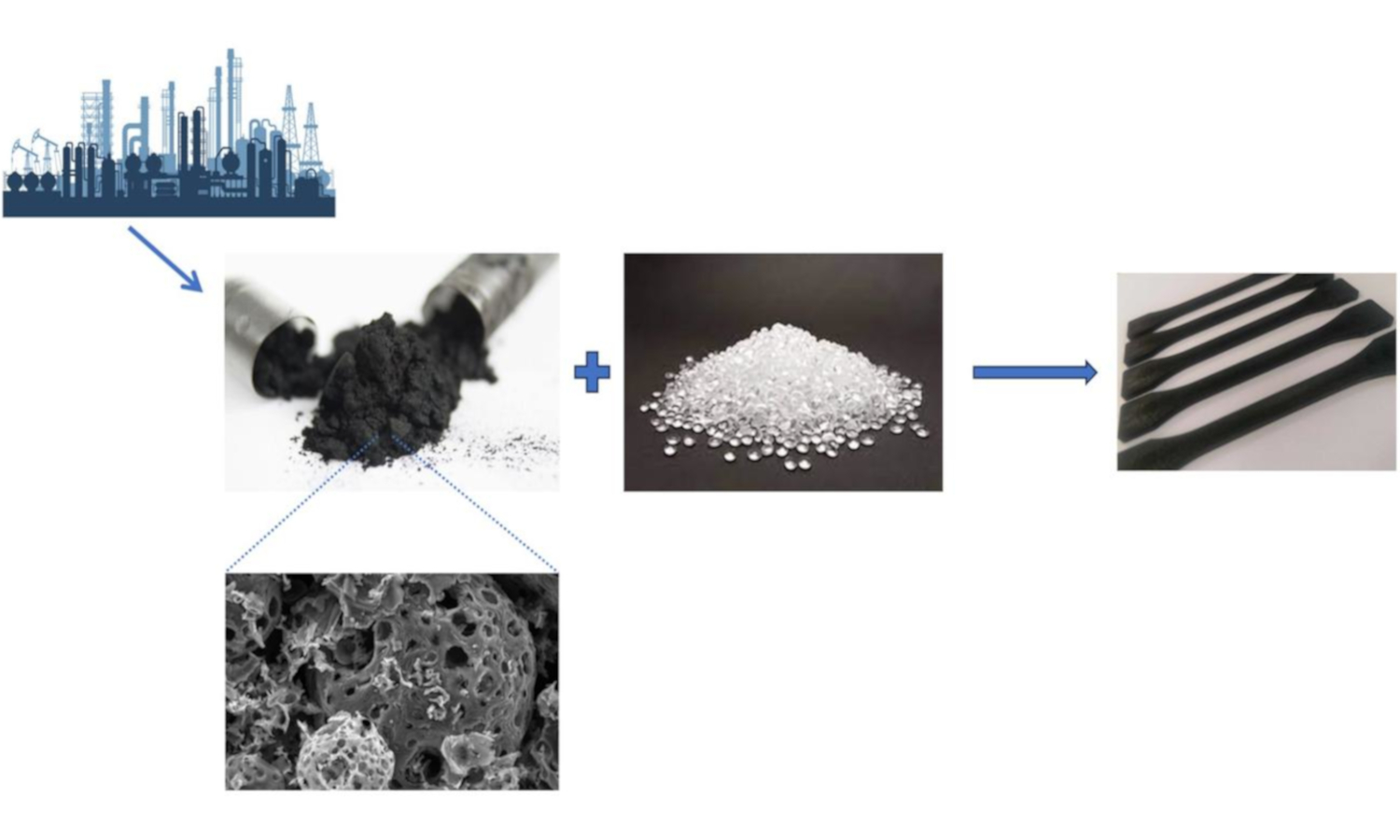
Crude oil, a natural hydrocarbon mixture, is a key energy source and the petrochemical industry’s primary feedstock. Its large-scale processing produces heavy oil fly ash (HOFA), a solid waste that demands effective management. This study explores HOFA’s valorization as a low-cost, carbon-based filler in isotactic polypropylene (iPP) composites. Composites containing 1–20 wt% HOFA were prepared by extrusion and injection molding, then subjected to tensile, impact, and structural analyses (differential scanning calorimetry (DSC), wide angle X-ray scattering (WAXS), microscopy). Mechanical testing revealed that even small HOFA additions raised Young’s modulus proportionately to filler content, consistent with typical filled-polymer behavior. Impact strength increased by roughly 25% at both 1 and 20 wt% loadings, while tensile strength and elongation at break remained comparable to neat iPP. DSC and WAXS demonstrated that HOFA acts as a nucleating agent, promoting the β-crystalline phase, known to enhance toughness, without significantly altering the melting or crystallization temperatures.
These findings confirm that HOFA, a waste by-product, can be an effective filler for iPP, improving stiffness and impact resistance without compromising other key properties. Its use offers both economic advantages, through reduced material costs, and environmental benefits by diverting industrial waste from disposal. This approach holds promise for developing sustainable, high-performance polymer composites.
These findings confirm that HOFA, a waste by-product, can be an effective filler for iPP, improving stiffness and impact resistance without compromising other key properties. Its use offers both economic advantages, through reduced material costs, and environmental benefits by diverting industrial waste from disposal. This approach holds promise for developing sustainable, high-performance polymer composites.