
The temptation of golden lies: Does Artificial Intelligence elevate or erode science?
József Gábor Kovács , Tibor Czigány
, Tibor CzigányVol. 19., No.3., Pages 230-232, 2025
DOI: 10.3144/expresspolymlett.2025.17
DOI: 10.3144/expresspolymlett.2025.17
Corresponding author: Tibor Czigány 
GRAPHICAL ABSTRACT
RELATED ARTICLES
Effect of natural cinnamon extract on the stabilizing properties of biodegradable packaging polymers
Anna Kosmalska-Olańska, Anna Masek
Vol. 20., No.1., Pages 52-71, 2026
DOI: 10.3144/expresspolymlett.2026.5
Vol. 20., No.1., Pages 52-71, 2026
DOI: 10.3144/expresspolymlett.2026.5
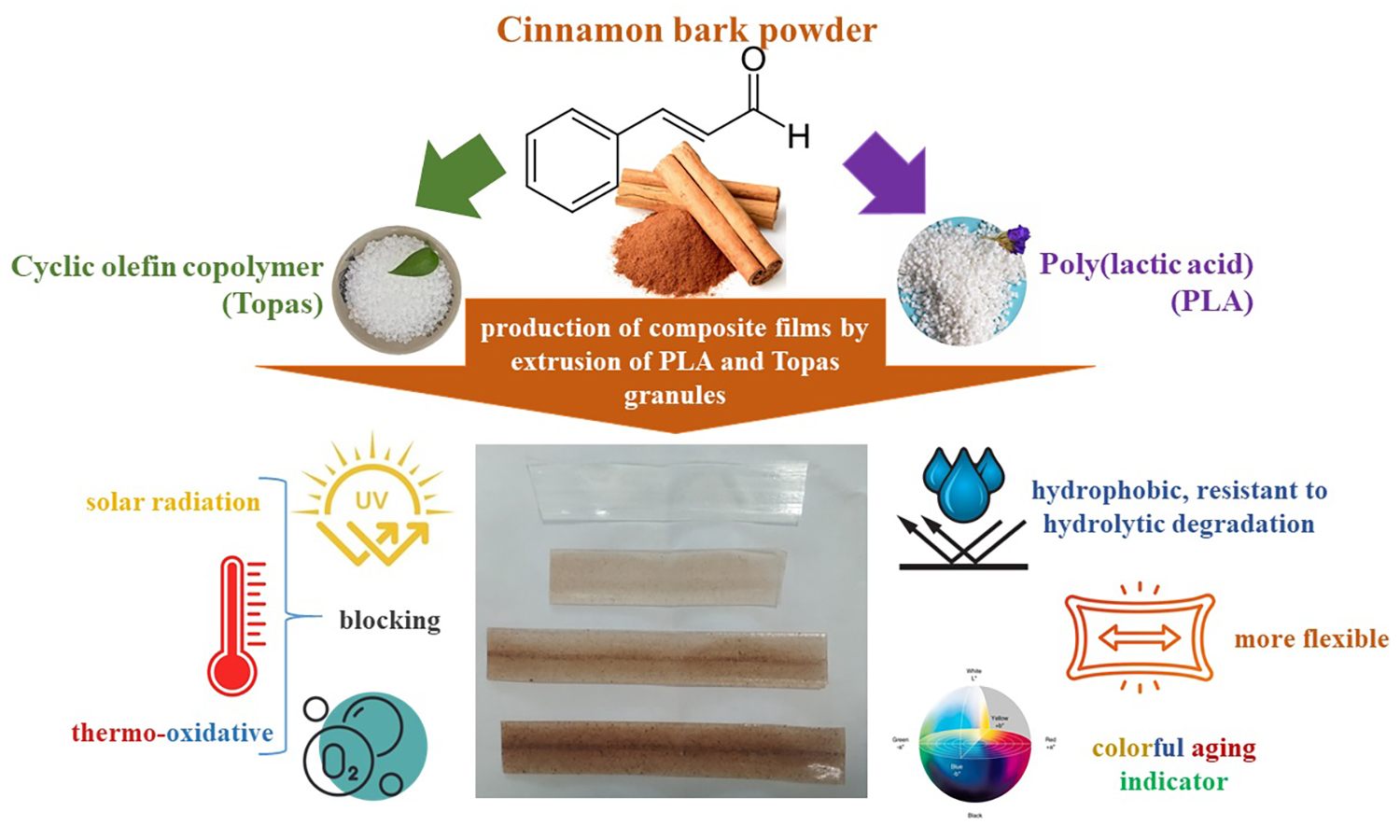
The growing focus on sustainability, eco-friendly technologies, decarbonization, and reducing carbon footprints shapes current industry challenges. This article reviews the potential of cinnamon as a bio-additive for polymer stabilization in packaging. Samples were prepared from ethylene-norbornene copolymer (Topas), a cyclic olefin copolymer known for purity, transparency, and low gas permeability, and poly(lactic acid) (PLA), a bio-based alternative to petroleum plastics. Cinnamon powder was added in 0.5, 1.0, and 1.5 wt%. After solar and thermo-oxidative aging, hydrophobicity, chemical composition, mechanical, and color properties were analyzed. Results showed higher hydrophobicity and resistance to hydrolytic degradation due to reduced water penetration. PLA, normally brittle, became more flexible, with 0.5 wt% cinnamon showing optimal performance after 100 h of solar aging, similar to Topas composites. Overall, PLA and cyclic olefin copolymer (COC) films with cinnamon improved durability, extended food shelf life, and acted as natural color indicators of material aging.
Karol Tutek, Anna Masek
Vol. 19., No.1., Pages 107-121, 2025
DOI: 10.3144/expresspolymlett.2025.8
Vol. 19., No.1., Pages 107-121, 2025
DOI: 10.3144/expresspolymlett.2025.8
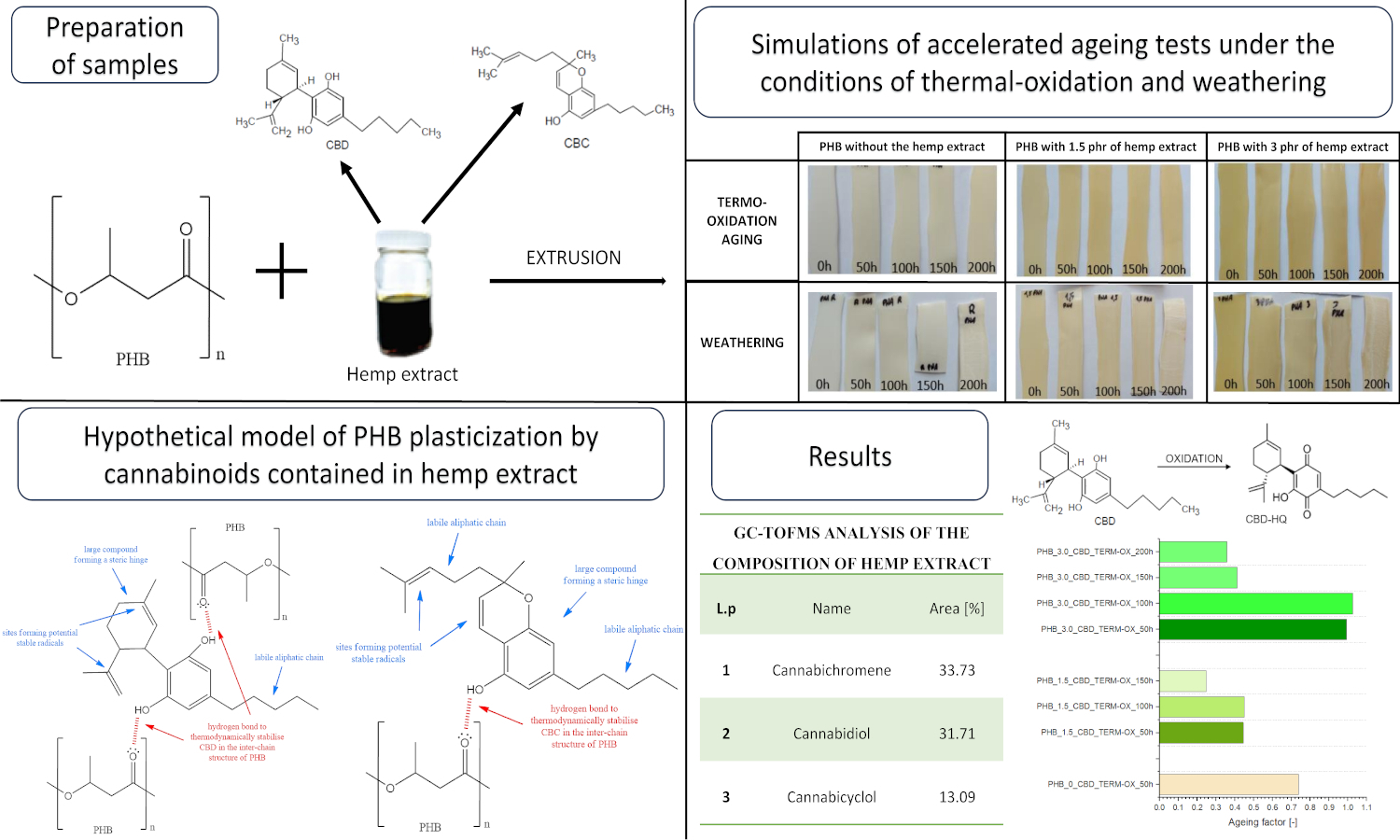
Biodegradable biopolymers like polyhydroxybutyrate (PHB) hold promise for sustainable packaging, but their inherent degradability reduces material stability. Synthetic stabilizers, though effective, raise environmental and potential toxicity concerns. This study explores a multifunctional natural anti-aging agent: a hemp extract rich in cannabidiol (CBD) and cannabichromene (CBC). PHB composites with varying hemp extract concentrations were prepared and subjected to thermooxidative and weathering aging. Characterization employed FTIR-ATR, carbonyl index, and spectrophotometry. Static mechanical properties, DSC, and surface free energy (SFE) were also assessed. Notably, the hemp extract exhibited stability under ambient conditions but showed migration with time and aging. The results suggest a plasticizing effect on PHB and highlight the contrasting roles of the extract: inhibiting thermooxidative aging while potentially accelerating aging under atmospheric conditions. This opens avenues for tailoring material durability, further evaluated by life cycle analysis (LCA). This work represents one of the first investigations into hemp extract as an anti-aging agent for eco-friendly polymers, expanding the knowledge base of natural multifunctional additives.