
Accelerator and zinc-free prevulcanized latex based on natural rubber-bearing benzyl chloride groups
Anchisa Bunsanong, Bencha Thongnuanchan , Rattanawadee Ninjan, Subhan Salaeh, Natinee Lopattananon, Abdulhakim Masa
Vol. 18., No.2., Pages 229-242, 2024
DOI: 10.3144/expresspolymlett.2024.16
DOI: 10.3144/expresspolymlett.2024.16
Corresponding author: Bencha Thongnuanchan 
GRAPHICAL ABSTRACT
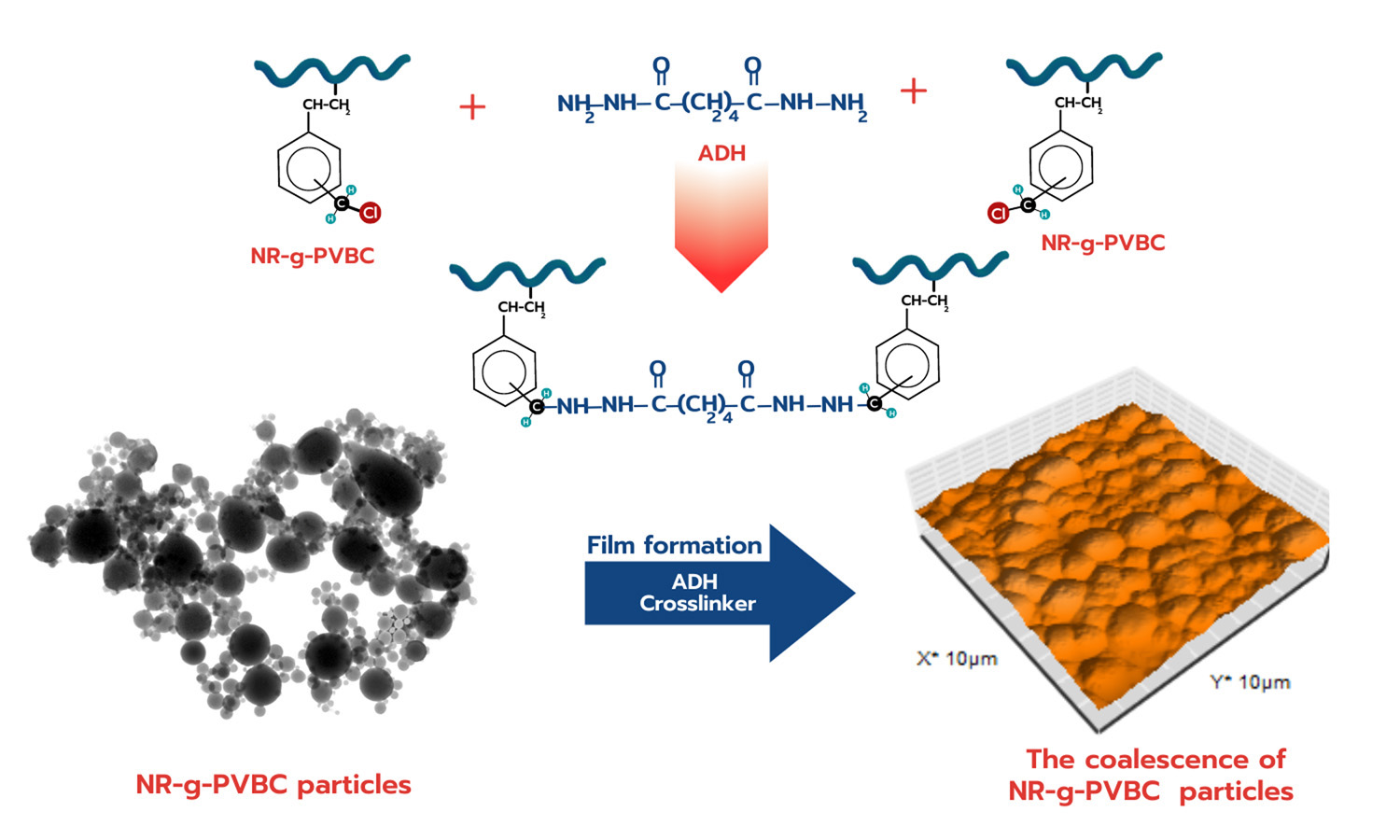
ABSTRACT
The present study aimed to prepare prevulcanized latex from modified natural rubber (NR) latex, graft copolymers of natural rubber and poly(vinylbenzyl chloride), NR-g-PVBC. The prevulcanized latex was prepared by heating NR-g-PVBC latex in the presence of adipic acid dihydrazide (ADH). The study showed that the tensile strength of the NR-g-PVBC films with ADH was significantly higher than that without ADH. Interactions of NR-g-PVBC with ADH were further investigated using X-ray photoelectron spectroscopy (XPS). Higher storage modulus (E′) in the rubbery plateau region was also observed for the films with ADH than that without ADH. These results corroborated that the crosslinking reaction occurred in the film with the addition of ADH. It was found that the optimal prevulcanization time was 20 min at 55 °C. After that, the effect of storage on the tensile properties of the prevulcanized latex was studied. Atomic force microscopy (AFM) analysis was performed to follow changes in the surface morphology of films obtained from the prevulcanized latex. A zeta potential value of –37.83 was observed for the prevulcanized latex after being stored for 60 days. Therefore, the present study demonstrated that grafting poly(vinylbenzyl chloride) onto NR particles offered an opportunity to prepare a new type of prevulcanized latex. This new system was accelerator-free and zinc-free, considered more environment-friendly than a sulfur-prevulcanization system.
RELATED ARTICLES
Song Wu, Jiaye Li, Shipeng Wen
Vol. 20., No.10., Pages 971-973, 2026
DOI: 10.3144/expresspolymlett.2026.71
Vol. 20., No.10., Pages 971-973, 2026
DOI: 10.3144/expresspolymlett.2026.71
This is an editorial article. It has no abstract.
Nabil Hayeemasae, Siriwat Soontaranon, Abdulhakim Masa
Vol. 20., No.7., Pages 664-676, 2026
DOI: 10.3144/expresspolymlett.2026.50
Vol. 20., No.7., Pages 664-676, 2026
DOI: 10.3144/expresspolymlett.2026.50
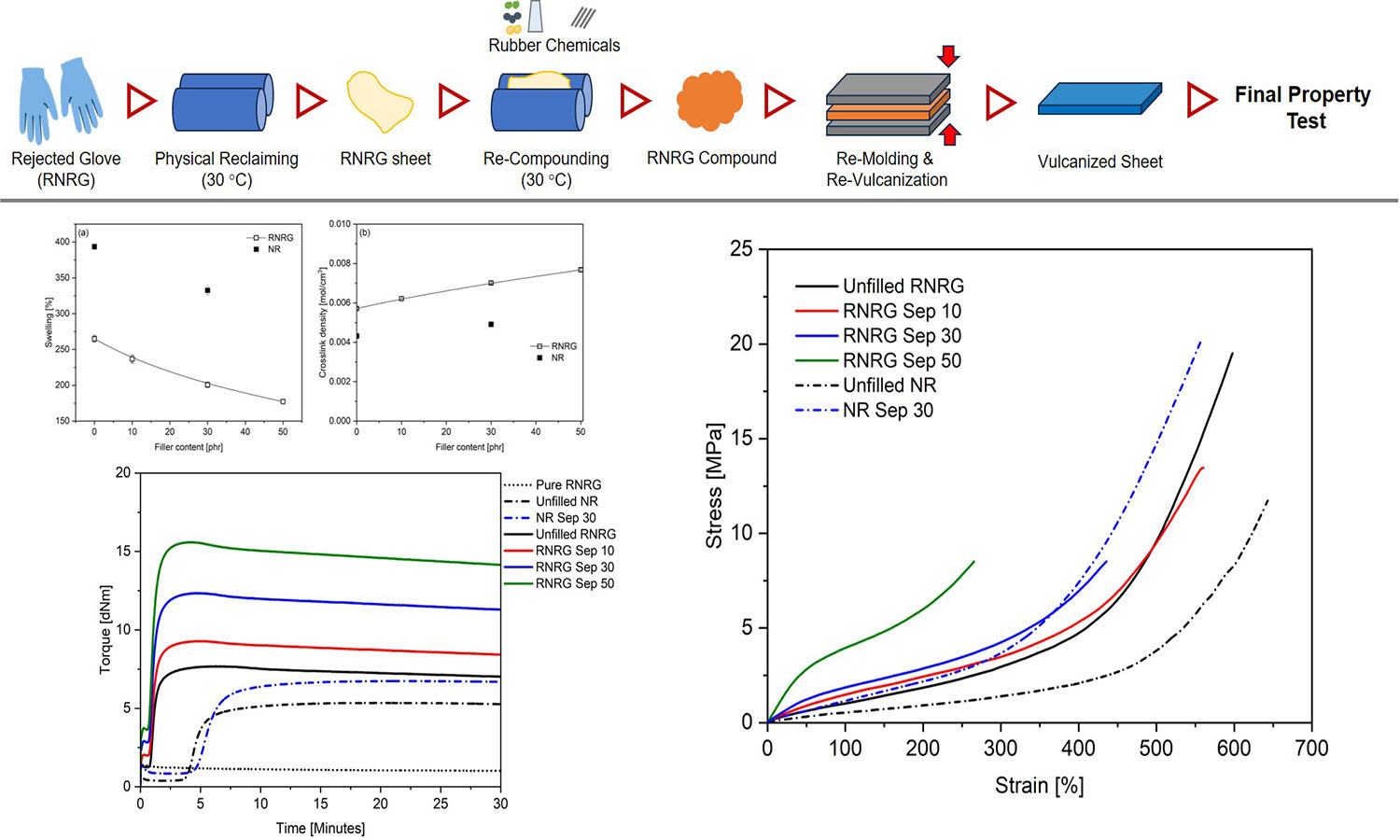
We investigated the possibility of applying rejected natural rubber gloves (RNRGs) as a matrix for rubber composites filled with sepiolite. The virgin natural rubber (NR) samples were also prepared for comparison. Clearly, the RNRGs can be re-mixed with rubber chemicals, re-shaped, and revulcanized. Maximum torque increased with sepiolite loading during vulcanization, along with stress at 100 and 300% strains and strain-induced crystallization ability, whereas the tensile strength and elongation at break of the RNRG composites exhibited an opposite trend. The unfilled RNRG possessed high tensile strength (~19.86 MPa) and extensibility (~600%), which was about 67% higher than that of the unfilled NR sample. However, increased sepiolite loading decreased the thermomechanical properties of the RNRG composites because the RNRG had undergone vulcanization before re-mixing and revulcanizing; the NR-based composite showed the opposite trend. Based on the results, the RNRGs can be re-used as the rubber matrix of rubber compounds when thermal properties are not critical.
Péter Tamás-Bényei, Andrea Kohári, Ákos Görbe, Lóránt Kiss, Katalin Litauszki, Ferenc Szabó, László Mészáros, Károly Renner, Tamás Bárány
Vol. 20., No.6., Pages 547-550, 2026
DOI: 10.3144/expresspolymlett.2026.41
Vol. 20., No.6., Pages 547-550, 2026
DOI: 10.3144/expresspolymlett.2026.41
This is an editorial article. It has no abstract.
Wu Qin, Rui Zhang, Long Zheng, Danling Wang, Sheng Chen, Huiming Ren, Shui Hu, Shipeng Wen
Vol. 20., No.6., Pages 551-562, 2026
DOI: 10.3144/expresspolymlett.2026.42
Vol. 20., No.6., Pages 551-562, 2026
DOI: 10.3144/expresspolymlett.2026.42
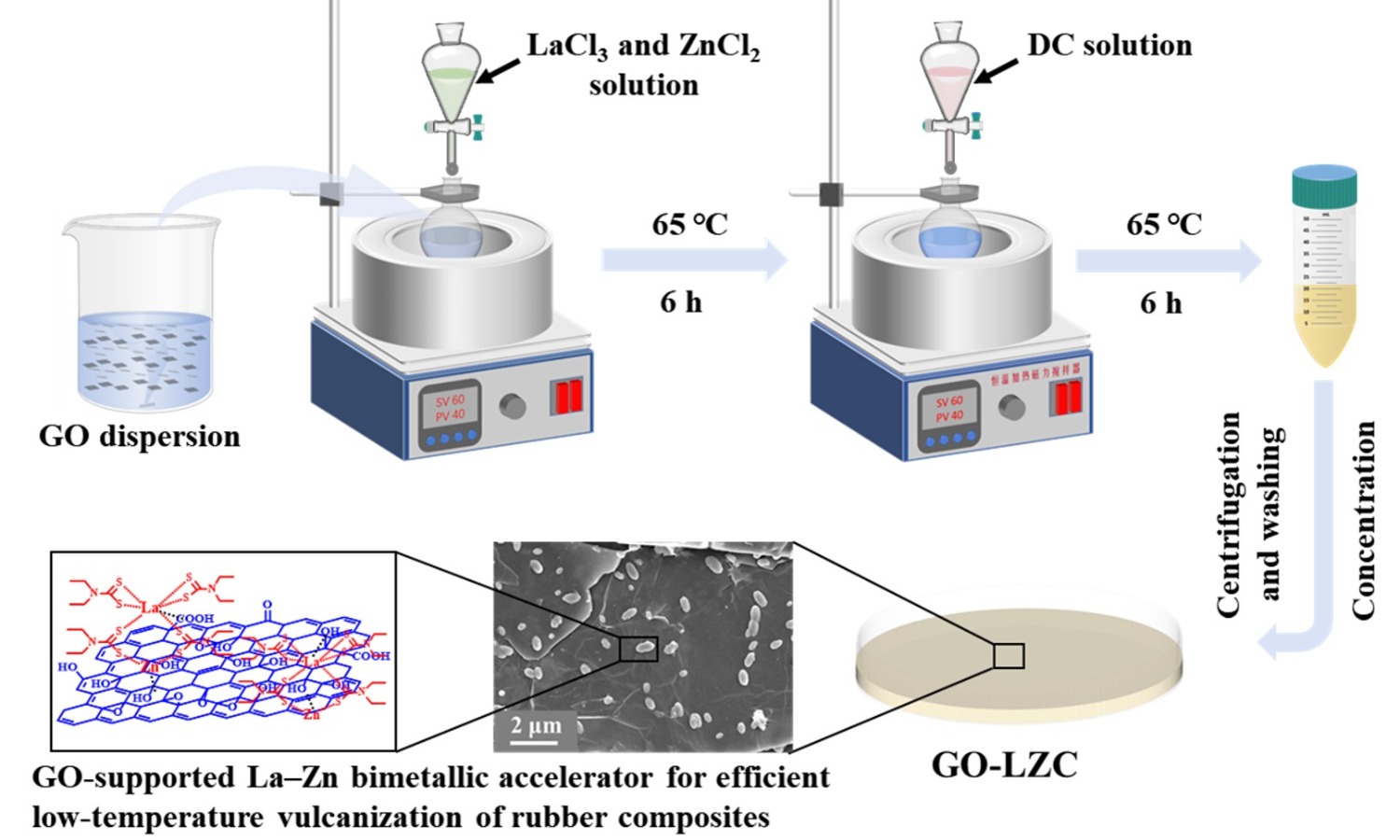
Conventional sulfur vulcanization in rubber manufacturing depends on elevated curing temperatures and zinc oxide activators, resulting in high energy consumption and increasing environmental concerns associated with zinc release. To overcome these limitations, a novel graphene oxide (GO)-supported rare-earth-containing accelerator (GO–LZC) was designed by coordinating lanthanum(III) and zinc(II) ions with sodium diethyldithiocarbamate (DC). At the same time, the oxygen-containing groups on GO further participated in ligand coordination. The resulting GO-immobilized complex exhibits a well-defined chelating structure and uniform nanoscale dispersion, which together enhance the accessibility and reactivity of active sulfurating species during curing. When incorporated into solution-polymerized styrene–butadiene rubber (SSBR), GO–LZC markedly promotes crosslink formation at reduced thermal input. Kinetic analysis reveals a substantial decrease in the apparent activation energy, and curing and mechanical tests confirm that efficient vulcanization can be achieved at 130 °C, representing a 20–40 °C reduction relative to typical industrial curing conditions. This work demonstrates a viable strategy for developing low-zinc, energy-efficient, and high-performance vulcanization systems. It highlights the potential of rare-earth/GO hybrid catalysts for sustainable rubber processing.
Using dual-cure architectures in HNBR: A detailed insight into their structure-property relationship
Sharmistha Dhar, Arshad Rahman Parathodika, Dibyendu Dey, Kinsuk Naskar
Vol. 20., No.5., Pages 514-530, 2026
DOI: 10.3144/expresspolymlett.2026.39
Vol. 20., No.5., Pages 514-530, 2026
DOI: 10.3144/expresspolymlett.2026.39
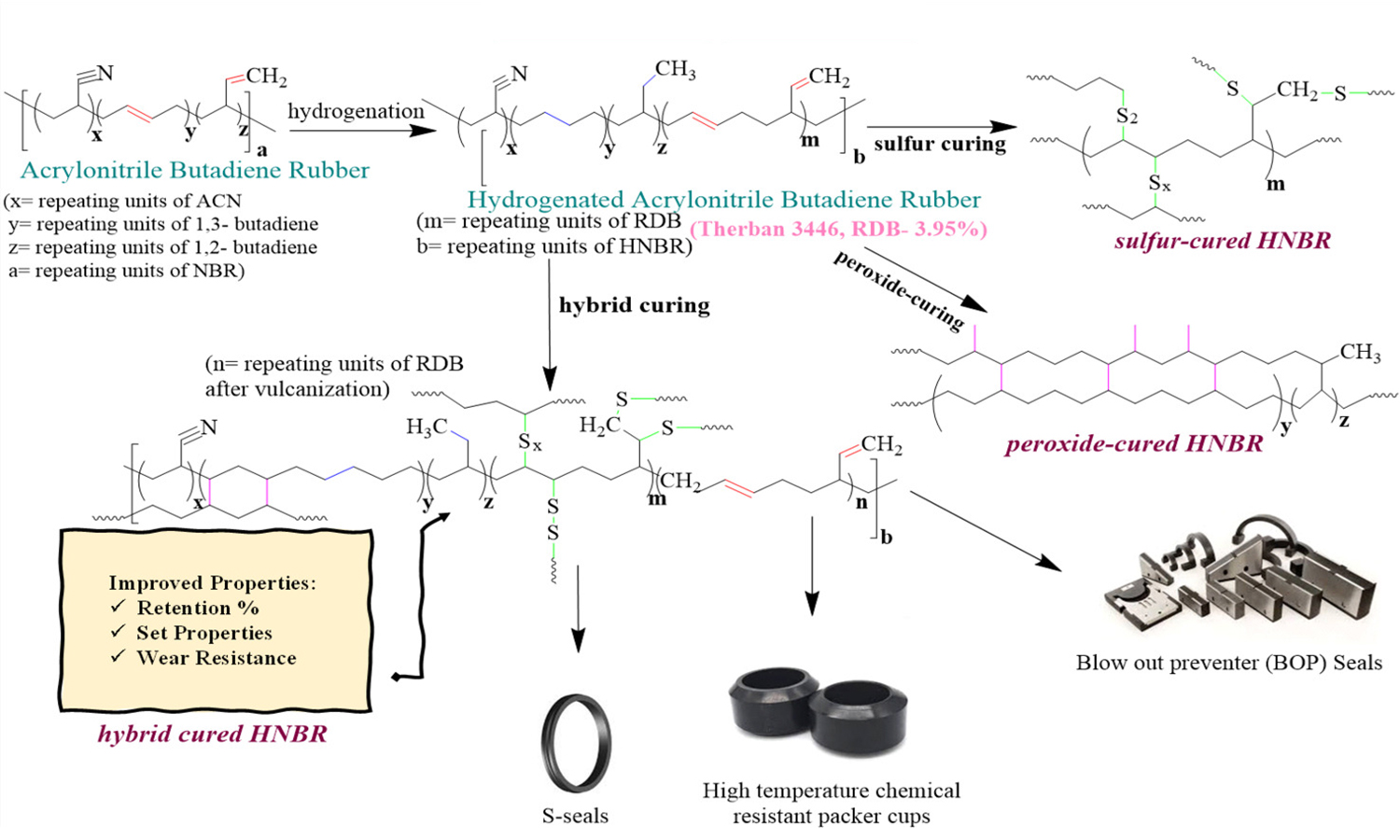
Hydrogenated acrylonitrile–butadiene rubber (HNBR) is widely used in automotive and sealing applications due to its oil resistance and mechanical durability; however, its long-term performance is significantly influenced by the curing chemistry. Sulfur vulcanization offers superior elasticity but restricted thermal stability, while peroxide curing improves heat resistance at the expense of flexibility. In this study, we investigate hybrid sulfur–peroxide curing to integrate these benefits. The hybrid pathway encompasses competitive and sequential processes, such as partial radical quenching and accelerator oxidation, resulting in a dual crosslink network. Dynamic mechanical, thermal, and temperature scanning stress relaxation (TSSR) evaluations demonstrate that hybrid systems provide precise modulation of the operational temperature–frequency range, broaden the glass-transition relaxation, and control stress dissipation. The coexistence of sulfur and C–C crosslinks results in a heterogeneous structure characterized by diverse crosslink densities and bond energies, leading to numerous relaxation modes and an optimal blend of elasticity, strength, and thermal stability. Microscopy confirms the absence of phase separation, indicating that hybrid vulcanization is a viable approach for producing robust, high-performance HNBR elastomers.