
Investigation of the physical and mechanical properties of poly(vinyl alcohol) cryogels filled with poly(3-hydroxybutyrate) microparticles
Alexandra V. Pozdniakova , Nikita D. Donskoy, Anton A. Miroshnichenko, Alexander V. Shabanov, Anas S. Hussein, Anna A. Sukhanova
, Nikita D. Donskoy, Anton A. Miroshnichenko, Alexander V. Shabanov, Anas S. Hussein, Anna A. Sukhanova Vol. 20., No.8., Pages 840-853, 2026
DOI: 10.3144/expresspolymlett.2026.62
DOI: 10.3144/expresspolymlett.2026.62
Corresponding author: Alexandra V. Pozdniakova 
GRAPHICAL ABSTRACT
ABSTRACT
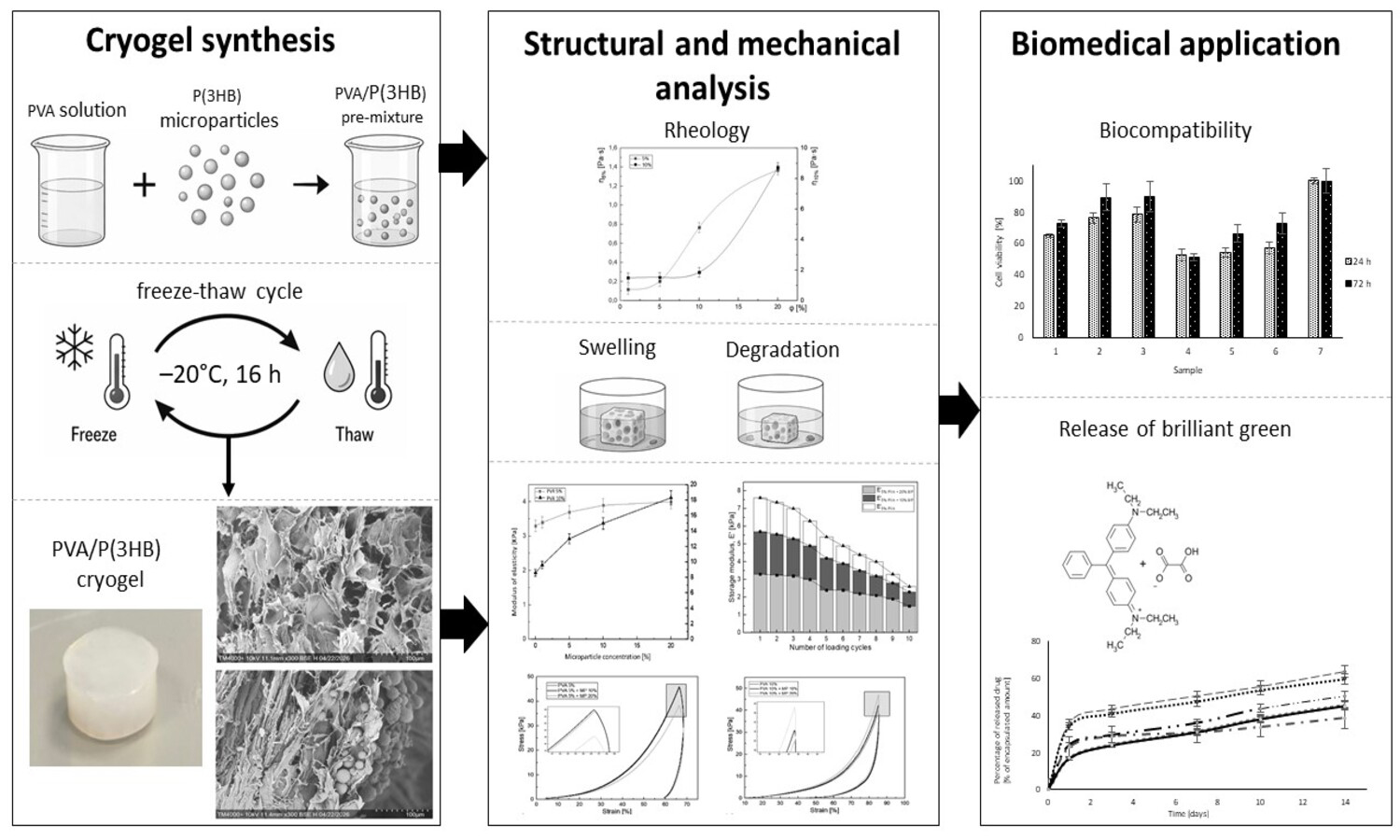
A key challenge in soft tissue engineering is developing biocompatible scaffolds with tunable stiffness and controlled degradation. Composite cryogels combining a porous polymer network, reinforcing microparticles, and encapsulation capacity address this challenge. In this study, we prepared poly(vinyl alcohol) (PVA)-based cryogels containing 5 and 10 wt% PVA and 1, 5, 10, and 20 wt% poly(3-hydroxybutyrate) (P(3HB)) microparticles (5.8–42.6 μm in diameter) by cyclic freeze–thaw. The P(3HB) microparticles reduced porosity (from 31 to 16%) and the swelling ratio (from 226 to 143%) without altering mean pore diameter (50–300 μm), with greater effects at 10 wt% PVA. Mechanical testing showed that increasing microparticle content enhanced the elastic modulus (from 8.7 to 18.3 kPa) and compressive strength (from 39 to 47 kPa) for 10 wt% PVA cryogels, whereas 5 wt% PVA cryogels showed minimal modulus improvement and reduced strength. Biocompatibility (ISO 10993-5) was confirmed for all 5 wt% PVA composites and for the 10 wt% PVA composite with 20 wt% P(3HB) (viability 72.8%). P(3HB) microparticles loaded with brilliant green significantly slowed its release from both cryogel matrices. These results establish PVA/P(3HB) composite cryogels as promising scaffolds with tunable stiffness and controlled release for soft tissue engineering.
RELATED ARTICLES
Ha Ngoc Giang, Thanh Thai Nguyen, Thu Thi Trang Luu, Anh Thi Ngoc Pham, Tuan Nguyen Anh Huynh
Vol. 19., No.5., Pages 519-530, 2025
DOI: 10.3144/expresspolymlett.2025.38
Vol. 19., No.5., Pages 519-530, 2025
DOI: 10.3144/expresspolymlett.2025.38
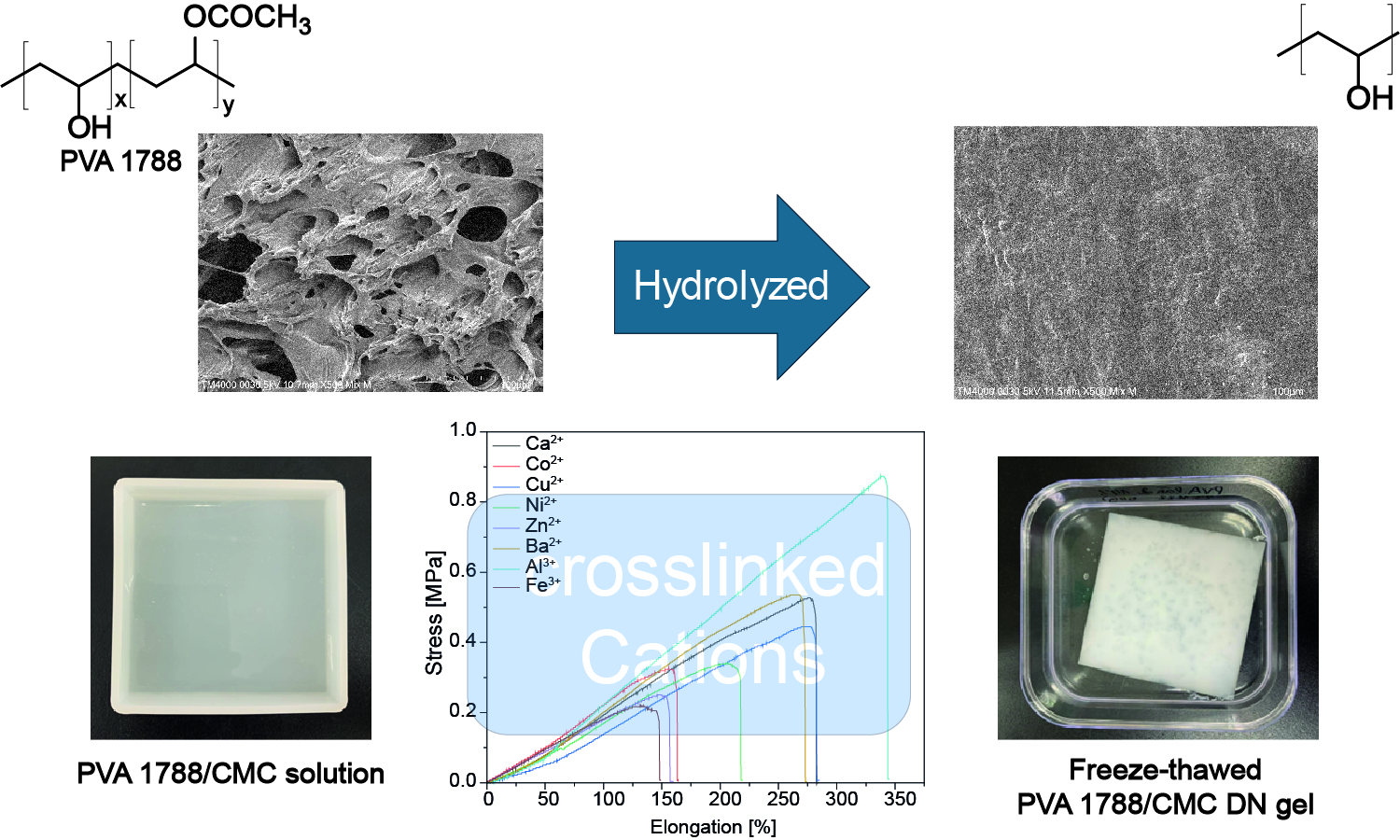
Freeze-thaw (F-T) poly(vinyl alcohol) (PVA) as a soft network and ionic-crosslinked sodium carboxymethyl cellulose (CMC) as a hard network were applied to fabricate a double network (DN) gel using a one-step process. Mechanical properties of the DN gel using a high degree of hydrolysis PVA (PVA-CMC of 60-1) were significantly improved compared to that of a single network gel of PVA. The tensile strength of ~0.55 MPa and elongation at break of 179% could be achieved. The mechanical properties of PVA-poly(acrylic acid) DN gel were lower than that of PVA-CMC samples. Fourier-transformed infrared (FTIR) spectroscopy results showed less compatibility between polyacrylic acid (PAA) and PVA compared to that of CMC. The solution made from the lower hydrolysis degree PVA (PVA1788) could form a strong gel after being treated with NaOH 1 M. The FTIR result showed the disappearance of acetate groups. A large melting peak in differential scanning calorimetry (DSC) results showed high crystallinity of the hydrolyzed-PVA1788. The effect of various multivalent cations on the mechanical properties of PVA1788-CMC DN gel was performed. The properties of the samples followed the order: Fe3+<Co2+<Ni2+<Cu2+<Zn2+<Ca2+~Ba2+<Al3+. The tensile strength of DN gel fabricated using AlCl3 solution could reach 0.87 MPa, and the elongation at break was 330%.