
Sustainable bio-resins as alternatives to phenol–formaldehyde resin for high-performance tire tread compounds
Dibyendu Dey , Sharmistha Dhar, Sambhu Bhadra, Sujith Nair, Kinsuk Naskar
, Sharmistha Dhar, Sambhu Bhadra, Sujith Nair, Kinsuk NaskarVol. 20., No.8., Pages 763-773, 2026
DOI: 10.3144/expresspolymlett.2026.58
DOI: 10.3144/expresspolymlett.2026.58
Corresponding author: Kinsuk Naskar 
GRAPHICAL ABSTRACT
ABSTRACT
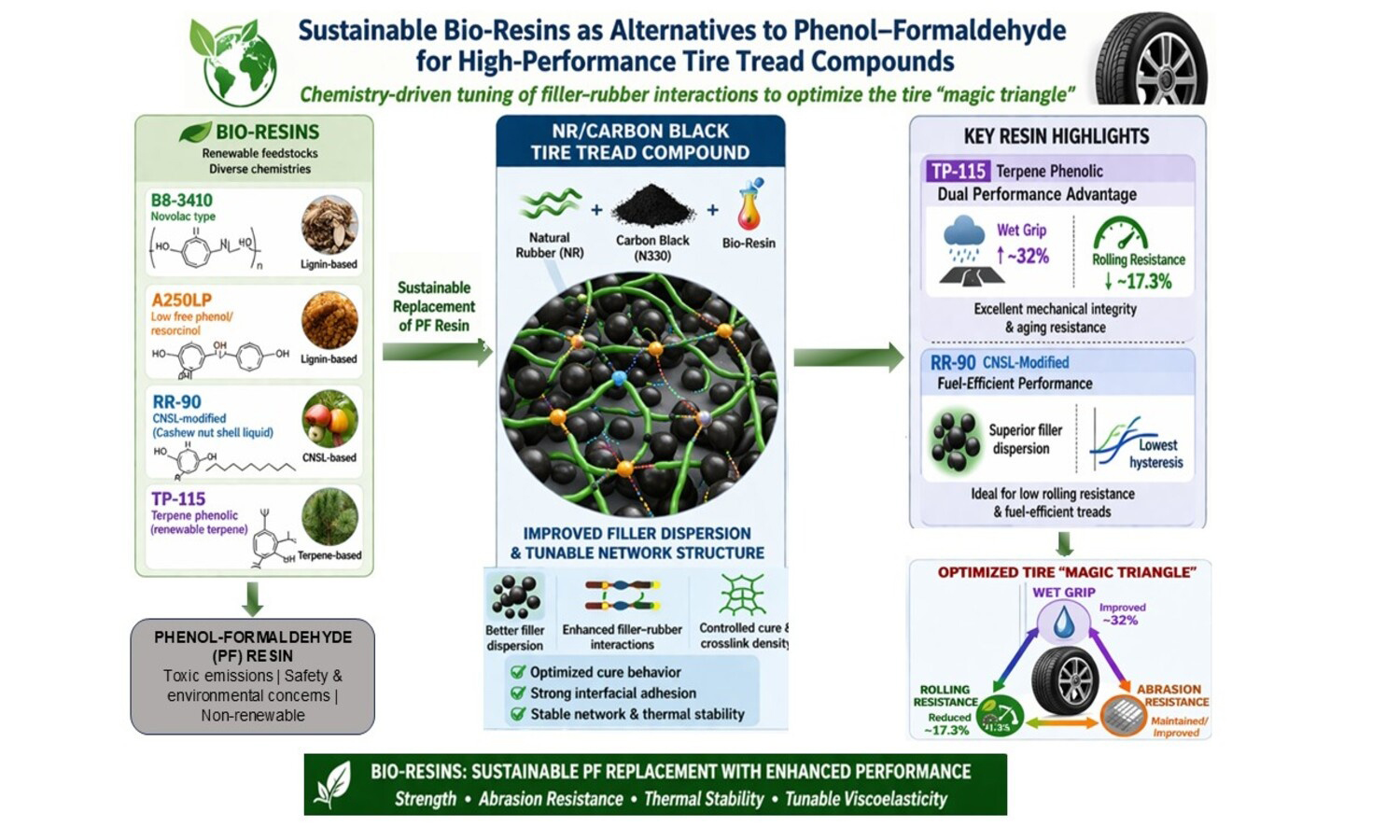
In this study, we explore alternatives to conventional phenol–formaldehyde (PF) resins in tire materials due to environmental and safety concerns. We evaluate several bio-resins – novolac type (B8–3410), low free phenol/resorcinol (A250LP), cashew nut shell liquid–modified (RR–90), and terpene phenolic (TP–115) – in carbon black–filled natural rubber tread compounds, focusing on their cure behavior, mechanical properties, abrasion resistance, thermal stability, and viscoelastic performance. Notably, TP–115 enhances wet grip by ~32% and reduces rolling resistance by ~17.3%, while maintaining mechanical integrity. RR–90 shows excellent dispersion and low hysteresis, suitable for fuel efficiency, whereas B8–3410 and A250LP provide balanced reinforcement and improved safety. This research highlights bio-resins as viable sustainable substitutes for PF resins, optimizing key tire performance parameters.