
Design and construction of a hierarchically structured F-SiO2/PVDF microporous membrane with tunable superficial properties for enhanced protein adsorption
Shijun Long, Yusu Wang, Qingbiao Cao, Yiwan Huang, Xuefeng Li
Vol. 20., No.8., Pages 788-798, 2026
DOI: 10.3144/expresspolymlett.2026.60
DOI: 10.3144/expresspolymlett.2026.60
Corresponding author: Shijun Long 
GRAPHICAL ABSTRACT
ABSTRACT
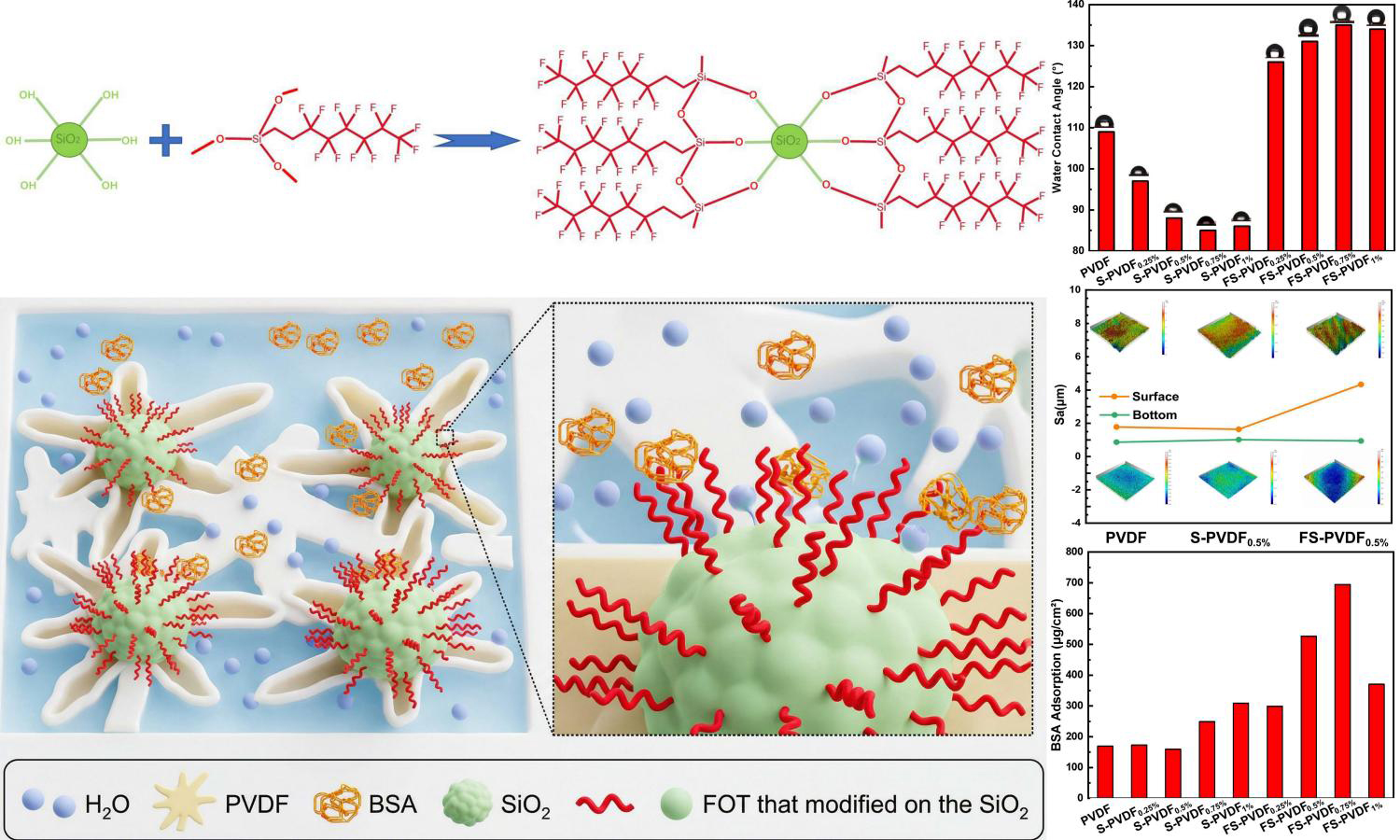
Controlling the surface properties of poly(vinylidene fluoride) (PVDF), especially its hydrophilicity and hydrophobicity, is a challenging research area with high application potential. We successfully fabricated a PVDF microporous membrane for efficient protein adsorption via a bulk modification strategy. Perfluorooctyltriethoxysilane (FOTS)-grafted silica microparticles (F-SiO2) were surface modified and dispersed into a PVDF casting solution to form a composite membrane via immersion phase separation. The F-SiO2 microparticles can act as crystallization nucleation sites, leading to the increase of β-type PVDF crystal, which has a protein binding capacity larger than the α-type crystal. Simultaneously, the F-SiO2 microparticles effectively modulated the membrane's surface morphology and internal porous architecture, producing a high degree of hydrophobicity and causing a marked enhancement in bovine serum albumin (BSA) adsorption capacity. When the amount of F-SiO2 reaches 0.75% of the dry weight of the membrane, the composite membrane reached a remarkable BSA adsorption capacity of 697 μg/cm2, a 303% increase compared to the pristine PVDF membrane. We present a high-performance PVDF modification strategy and clarify one protein adsorption mechanism.