
A novel photocatalytic sheath/core bicomponent fibre for severe acute respiratory syndrome coronavirus inactivation
Widtawad Reantong, Siriluk Chiarakorn , Pornsawan Leangwutwong, Akanitt Jittmittraphap, Nanjaporn Roungpaisan, Natee Srisawat
, Pornsawan Leangwutwong, Akanitt Jittmittraphap, Nanjaporn Roungpaisan, Natee SrisawatVol. 19., No.2., Pages 176-191, 2025
DOI: 10.3144/expresspolymlett.2025.13
DOI: 10.3144/expresspolymlett.2025.13
Corresponding author: Pornsawan Leangwutwong 
GRAPHICAL ABSTRACT
ABSTRACT
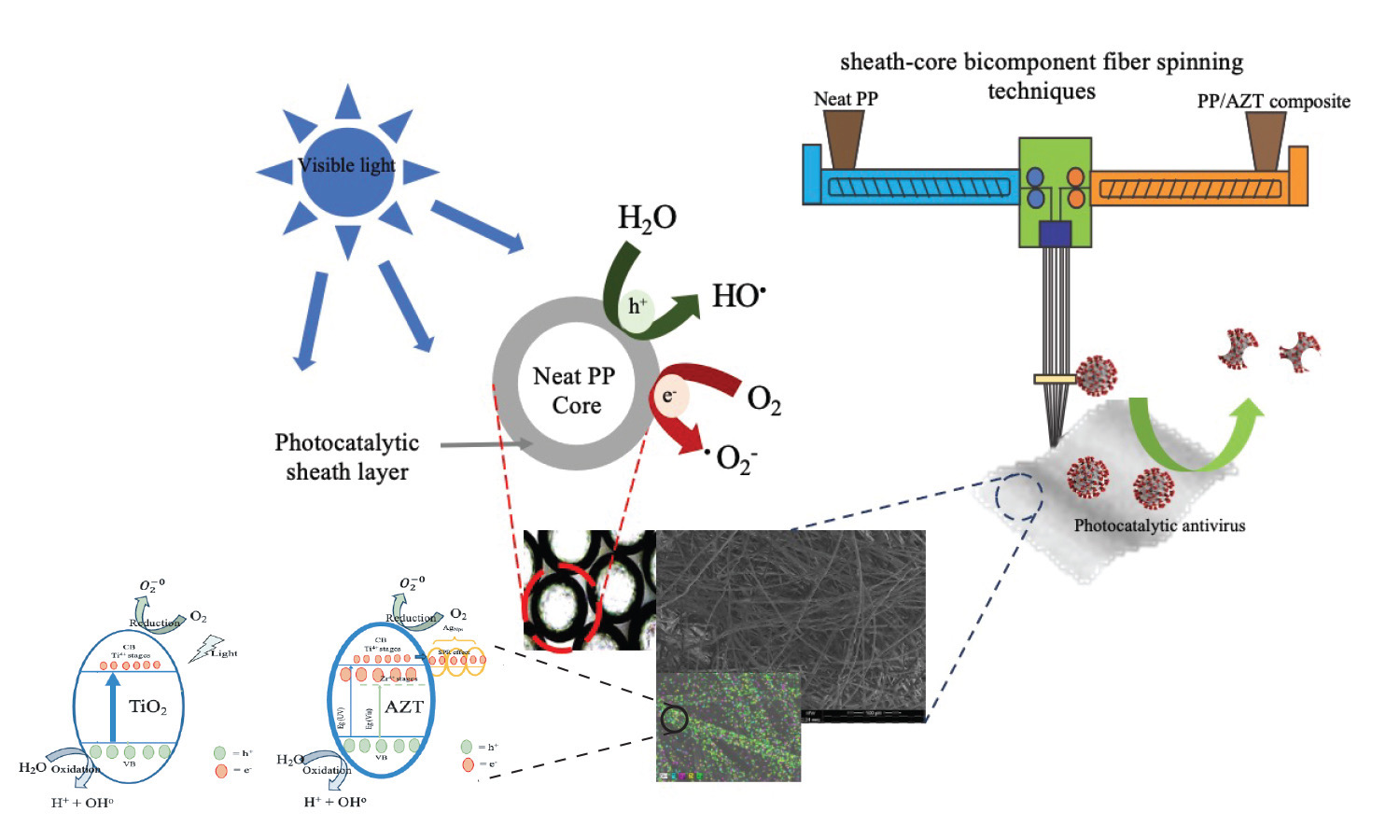
The coronavirus disease of 2019 (COVID-19) has become a global pandemic, leading to severe health issues such as pneumonia, organ failure, and death. Face masks made of non-woven textiles have been widely used to protect against SARS-CoV-2, but concerns arose regarding the potential infection from contaminated masks. To address this, titanium dioxide, a photocatalyst, shows promise in antimicrobial applications, including virus inhibition. This study explores the development of a sheath-core bicomponent fibre with a polypropylene core and a sheath containing an Ag and Zr co-doped TiO2 photocatalyst (AZT). Zr-Ag-TiO2 The fibres were produced using a double-extrusion spinning system, and the effects of the sheath-core ratio (50:50 and 80:20 w/w) and AZT content (1–3 wt%) on mechanical and antiviral properties were analysed. The fibres demonstrated improved mechanical strength and thermal stability, with the highest anti-SARS-CoV-2 activity (99.91%) observed in fibres with 2 wt% AZT at a 50:50 ratio after 30 min of fluorescent irradiation.
RELATED ARTICLES
Amanda Legnani, André Luis Marcomini, Philipe Augusto Pocidonio Silva, Ricardo Geraldo de Sousa, Anderson Júnior dos Santos, João Paulo Ferreira Santos
Vol. 20., No.4., Pages 326-341, 2026
DOI: 10.3144/expresspolymlett.2026.26
Vol. 20., No.4., Pages 326-341, 2026
DOI: 10.3144/expresspolymlett.2026.26
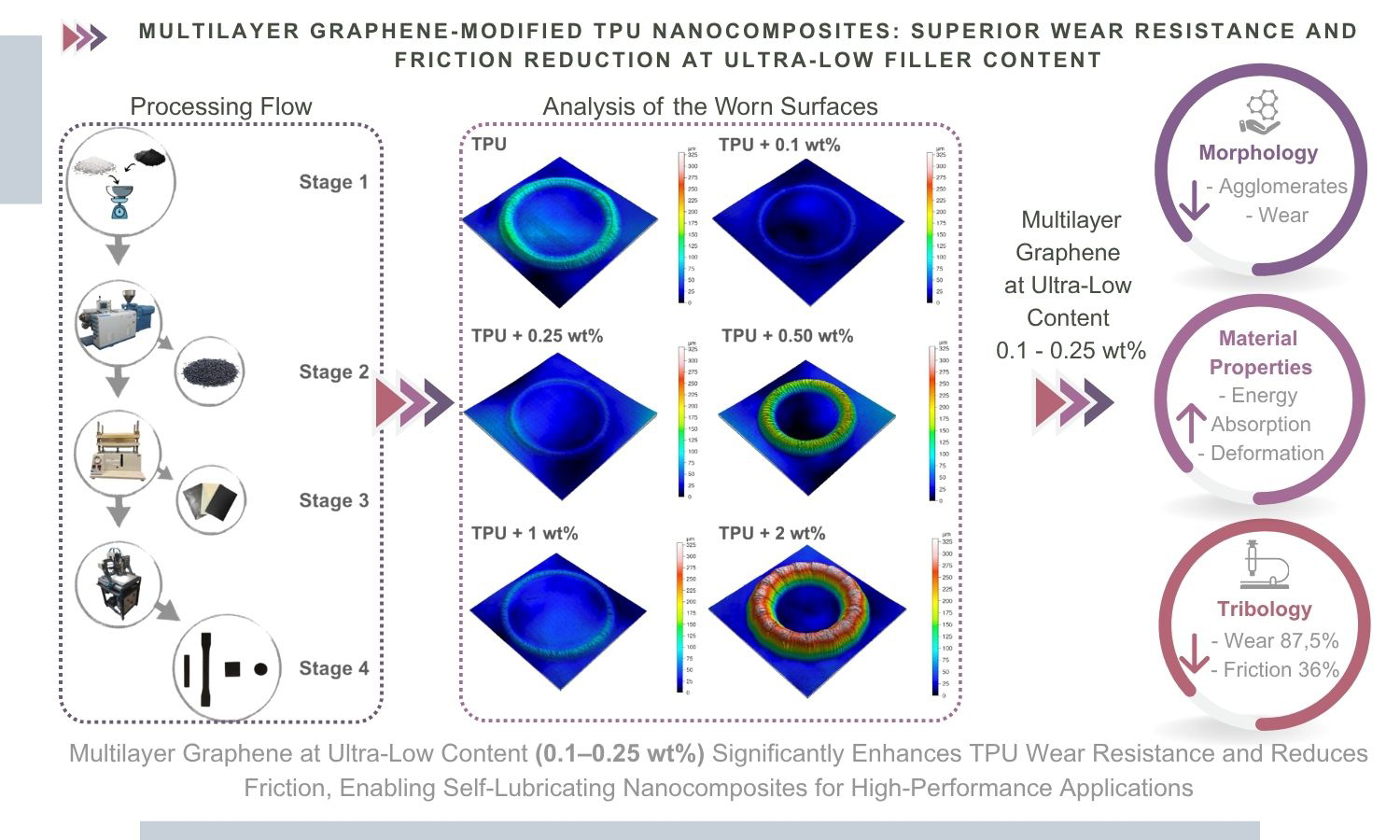
This work presents the development of high-performance thermoplastic polyurethane (TPU) nanocomposites reinforced with low contents of multilayer graphene (mG), aiming to improve their tribological behavior. Using twin-screw extrusion followed by hot pressing, nanocomposites containing 0.1, 0.25, 0.5, 1, and 2% mG weight were fabricated and systematically evaluated. Nanocomposites with only 0.1–0.25 wt% mG achieved a 36% reduction in friction coefficient and 87.5% reduction in wear volume compared to neat TPU. Results are rarely reported at such low filler loadings. Scanning electron microscopy (SEM) analysis revealed uniform dispersion at these optimal concentrations, while higher mG contents led to agglomeration and performance loss. Rheological studies indicated improved flow behavior, and dynamic-mechanical analysis confirmed increased energy dissipation and thermal response. These results suggest that the concentrations of 0.1% and 0.25% of multilayer graphene used in the study are promising for improving the performance of TPU nanocomposites in applications requiring high wear resistance for advanced applications in automotive, biomedical, and high-load engineering components, where durability and low friction are essential.
Widtawad Reantong, Siriluk Chiarakorn, Muthita Vanaporn, Natee Srisawat
Vol. 19., No.12., Pages 1256-1273, 2025
DOI: 10.3144/expresspolymlett.2025.93
Vol. 19., No.12., Pages 1256-1273, 2025
DOI: 10.3144/expresspolymlett.2025.93
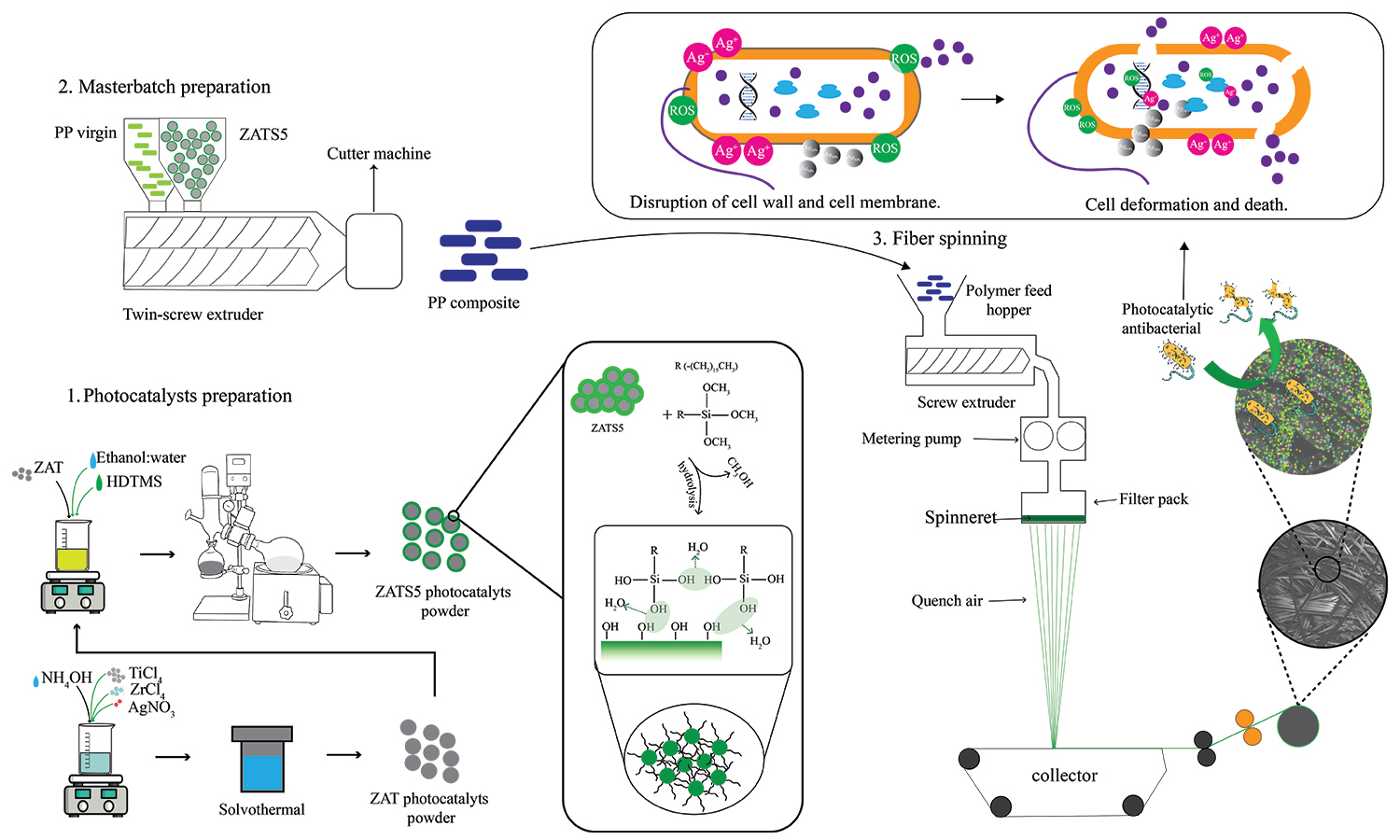
The development of functional antibacterial spunbond fabrics is critical for improving indoor environmental treatment. This study presents the fabrication of polypropylene (PP) fibers embedded with silane-modified Zr/Ag co-doped TiO2 nanoparticles. The Zr (5 mol%) and Ag (3 mol%) co-doped TiO2 nanoparticles were synthesized via a solvothermal method and subsequently modified with 5 wt% hexadecyltrimethoxysilane (HDTMS), referred to as ZATS5. The solvothermal method enables the controlled synthesis of phase-pure, well-dispersed nanostructures and facilitates dopant incorporation in the photocatalysts completely. Additionally, HDTMS surface modification improved compatibility with the polypropylene matrix, enhancing dispersion and interfacial bonding and improving overall composite performance. ZATS5 was incorporated into the PP matrix through melt spinning to produce composite fibers. The minimum of ZATS5 at 1 wt% embedded in spunbond nonwoven composite (PP/ZATS5-1) demonstrated the fiber’s structural integrity and remarkable antibacterial activity. The PP/ZATS5-1 nonwoven fabric achieved 99.98% inactivation of Legionella pneumophila under dark conditions and complete inhibition under visible light. This research offers a scalable and effective strategy for developing antibacterial spunbond nonwoven fabrics with potential applications in medical textiles, as well as air and water purification systems operating under ambient indoor lighting.