
Poly(lactic acid) (PLA) – Short review of synthesis methods, properties, recent progress, and new challenges
Konrad Stefaniak, Anna Masek
Vol. 19., No.4., Pages 386-408, 2025
DOI: 10.3144/expresspolymlett.2025.29
DOI: 10.3144/expresspolymlett.2025.29
Corresponding author: Anna Masek 
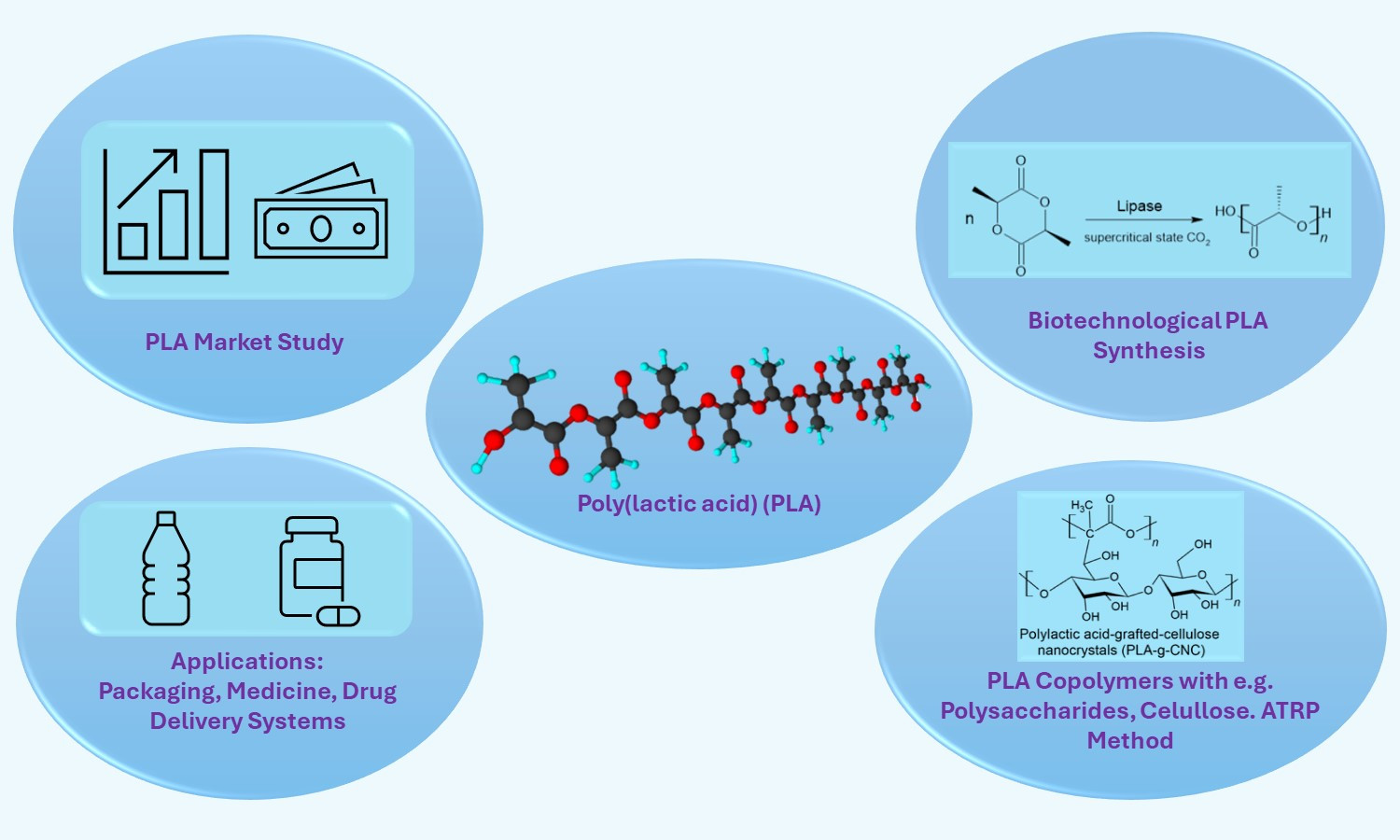
GRAPHICAL ABSTRACT
ABSTRACT
This review is focused on recent achievements in poly(lactic acid) (PLA) synthesis and copolymerization with special regard to biotechnological routes of PLA synthesis, which use bacteria/enzymes (e.g., enzymatic ring opening polymerization (eROP)). Besides PLA, also lactic acid (LA) synthesis is described and an emphasis is put on the biotechnological methods. Having regard to PLA copolymerization, this paper attempts to describe different types of PLA copolymers (such as block copolymers, PLA copolymers with polysaccharides, PLA-cellulose copolymer composites, and PLA polymer brushes). A detailed overview of the recent accomplishments in the field of PLA copolymers is presented. Various enhanced properties and applications of presented PLA copolymers are discussed. The attention is placed mainly on applications in the field of tissue engineering, drug delivery systems, and the packaging sector. Furthermore, a PLA market study and its economic forecast are presented. Eventually possible directions for future research in the field of PLA synthesis and copolymerization are indicated.
RELATED ARTICLES
Praveenkumara Jagadeesh, Gokul Kannan, Mat Jusoh Suriani, Madhu Puttegowda, Sanjay Mavinkere Rangappa, Suchart Siengchin
Vol. 20., No.8., Pages 799-839, 2026
DOI: 10.3144/expresspolymlett.2026.61
Vol. 20., No.8., Pages 799-839, 2026
DOI: 10.3144/expresspolymlett.2026.61
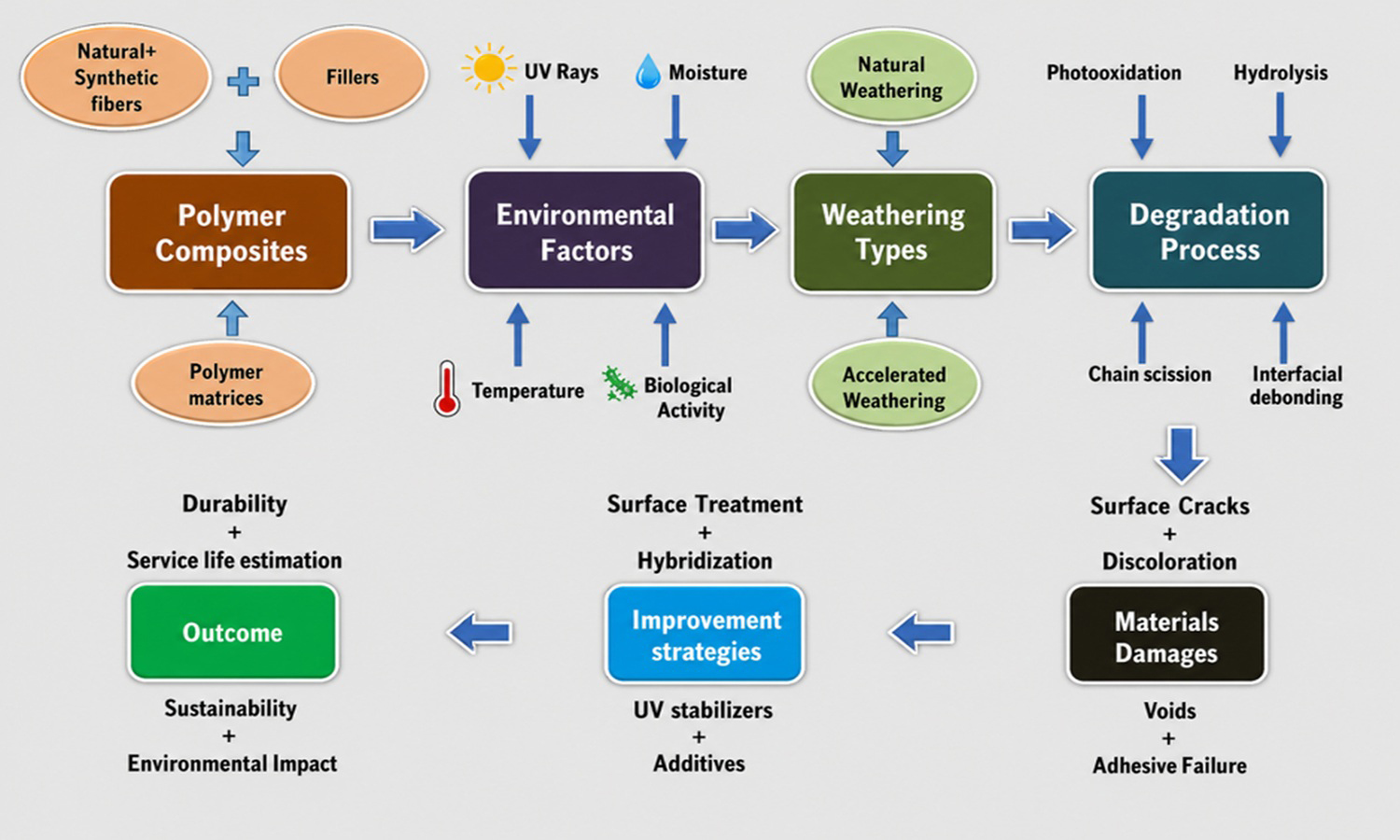
Polymer composites are widely used in indoor and outdoor applications owing to their high strength-to-weight ratio, corrosion resistance, and design flexibility. However, exposure to environmental factors such as ultraviolet (UV) radiation, humidity, temperature fluctuations, and biological agents significantly affect their long-term durability and performance. In this review, we comprehensively examine the degradation mechanisms of polymer composites under both natural and accelerated weathering, with particular emphasis on degradation mechanisms, characterization techniques, and durability assessment. We critically discuss the fundamental degradation mechanisms, including photo-oxidation, hydrolysis, polymer chain scission, crosslinking and interfacial debonding. We also evaluated accelerated weathering techniques, conducted under standardized testing conditions, for their ability to simulate long-term outdoor exposure within significantly shorter timeframes, by controlling key environmental parameters such as UV radiation, humidity, and temperature. We also examine the influence of reinforcements, including natural fibres, synthetic fibres, and nanofillers, on the weathering resistance of polymer composites. Attention is given to natural fibre–reinforced composites because their inherent hydrophilicity promotes moisture absorption, accelerating degradation and weakening the fibre–matrix interface. Furthermore, we critically evaluate the effects of weathering on the mechanical properties, crystalline structure and barrier performance of polymer composite films, and discuss recent advances in enhancing weather resistance through hybridization, surface modification, and the incorporation of stabilizing additives. Finally, the review highlights the key challenges and future research directions for the development of durable, high-performance, and sustainable polymer composite systems for long-term outdoor applications.
György Marosi
Vol. 20., No.8., Pages 761-762, 2026
DOI: 10.3144/expresspolymlett.2026.57
Vol. 20., No.8., Pages 761-762, 2026
DOI: 10.3144/expresspolymlett.2026.57
This is an editorial article. It has no abstract.
Aswathy Sasidharan Pillai, Peter Polyak, Gabor Kaszas, Judit E. Puskas
Vol. 20., No.6., Pages 629-636, 2026
DOI: 10.3144/expresspolymlett.2026.47
Vol. 20., No.6., Pages 629-636, 2026
DOI: 10.3144/expresspolymlett.2026.47
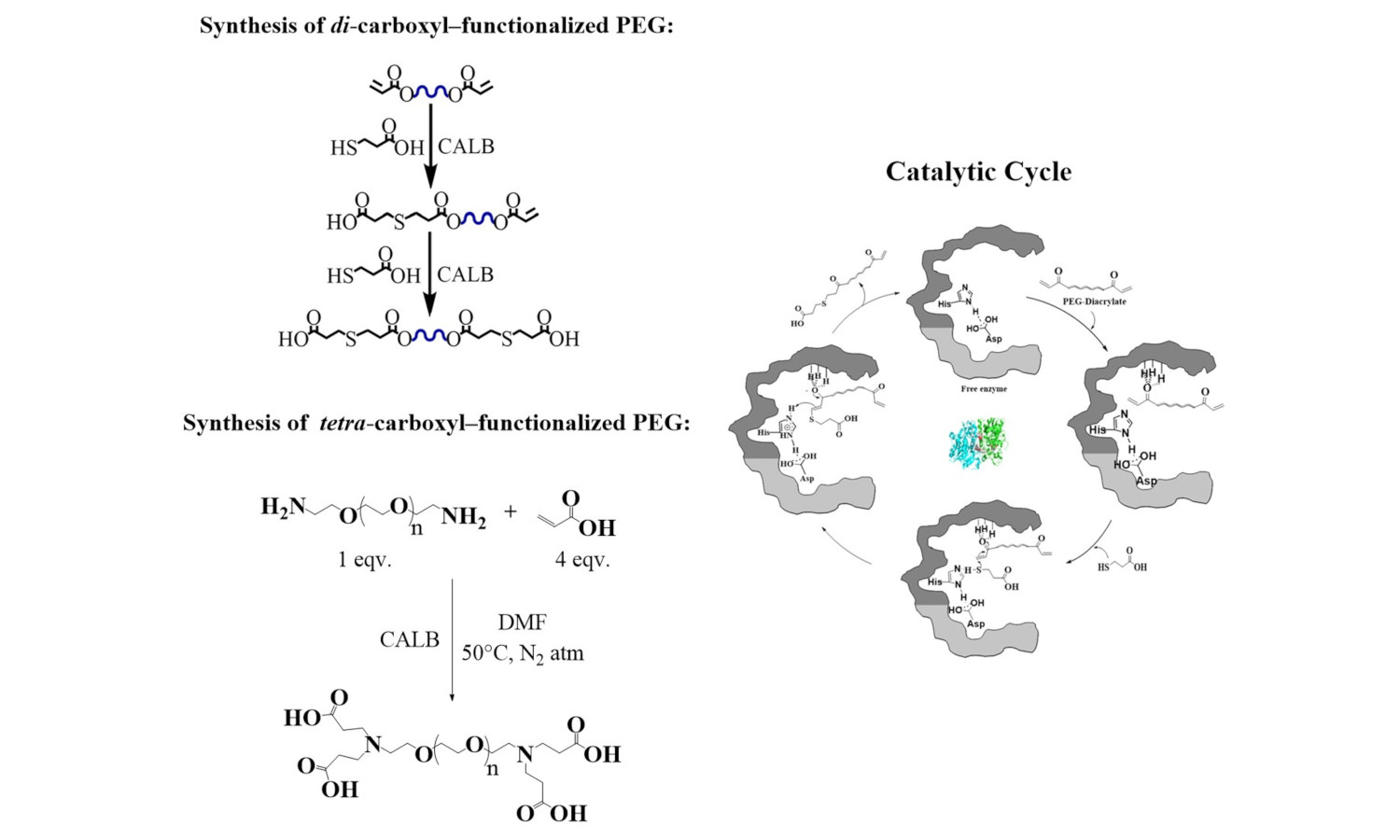
In this study, we present an effective chemo-enzymatic method for synthesizing di- and tetra-carboxyl–functionalized poly(ethylene glycol)s (PEGs) using Candida antarctica lipase B (CALB). PEG-diacid was synthesized through CALB-catalyzed Michael addition of 3-mercaptopropionic acid (3-MPA) to PEG-diacrylate. We found that the reactions proceeded in a stepwise manner, first producing monoacid. The synthesis of diacid required additional fresh CALB and 3-MPA. The structure of the products was confirmed by 800 MHz 1H NMR. PEG-tetraacid was synthesized in a single step via CALB-catalyzed Michael addition of acrylic acid to PEG-diamine. In both cases, the CALB-Catalyzed Michael addition reactions effectively produced carboxyl-functionalized PEGs.
Wen Shyang Chow
Vol. 20., No.4., Pages 324-325, 2026
DOI: 10.3144/expresspolymlett.2026.25
Vol. 20., No.4., Pages 324-325, 2026
DOI: 10.3144/expresspolymlett.2026.25
This is an editorial article. It has no abstract.
Paulina Bednarczyk, Kamil Rożniakowski
Vol. 20., No.3., Pages 233-245, 2026
DOI: 10.3144/expresspolymlett.2026.19
Vol. 20., No.3., Pages 233-245, 2026
DOI: 10.3144/expresspolymlett.2026.19
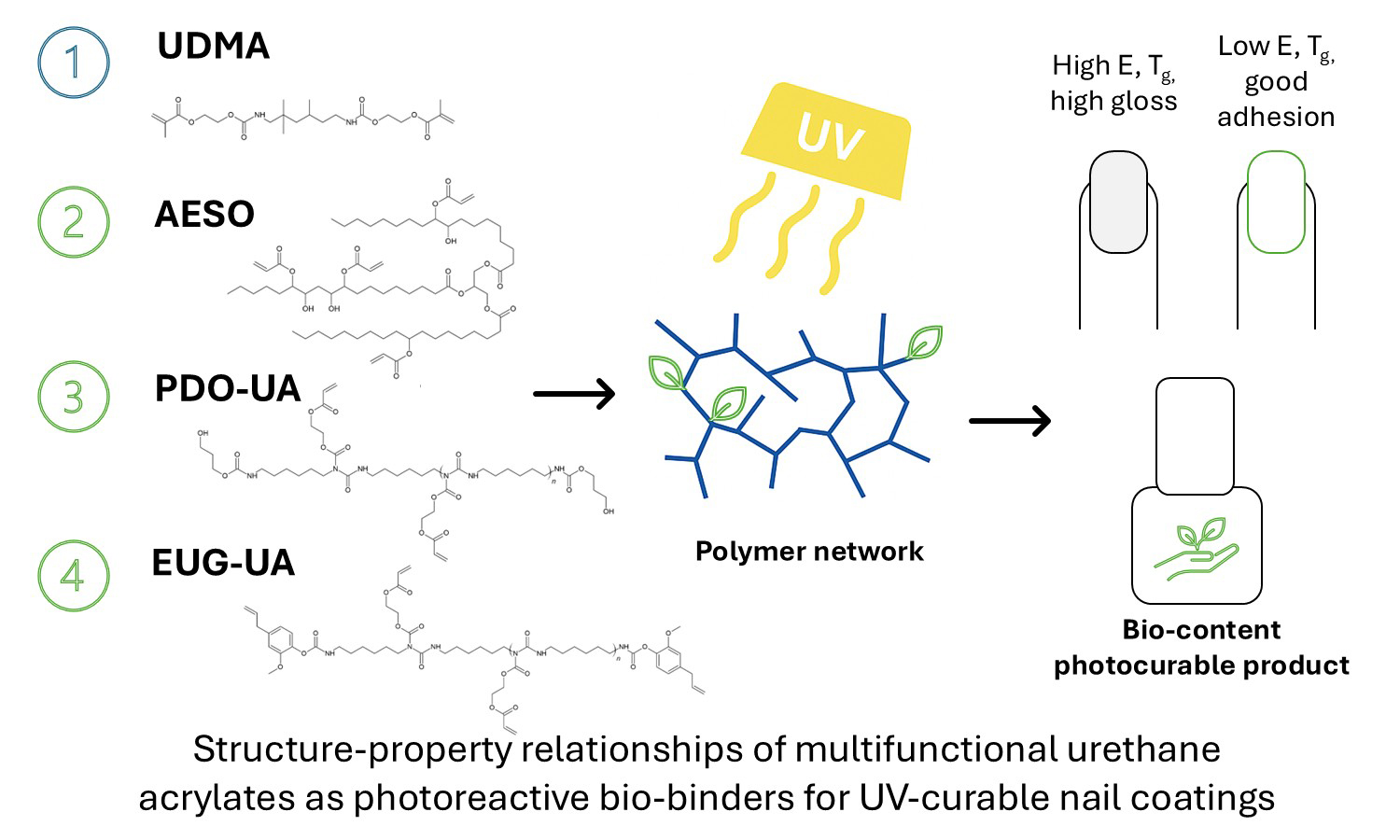
This study investigates the structure–property relationships of multi-functional urethane acrylate resins designed as photoreactive binders for UV-curable nail coatings. Four systems were examined: a commercial resin urethane dimethacrylate (UDMA), a bio-based acrylated epoxidized soybean oil (AESO), and two newly synthesized bio-based urethane acrylates derived from 1,3-propanediol (PDO–UA) and eugenol (EUG–UA). Photopolymerization kinetics were analyzed by realtime FTIR, while the properties of the cured coatings were also determined. The mechanical and thermal behavior of selfsupporting polymer films was evaluated by tensile testing and DSC analysis. The UDMA network exhibited the highest crosslink density, reflected in its high modulus (≈0.5 GPa), tensile strength (≈15 MPa), and Tg (≈60°C), making it suitable for use as a top coat. AESO showed moderate stiffness and flexibility, whereas PDO–UA and EUG–UA formed soft, low-Tg (–12 and –17°C) and highly deformable networks typical of elastomeric materials. The combined mechanical and thermal results confirmed that crosslink density strongly governs coating performance and applicability. This study demonstrates that blending UDMA with bio-based oligomers enables the design of sustainable, UV-curable nail lacquers with an optimal balance of hardness, flexibility, and adhesion to the natural nail plate.